Best Stationary Table Saws for Processing Kiln-Dried Hardwood
What's inside
As an Amazon Associate I earn from qualifying purchases. This post may contain affiliate links at no extra cost to you.
Contents
What kiln-dried hardwood demands from a table saw
Kiln-dried hardwood is not automatically difficult to cut, but dense species such as hard maple, white oak, and hickory put more load on a saw than construction lumber. Wide boards add another challenge: they need steady support, and internal stress can cause a kerf to pinch the blade or the offcut to move as the cut progresses.
For regular work, prioritize a rigid cabinet, reliable fence, effective dust collection, and enough power to keep the blade cutting without forcing the feed. A sharp, appropriate blade matters just as much. A 10-inch, 40-tooth combination blade is a useful general-purpose starting point; for clean ripping, a sharp 24-tooth ripping blade usually feeds more easily. A dull blade can burn oak, wander in a cut, and make even a powerful saw feel underpowered.
As an Amazon Associate we earn from qualifying purchases at no extra cost to you.


Choose the saw type for your workload
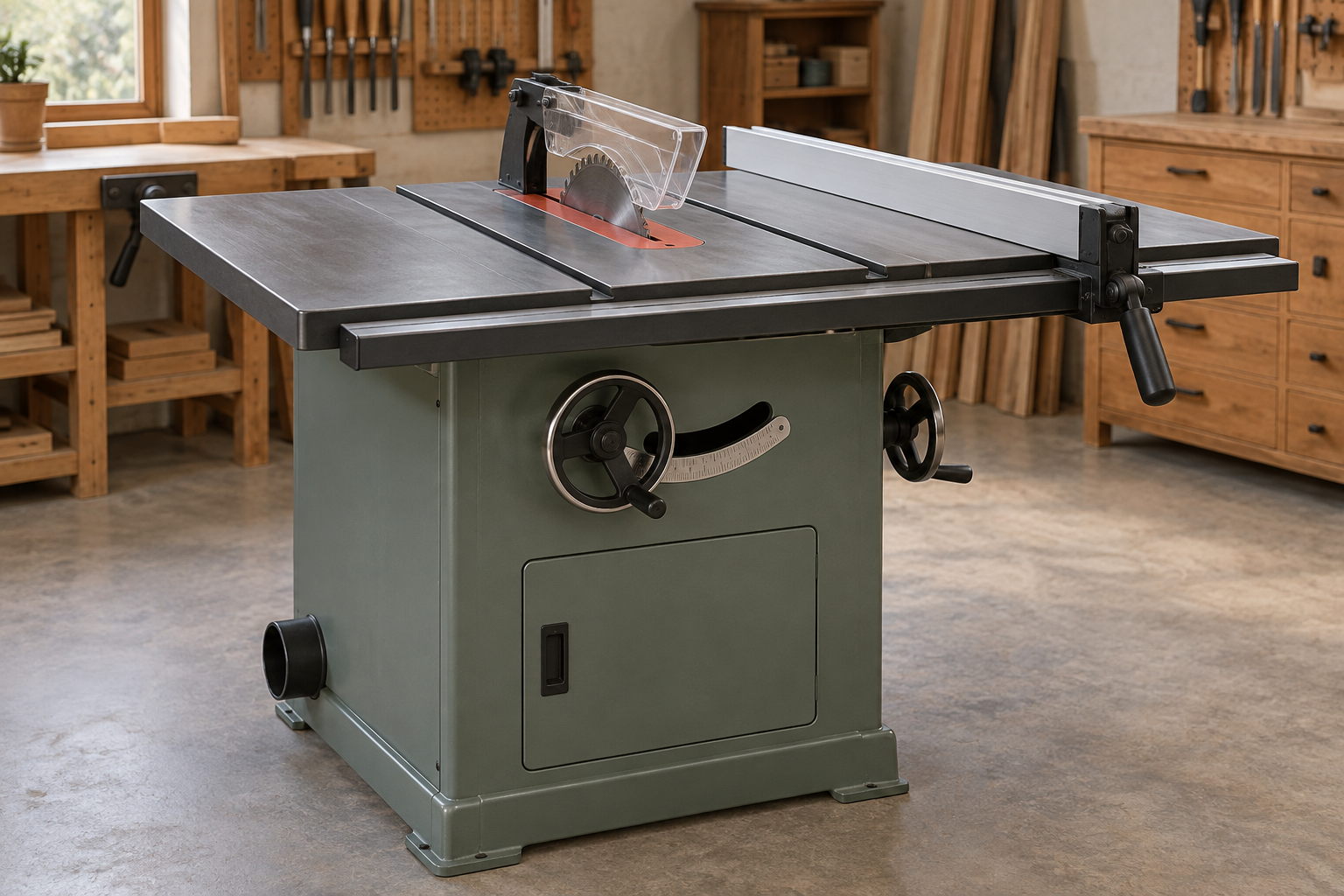
A cabinet saw is the strongest fit for a shop that routinely rips thick, dense stock or handles heavy production. Its enclosed base and substantial trunnion assembly help limit vibration, while a 3-horsepower motor provides useful headroom for demanding cuts. These saws often require 240-volt power, and their weight and price make them a poor match for occasional projects in a small garage.
A 1.75-horsepower, 120-volt hybrid saw is a practical middle ground for furniture makers processing hardwood a few days a week. It is more substantial than a jobsite saw but may slow down on thick, continuous ripping, especially with a dull blade or a tight-grained board. A jobsite saw can handle hardwood for small projects and modest workloads, but its lighter construction and limited outfeed support become more noticeable with long, heavy boards.
For most dedicated home shops, compare 1.75-horsepower hybrid table saws against cabinet saws based on your electrical service and how often you rip stock thicker than 8/4. Pay for cabinet-saw capacity when the work warrants it, not just because the machine is heavier.
Comparing stationary saw options
| Saw type | Typical power | Best fit | Main trade-off |
|---|---|---|---|
| Cabinet saw | About 3 hp, usually 240 V | Frequent ripping of dense or thick hardwood | High cost, weight, and electrical demands |
| Hybrid saw | About 1.5–2 hp, often 120 V | Regular hobby or small-shop furniture work | Less reserve for long, heavy rips |
| Contractor-style saw | Varies; check the motor and circuit | Moderate shop use on a tighter budget | Performance and dust control vary widely |
| Jobsite saw | Usually 120 V | Occasional cuts and limited shop space | Less mass and support for large boards |
These are broad categories, not guarantees. Check the manufacturer’s stated motor rating, voltage, rip capacity, arbor size, and operating requirements before buying. A saw advertised with a given horsepower may not deliver the same sustained cutting performance as another design with the same rating.
Features worth paying for
Check that the fence locks parallel to the blade and stays put when pressure is applied near its far end. A fence that shifts can create tapered cuts or trap the workpiece. The miter slots, arbor, and blade should also be aligned according to the manual. As a starting point, aim for blade-to-slot alignment within a few thousandths of an inch, then confirm with the saw maker’s procedure and a reliable gauge.
For hardwood, a 10-inch blade with at least 3 inches of cutting depth at 90 degrees covers many furniture tasks, including nominal 8/4 stock. Verify the actual depth in the specifications; blade diameter alone does not guarantee it. A cabinet saw with a riving knife is a strong choice, and the knife should sit close behind the blade to help prevent a closing kerf from pinching it. Do not remove the guard or knife for routine ripping simply because the cut seems manageable.
Dust collection is also part of the buying decision. Hardwood dust accumulates inside an open cabinet and around the operator, while small ports can restrict extraction. Check the port diameter and plan for a collector that matches it; a shop vacuum may suit a small saw, but it is often inadequate for a large cabinet saw. For a small shop, 3-horsepower cabinet table saws make sense when the shop has 240-volt service and the workload justifies the cost.
Rip hardwood without fighting the saw
Inspect each board before cutting. A straight-looking board may contain knots, twist, or drying stress. If the kerf closes behind the blade, stop the saw and reassess rather than pushing through a trapped workpiece. Use a splitter or riving knife, stand out of the likely kickback path, and use a push stick or push block when your hands would otherwise approach the blade. For a narrow rip, keep the guard and riving knife installed where the cut allows.
Support long stock so it stays level with the table, but do not use an outfeed roller that can steer the board sideways. For wide panels, use a stable outfeed table or a helper who knows not to pull the workpiece. Never freehand a rip against the blade; the fence must guide the stock. If a board is bowed or twisted, joint one face and edge first, or use a bandsaw to rough-rip it before bringing it to the table saw.
Feed at a steady pace. If the motor slows markedly, the blade burns the wood, or you need to lean hard on the stock, stop and check for a dull or unsuitable blade, misalignment, or a closing kerf. For a careful buyer, the best saw is the least expensive stationary machine that can make your usual cut without strain, with a fence and support setup you can trust.