Best Table Saws with Micro-Adjustable Rip Fences
What's inside
As an Amazon Associate I earn from qualifying purchases. This post may contain affiliate links at no extra cost to you.
A micro-adjustable rip fence lets you nudge the fence by a small, controlled amount after the main lock is set. That matters when a cut needs to land within a fraction of a millimeter, or when repeated test cuts show the fence is slightly off. It does not make a saw accurate by itself: fence stiffness, locking alignment, blade condition, and setup still determine the result.
For most buyers, the best choice is a contractor-style or cabinet saw with a rigid fence that locks securely and offers a fine-adjustment mechanism. A standalone aftermarket adjuster can also work, but only if it fits the fence and rail without compromising the lock. Before buying, check whether “micro-adjustable” means a built-in adjuster, an accessory, or simply a fence that can be tapped into position.
Contents
What micro-adjustment does—and does not do
A fine adjuster gives you better control over fence movement than pushing or tapping it by hand. Depending on the design, a knob or screw shifts the fence in small increments; some systems let you disengage the adjuster for normal positioning. This is useful for fitting cabinet parts, dialing in a tenon cheek, or correcting a test cut without repeatedly overshooting.
It is not a substitute for checking the cut. A scale may be off, a fence can deflect under pressure, and a blade can wander if it is dull or poorly aligned. Measure the workpiece or make a test cut, then adjust. For ordinary framing and rough breakdown, a sound fence without a micro-adjust feature is often entirely adequate.
Which saw type makes sense?
| Saw type | Fence and adjustment outlook | Best fit | Main trade-off |
|---|---|---|---|
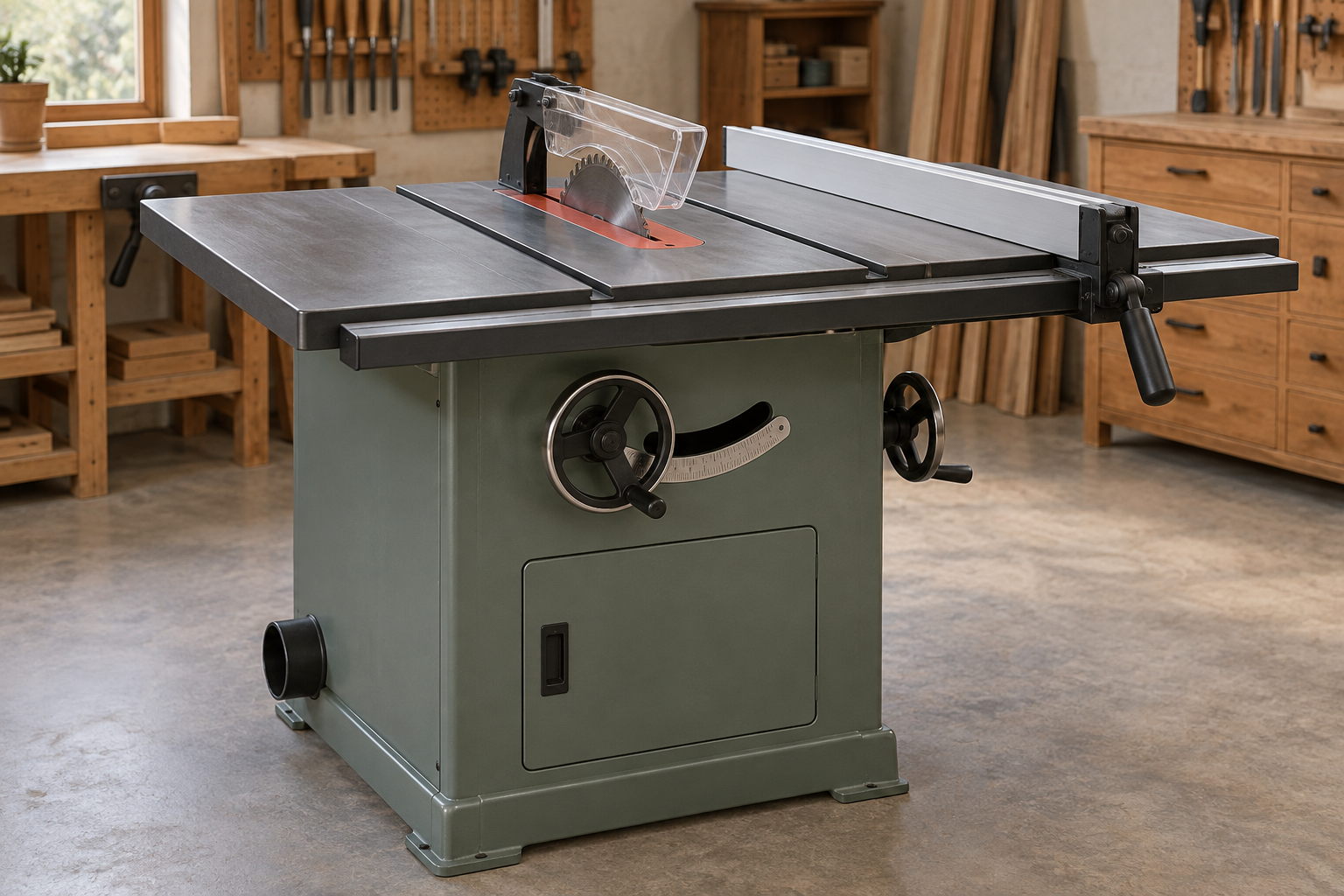
| Cabinet saw | Usually the most rigid platform; check whether fine adjustment is built in or an accessory | Furniture shops and frequent precision work | High purchase price, weight, and dust-collection demands |
| Contractor-style saw | Can offer a capable rail fence and add-on adjuster at lower cost | Serious hobby shops with limited space or budget | Fence quality and adjustment compatibility vary widely |
| Benchtop saw | Often has a lighter fence; fine adjustment may be improvised or unavailable | Occasional cutting and portability | Less mass and fence rigidity can make repeatable fine cuts harder |
For a fixed shop, compare cabinet table saws with fine-adjustable fences if you regularly cut sheet goods or need consistent joinery. A cabinet saw is not automatically more accurate, though: confirm the fence locks parallel to the blade and stays put when pressure is applied near the front and rear.
Fence features worth paying for
Prioritize a fence that locks at both ends without shifting, stays square to the table, and has enough rail travel for the stock you cut. A fine adjuster is useful only if the fence remains rigid after adjustment. Check that the mechanism has a clear way to engage and disengage, and that its adjustment range is practical; a tiny range can be frustrating when moving from a rough setting to a precise one.
Look for a readable scale, but treat it as a starting point. If you need a finished width of 100 mm, set the fence near that mark, cut scrap, and measure the result with a reliable rule or caliper. A discrepancy of 0.5 mm can matter for a snug-fitting part, while it is immaterial on many rough cuts. Repeat the test after moving the fence, since some locks pull the fence slightly as they clamp.
Compatibility matters with add-on adjusters. Measure or identify the fence and rail system, and check that the accessory does not obstruct the lock, rails, or fence movement. A mismatch can create backlash—the knob turns, but the fence does not move immediately—or leave the fence able to creep during a cut. If the manufacturer does not list compatibility, do not assume a universal fit.
Buying options by budget
If you already own a contractor-style saw with a solid fence, an accessory may be the economical route. Search for table-saw fence micro-adjusters, then verify fit against your exact fence. A cheap adjuster is not a bargain if it introduces play or makes the fence harder to lock.
If you are buying a saw from scratch, compare the total package: fence, rails, extension support, blade capacity, dust port, and any required accessory. A contractor-style table saw with a precision fence can be a sensible middle ground for a home shop. The cheaper benchtop option is fine for intermittent work, limited space, and rougher tolerances, especially if you can make careful test cuts. Avoid paying a large premium for a micro-adjust feature if you will rarely use it.
Set it up and use it safely
Before judging the fence, unplug the saw and check that the blade is aligned with the miter slot according to the manual. Then lock the fence and measure its distance from the blade at the front and rear. Use the saw maker’s tolerance if provided; otherwise, aim for a small difference and test-cut scrap. A fence that angles toward the blade at the rear can pinch the workpiece; one that angles away may leave a wider cut or rough edge.
When making a fine correction, approach the target from the same direction each time to reduce the effect of mechanical play. Lock the fence, confirm the measurement, and make a test cut before using valuable stock. Keep hands out of the blade path and use a push stick or push block when the workpiece requires it. Never rely on a fine adjuster to hold the fence: the main lock must be fully engaged before cutting.
The practical choice
Choose a rigid, repeatable fence first and micro-adjustment second. Cabinet saws suit shops where precision, capacity, and daily use justify their cost. A well-matched adjuster can improve an existing contractor saw for much less. For occasional cuts, a basic saw and careful measuring are usually enough. In every case, a test cut is the final check—not the scale, the knob, or the product description.