Open-Stand vs Enclosed-Base Jointer for Dust Collection
What's inside
As an Amazon Associate I earn from qualifying purchases. This post may contain affiliate links at no extra cost to you.
Choosing between an open-stand and enclosed-base jointer affects more than appearance. The base changes how chips leave the machine, how easily you can connect dust collection, and how much debris ends up on the floor. Both styles can produce flat, square stock, but they suit different shops and dust-collection systems.
As an Amazon Associate we earn from qualifying purchases at no extra cost to you.


Contents
The Basic Difference
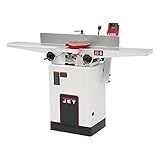
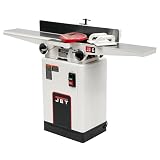
An open-stand jointer mounts its tables and cutterhead on a metal frame with the area below largely exposed. The cutterhead usually has a dust port beneath it, but the surrounding stand does little to contain airborne chips. An enclosed-base jointer places the cutterhead and lower housing inside a cabinet. Its dust outlet is normally part of a more controlled path from the cutterhead to the collection hose.
Open stands are common on smaller, less expensive jointers. They are easier to inspect and often easier to move around a crowded shop. Enclosed bases are more typical on heavier machines, though some compact jointers use enclosed sheet-metal cabinets without offering especially strong dust control.
Why the Base Matters for Dust Collection
Dust collection works best when the machine captures chips at the point where they are thrown. A jointer produces large chips as well as fine dust, and the cutterhead sends them downward and backward at high speed. If the housing and ductwork guide that stream directly to the port, the collector removes most of it before it reaches the floor.
An enclosed base can reduce leakage around the cutterhead housing and keep the air stream more predictable. That does not make it dustproof. Poorly sealed access panels, a restrictive port, or an undersized collector can still leave a pile of chips under the machine.
On an open stand, chips can escape through the sides and back before reaching the port. The dust port may still collect much of the material, especially with a short, smooth hose, but the machine generally leaves more cleanup. Fine dust can also remain suspended around the operator instead of entering the hose.
For either design, a 4-inch dust port is common. A typical 1.5-horsepower shop collector may move roughly 800 to 1,200 cubic feet per minute under favorable conditions, but airflow at the machine is lower after hose, bends, blast gates, and filters are included. A small 1-horsepower collector or high-pressure dust extractor may struggle with the volume of chips from a wide jointer.
Open Stand vs. Enclosed Base
| Feature | Open stand | Enclosed base |
|---|---|---|
| Typical price | Lower | Higher |
| Chip containment | More leakage and floor debris | Usually better containment |
| Dust-port access | Often easy to reach | May require panels or tight hose routing |
| Cleaning and inspection | Fast visual access | More enclosed and sometimes slower to service |
| Shop footprint | Can be visually and physically more open | Uses the base area for a cabinet |
| Best fit | Budget shops and occasional use | Frequent use and better-contained shops |
When an Open Stand Is the Better Buy
The cheaper option is fine when you joint only a few boards at a time, already sweep the floor regularly, and have limited room around the machine. An open stand also makes sense if the jointer’s dust hood is well designed and your collector has enough capacity. The stand itself is not the only factor; port shape, cutterhead housing, and hose routing often matter more.
Open stands are useful in shops where the machine must be moved or accessed from several sides. You can quickly spot a loose belt, a packed chute, or a chip buildup. If you buy one, look for a port that points toward your collector rather than forcing a tight 90-degree bend immediately below the machine.
Expect more floor cleanup. A realistic failure mode is a growing ridge of chips behind the jointer after several boards, even though the hose is connected. That usually indicates leakage or insufficient airflow, not necessarily a defective machine.
See current options in the open-stand jointer category if price and service access matter more than maximum containment.
When an Enclosed Base Is Worth the Extra Cost
An enclosed base earns its price in a production-oriented shop, a basement shop, or any workspace where airborne dust is difficult to control. Better containment means less dust settling on nearby tools and less time spent sweeping under the machine. It also makes it easier to connect the jointer to a fixed 4-inch duct line without leaving the lower housing open to the room.
The advantages are most noticeable when the jointer is used continuously or for wide, heavy stock. A 6- or 8-inch jointer can generate a large chip stream quickly. If the collector falls behind, the enclosed housing may slow the escape of chips, but it cannot overcome a blocked filter or an undersized system.
Look for a broad, unobstructed dust path and a port that matches your ducting. A nominal 4-inch port can be restricted by a smaller internal opening, a sharp elbow, or a flexible hose collapsed by suction. Check access panels as well. You need to clear chips and inspect the cutterhead without dismantling half the machine.
Browse enclosed-base jointers when dust containment and repeated use justify the added cost and cabinet space.
How to Improve Collection on Either Style
Use the shortest practical hose, avoid unnecessary bends, and keep the hose interior smooth. Open the blast gate fully before starting the jointer. Empty the collector before the chip bin is full, because a packed bin can reduce airflow and cause chips to back up at the machine.
Inspect the jointer port after the first few cuts. A good setup sends most chips into the hose, with only a small amount left on the tables or floor. If chips pile up, check for a clogged cutterhead chute, a loose port gasket, a filter loaded with fine dust, or a hose that has collapsed under suction.
Never treat dust collection as a substitute for safe cutting practices. Keep hands clear of the cutterhead, use push blocks, and wear hearing and eye protection. A collector can reduce exposure, but it does not capture every fine particle; use suitable respiratory protection and ventilate the shop when practical.
The Practical Buying Decision
Choose an open stand if you need the lowest purchase price, easy access, and occasional capacity. Choose an enclosed base if the jointer will run often, sits near finished surfaces, or connects to a properly sized fixed collection system. If dust control is your main concern, prioritize the dust hood and airflow path over the label on the base. A well-designed open-stand jointer can outperform a poorly sealed enclosed machine.
Before buying, measure the available space, confirm the dust-port diameter, and compare the collector’s real airflow with the jointer’s chip volume. Spending extra on a larger collector, better ducting, and a reliable filter may improve the shop more than spending the same amount solely on an enclosed cabinet.