Bench-Top vs Floor-Standing Drill Press for Repetitive Joinery
What's inside
As an Amazon Associate I earn from qualifying purchases. This post may contain affiliate links at no extra cost to you.
Contents
Choosing a Drill Press for Repetitive Joinery
Repetitive joinery changes what matters in a drill press. For one or two holes, almost any sound machine can produce an acceptable result. For a run of mortises, dowel holes, shelf-pin rows, or hinge cups, the machine must hold its settings, position work consistently, and survive repeated cycling without the table drifting or the quill developing play.
A bench-top drill press is often the sensible choice for a small shop. A floor-standing press earns its extra space and cost when you need more throat depth, greater capacity, longer quill travel, or a stable setup that stays dedicated to production work. The right choice depends less on the advertised horsepower than on the joinery and workpieces you actually make.
As an Amazon Associate we earn from qualifying purchases at no extra cost to you.

Where Bench-Top Presses Work Well
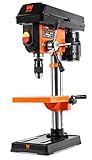
A bench-top press is usually adequate for doweling cabinet parts, drilling shelf pins, boring hinge cups, and making small mortises with a router-style mortising attachment. Typical machines have a 10- to 12-inch swing, a 2- to 3-inch quill stroke, and enough speed range for bits from small brad points to Forstner bits around 2 inches in diameter.
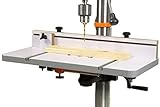
The biggest advantage is not just price. A bench-top press can be mounted on a purpose-built stand at a comfortable height, with storage underneath for fences, stops, and drill bits. You can also build a wider auxiliary table around it. For repetitive joinery, that auxiliary table often improves accuracy more than moving up to a larger machine.
Choose a bench-top drill press for woodworking when your parts are generally under 24 inches wide, your largest common bit is about 1-1/2 inches, and you can work close to the front of the column. A quality bench-top press can repeatedly drill dowel holes within roughly 1/32 inch when paired with a rigid fence and positive stop.
When a Floor-Standing Press Pays Off
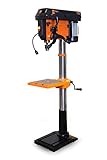
A floor-standing drill press normally offers a 14- to 17-inch swing, 3- to 6-inch quill travel, and a larger table. That extra reach is useful when drilling into the middle of a wide cabinet side, stair component, tabletop, or long structural part. You spend less time repositioning the work and are less likely to lose a reference edge.
More mass also reduces vibration. This matters with large Forstner bits, especially when boring hinge recesses or hardware pockets in hardwood. A lightweight bench machine may walk, chatter, or stall as the bit enters the material. A floor model will not eliminate those problems, but its heavier column, larger table, and stronger spindle usually make them easier to control.
Buy a floor-standing drill press if your routine includes wide panels, deep boring, large-diameter bits, or hundreds of holes per project. It is also the better platform for a dedicated cross-slide table, indexing jig, or shop-made fence that would overwhelm a small table.
Bench-Top Versus Floor-Standing
| Factor | Bench-top press | Floor-standing press |
|---|---|---|
| Typical swing | 10–12 inches | 14–17 inches |
| Typical quill travel | 2–3 inches | 3–6 inches |
| Best use | Dowels, shelf pins, hinge cups, small parts | Wide panels, deep boring, large jigs, production runs |
| Space and cost | Lower; requires a sturdy stand or bench | Higher; occupies dedicated floor space |
| Main limitation | Limited reach and lighter construction | More expensive and slower to move or reconfigure |
Features That Matter for Repetitive Holes
Prioritize a rigid table and a reliable depth stop. A rack-and-pinion table is convenient, but the locking mechanism must clamp firmly. Test it with the quill extended: if the table shifts when you push sideways by hand, it will shift during boring. A depth stop should lock without creeping. A few thousandths of an inch of error per hole can become visible when several dowel joints meet.
A keyed chuck is acceptable for general woodworking and often grips large bits well. A keyless chuck is faster when changing sizes, but some inexpensive versions loosen under repeated reversing pressure or when large bits catch. Check the chuck’s stated capacity; a 1/2-inch chuck is more useful than a 3/8-inch chuck for joinery, provided the spindle and bearings are equally robust.
Variable speed is helpful, but a wide speed range is not a substitute for torque. Forstner bits generally need slower speeds as diameter increases. A 2-inch bit in hardwood may need roughly 500 to 700 rpm, while a 1/4-inch brad-point bit may run around 2,000 to 3,000 rpm. Use the manufacturer’s chart and reduce speed if the bit burns, squeals, or stops cutting cleanly.
Look for a quill with minimal side play. Lower the spindle, lock it, and try to move the chuck sideways. Any noticeable clunk can produce oversized holes and poor-fitting dowel joints. Also inspect the quill return spring. A weak or jerky spring becomes irritating after several hundred cycles and makes consistent feed pressure harder.
Jigs Matter More Than Machine Size
For repetitive joinery, build the locating system before buying a larger press. A plywood auxiliary table with a replaceable insert, a straight fence, and a stop block can turn a basic press into a repeatable production tool. Add a toggle clamp when the workpiece is small enough to bring your hands near the bit. The clamp prevents a part from rotating when a large bit exits the material.
For dowel holes, use a drill guide or a dedicated indexing jig rather than relying on pencil marks. For shelf pins, a long fence and a fixed indexing pin are faster and more accurate than measuring each hole. For hinge cups, a stop block and a sacrificial backer prevent breakout as the bit exits.
Common Failure Modes
Burned holes usually indicate excessive speed, a dull bit, too much feed pressure, or packed chips. Blowout on the back of a panel is usually a support problem; clamp a backer board underneath and stop feeding as the point breaks through. Oversized holes often come from a loose chuck, spindle runout, table movement, or forcing a dull bit sideways.
Do not let a floor-standing machine create false confidence. Its extra power can grab a large bit hard enough to spin a workpiece or break a clamp. Secure the work for every operation, especially when boring with Forstner bits. A bench-top press is cheaper and entirely adequate when the work is small, the jig is sound, and production volume is modest. Pay for the floor model when its reach, stiffness, and capacity remove a real limitation—not simply because it looks more professional.