Lightweight Cordless Circular Saw
Key takeaways
- An editorial buying guide to the lightweight cordless circular saw, judged on base flatness, guard action, cut depth and dust control rather than marketing weight claims.
What's inside
As an Amazon Associate I earn from qualifying purchases. This post may contain affiliate links at no extra cost to you.
A lightweight cordless circular saw sounds like an easy win until you carry one up a ladder, cut a sheet of three-quarter plywood overhead, and discover the shoe flexes under thumb pressure. Weight is the number that sells these saws, but weight alone tells you almost nothing about whether the tool will track a line. We have looked at enough compact saws on the shelf and in the shop to say plainly: the trim-weight class contains both genuinely useful tools and several that trade away the exact rigidity that makes a circular saw worth owning.
The category also suffers from a naming problem. Manufacturers apply “compact,” “sub-compact,” “lightweight” and “one-handed” to blade sizes ranging from 4-1/2 inches up to a full 7-1/4, and bare-tool weights that exclude the battery you must attach to use the thing. So this guide sets aside the spec sheet romance and judges on mechanics: base flatness and material, guard retraction, depth and bevel lock design, blade availability, and where the dust actually goes.
As an Amazon Associate we earn from qualifying purchases at no extra cost to you. Product prices and availability are accurate as of the date shown and are subject to change.


| Saw class | Typical blade | Realistic use | Watch out for |
|---|---|---|---|
| Sub-compact one-hand | 4-1/2 to 5-3/8 in | Plywood, trim, blocking, ladder work | Shallow depth, odd blade sizes |
| Mid-size compact | 6 to 6-1/2 in | Sheet goods, general carpentry | Base stiffness varies widely |
| Full-size brushless | 7-1/4 in | Framing, rafters, thick stock | Heavy with a big battery |
| Track-compatible compact | 6-1/2 in | Cabinet work, panel breakdown | Track sold separately, cost adds up |
What “lightweight” actually costs you
Every pound removed comes from somewhere. In practice manufacturers find that weight in four places, and only two of them are harmless.
Blade diameter. Dropping from 7-1/4 to 6-1/2 inches costs roughly a half inch of cut depth at 90 degrees, and considerably more at a 45-degree bevel. On a sub-compact saw with a 4-1/2 or 5-3/8 inch blade, you are typically looking at depth in the neighborhood of an inch and a half to under two inches. That handles plywood, one-by material and single-layer sheathing. It does not handle a doubled two-by in one pass, and it will not bevel through a 2×4 corner.
Motor and gearcase. This is the good kind of weight loss. Brushless motors let a smaller housing produce respectable torque, and the better compact saws now cut sheet goods without the bogging that plagued the brushed generation. If a saw in this class is still brushed, its main appeal is price, not performance.
Base material. Here is where the category divides. Magnesium and thicker stamped steel hold a plane; thin stamped steel and glass-filled polymer can twist. Set the saw on a known-flat surface, such as a jointer bed or a piece of plate glass, and look for light under the shoe. Then push down on the outboard front corner. If it moves noticeably, every crosscut you make will inherit that flex.
Guard and linkage. Cheap lower guards use thin springs and loose pivots. A guard that hangs up on the leading edge of a bevel cut is not a nuisance, it is a genuine hazard, because the instinct is to hold it open with a finger.
The criteria we judge on
Base flatness and rigidity. Non-negotiable. Check for light under the shoe, then test corner deflection by hand. A saw that cannot present a flat reference face to the workpiece cannot cut square, regardless of motor quality.
Fence and reference edge quality. Most compact saws include a rip fence in the box, and most of those fences are an afterthought: thin stock, a single thumbscrew, and no meaningful registration to the blade. Judge instead the machined edge of the shoe itself, since that is what rides your straightedge or track. Look for a crisp, burr-free edge parallel to the blade.
Blade guides and kerf indicators. The sight notch should let you see the blade path with the guard closed. Cast-in arrows stamped at the factory are frequently off by a kerf width, so plan to verify against a test cut and mark the true line on the shoe yourself.
Depth and bevel locks. Cam levers should clamp without tool assistance and should not creep under vibration. Bevel scales in this class are coarse. Treat detents at 45 degrees as a starting point, then confirm with a square.
Dust ports. Increasingly common on the cabinet-oriented compacts and genuinely valuable when you are cutting inside a finished space. A well-shrouded port that accepts a standard 1-1/4 or 1-1/2 inch hose captures a real share of the dust. A shroud that merely redirects chips away from the sight line is better than nothing but should not be sold as extraction.
Vibration and balance. Compact saws often place the battery high and rearward, which encourages the saw to tip off the line as the cut begins. Hold the tool with the battery you intend to run and see whether it sits down on its shoe naturally or wants to rock.
Compact 6-1/2 in. brushless circular saw (mid-size class)
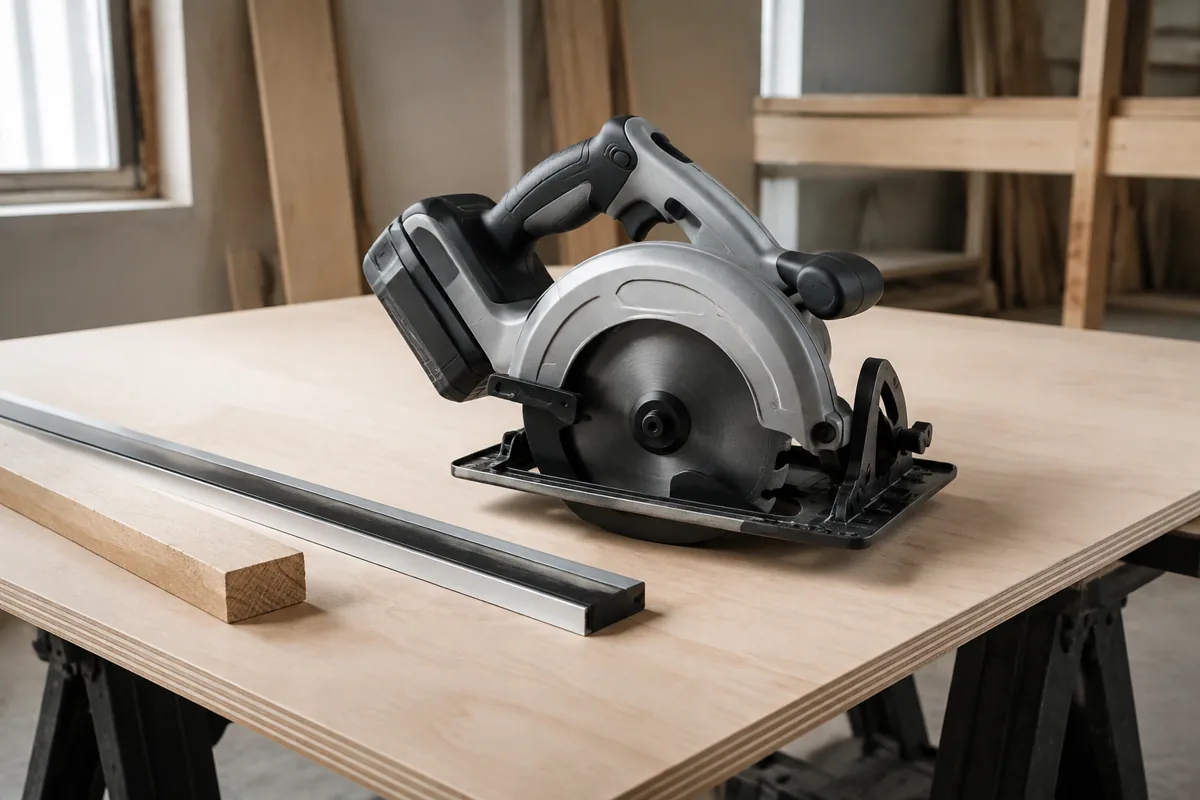
For most readers this is the sweet spot. A 6-1/2 inch brushless saw keeps enough depth for two-by stock in a single pass while shaving meaningful weight off a full-size framing saw. Prioritize a magnesium or heavy stamped shoe and confirm blade availability locally before you commit to a platform.
Choosing a lightweight cordless circular saw by the work you do
Cabinet and furniture work. Buy for the shoe edge and the dust port. Your saw’s real job is breaking down sheet goods to rough size before the table saw or track saw does the finish work. Depth beyond two inches rarely matters. A compact saw riding a shop-made plywood straightedge will outperform a heavier saw used freehand.
Remodeling and punch-list carpentry. Weight matters most here because the tool spends its day in a bag, on a ladder, or overhead. A sub-compact one-hand saw excels at cutting blocking, notching plywood, and trimming shims in place. Keep a full-size saw for anything structural.
General DIY and homeowner use. One saw has to do everything, which argues for the mid-size compact. It cuts a 2×4 at 90 degrees, handles decking, and does not punish you during a long fence project.
Battery platform. This decision outlives the saw. DeWalt XR, Milwaukee FUEL and Makita LXT all field credible compact saws with wide accessory support and easy blade sourcing. If you already own batteries in one of these systems, staying inside it is usually the better financial answer than chasing a slightly nicer saw on a fifth platform.
- ✔ Genuinely easier to control overhead and on ladders
- ✔ Brushless compacts now cut sheet goods without bogging
- ✔ Less fatigue means straighter cuts late in the day
- ✔ Fits in a tool bag with the drill and driver
- ✘ Reduced depth of cut, especially at bevel
- ✘ Thin or flexible shoes are common at the low end
- ✘ Small blade diameters can be harder to source locally
- ✘ High rear battery placement can upset balance
Blades matter more than the saw
A compact saw has less motor and less mass to muscle through a bad blade, so blade choice is not a refinement here, it is the difference between clean work and burning. The stock blade shipped with most saws is a coarse general-purpose carbide unit intended to prove the tool runs. Replace it.
For plywood and melamine, a high-tooth-count fine-finish blade with a thin kerf reduces both tearout and current draw, which also stretches runtime. For framing and rough stock, a 24-tooth thin-kerf blade keeps the motor in its comfort zone. Before buying into a sub-compact platform, check that its blade size is stocked at your local home center. A saw dependent on a mail-order-only diameter is a saw you eventually stop using.
Thin-kerf fine finish blade for compact saws
The cheapest meaningful improvement to any compact saw. A thin-kerf, high-tooth-count blade cuts cleaner in plywood and asks less of a small motor. Buy two so you always have a sharp one, and keep the coarse blade for demolition and dirty lumber.
Setup checks worth ten minutes
Before the first real cut, square the blade to the shoe with a machinist square or a reliable combination square, ignoring the factory bevel scale. Verify the depth lock holds by making a cut and confirming the depth did not creep. Cut a test kerf in scrap and mark the true blade line on the shoe with a fine paint pen, since that mark, not the molded arrow, is what you will actually follow.
Then build a straightedge guide. A strip of half-inch plywood with a factory edge, clamped to the work, converts a compact saw into a serviceable panel saw for a few dollars. It is the single highest-return accessory in this category, and it does more for cut quality than moving up a price tier.
Frequently asked questions
Can a lightweight cordless circular saw cut 2×4 lumber? A mid-size compact with a 6 to 6-1/2 inch blade will cut a 2×4 at 90 degrees in one pass, and usually at 45 degrees too, though bevel capacity is tighter. A sub-compact with a 4-1/2 or 5-3/8 inch blade generally cannot, and cutting from both faces to get through is a practice we would not recommend.
Is brushless worth the extra money in a compact saw? Yes, and it is the clearest upgrade in the class. Brushless motors give a small saw the torque to finish a cut in sheet goods without stalling, and they draw less current, so a compact battery lasts through more work. A brushed compact saw only makes sense when budget is the binding constraint.
Do I need a track saw instead? If your work is primarily cabinetry and repeatable panel cuts with a finished edge straight off the saw, a track saw does that better. If you need one saw for mixed carpentry, blocking, decking and occasional sheet goods, a compact circular saw plus a shop-made straightedge covers far more ground for less money.
Verdict
The mid-size compact brushless saw, running a 6 to 6-1/2 inch blade on a battery platform you already own, is the right buy for most readers. It keeps enough depth to be a real carpentry tool while delivering the handling advantage that justifies the category. Choose it on shoe rigidity first, guard action second, and dust port quality third, then spend the savings on a thin-kerf blade and a straightedge.
Sub-compact one-hand saws are worth owning as a second saw for ladder work and punch-list cutting, not as a primary. And we would pass on any saw in this class with a flexible base, whatever its weight advantage. A saw that cannot hold a plane cannot hold a line, and no amount of saved weight compensates for that.
Check prices on Amazon →