Best Stationary Jointers for Low-Dust Woodworking Shops
What's inside
As an Amazon Associate I earn from qualifying purchases. This post may contain affiliate links at no extra cost to you.
A jointer is a major dust source because its cutterhead throws chips straight into the machine’s exhaust port. A good collector helps, but the result depends just as much on port size, duct layout, filter performance, and how you use the machine. For most small shops, a 6-inch jointer with a 4-inch dust port is the practical starting point. Wider beds and larger ports can improve capacity, but they also call for more floor space and stronger dust collection.
As an Amazon Associate we earn from qualifying purchases at no extra cost to you.



Contents
What matters most for low-dust jointing
Look for a machine with an enclosed base, a dust port of at least 4 inches, and a clear, direct path from the cutterhead to the port. Enclosed bases help contain chips that miss the exhaust opening; they do not make a weak collector effective. Check that the port is accessible and that the fence or stand will not force a sharp bend in the hose.
Dust collection is not the same as fine-dust filtration. A collector that moves a lot of air may capture most visible chips, while its filter still releases fine particles into the shop. Pair the jointer with a collector rated for your duct setup and a filter suited to fine dust. A 4-inch branch needs substantially more airflow than a small shop vacuum can usually provide, especially through long or corrugated hose. Keep the run short, use smooth-walled duct where practical, and open blast gates fully while jointing.
Jointer choices compared
| Type | Typical width | Dust port | Best fit | Main trade-off |
|---|---|---|---|---|
| Benchtop | 6 inches | Often 2 to 2½ inches | Small shops and occasional narrow stock | Harder to collect chips efficiently; shorter beds limit long boards |
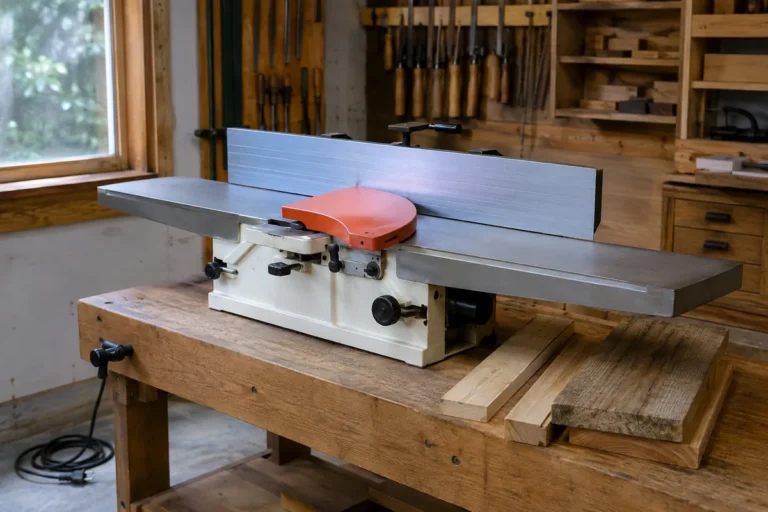
| Open-stand floor model | 6 inches | Usually 4 inches | Regular home-shop use | Good value, but chips can escape through the open stand |
| Enclosed-base floor model | 6 to 8 inches | Usually 4 inches | Frequent use and cleaner shop layouts | Costs more and takes more space |
These are common configurations, not guarantees: verify the port diameter and base design on the machine you are considering. For many buyers, an enclosed-base 6-inch jointer is the sensible balance of capacity, footprint, and chip containment. Compare 6-inch enclosed-base jointers by port layout, bed length, fence adjustment, and cutterhead type rather than relying on width alone.
Choose width and bed length for your work
A 6-inch jointer handles most face-jointing for furniture parts and typical cabinet stock. An 8-inch machine is useful when you regularly flatten wider boards, but it costs more and is heavier to move. If the boards you buy are mostly 5 to 7 inches wide, paying for an 8-inch cutterhead may not improve your work enough to justify the space.
Bed length matters when you joint long boards. Short beds can make it harder to keep a long, bowed edge straight because the board has less support. A benchtop machine is a reasonable choice for small projects, short parts, and limited storage. It is a poor fit if you routinely flatten long boards or expect it to replace a full-size floor machine. Compare 6-inch benchtop jointers carefully for bed length, mounting stability, and dust-port size.
Cutterhead type affects upkeep, not just finish
Straight-knife cutterheads are generally less expensive and can produce a clean surface when the knives are sharp and set evenly. Dull or poorly aligned knives leave ridges and may increase tear-out. Helical or spiral cutterheads use small inserts; rotating a nicked insert can restore a clean cut without setting a long knife. They often cost more, and inserts still need cleaning or replacement.
Neither style solves poor dust collection. Chips can clog the hood or port if the duct is undersized, a blast gate is partly closed, or the collector filter is loaded. If extraction suddenly drops, stop the machine and check those points before continuing. Running with a blocked hood can pack chips around the cutterhead and scatter them through gaps in the base.
Match the jointer to the collector
For a floor jointer with a 4-inch port, start with a dust collector and duct system designed to move air through a 4-inch connection. A small shop vacuum may connect with an adapter, but a narrower hose and extra fittings can choke airflow. It may collect some chips at the source, yet leave a visible trail of shavings in the base. Adapters are fine for occasional light work when the machine allows them; they are not a substitute for adequate airflow.
Do not judge performance only by whether the floor looks clean. Fine dust can remain airborne after the visible chips are gone. Use an appropriately rated filter, keep the collector’s filter clean, and consider separate ambient filtration if several machines run in the same room. Wear suitable respiratory protection when emptying a collector or clearing packed chips.
A practical buying checklist
Before buying, confirm the jointer’s actual port diameter, the collector’s inlet size, and the route between them. Measure floor space with room for the infeed and outfeed tables, fence movement, and long stock. Check that you can reach the dust hood for clearing jams and that the fence locks securely without shifting.
If budget is tight, an open-stand 6-inch floor jointer can be a good buy when paired with a short, effective 4-inch duct run and careful cleanup. Choose an enclosed-base model if chip containment and a cleaner surrounding area matter enough to justify the added cost. Choose a benchtop machine only when its shorter beds and smaller port match your workload. For a cleaner, more capable general-purpose setup, browse 6-inch floor jointers with 4-inch dust ports and compare the machine and collector as one system.