Best Jointers for Flattening Wide Live-Edge Boards
What's inside
As an Amazon Associate I earn from qualifying purchases. This post may contain affiliate links at no extra cost to you.
A jointer can flatten a live-edge board only when the board has a stable reference face and fits the machine’s usable width. That rules out many slabs: a six-inch jointer cannot safely flatten a 14-inch board in one pass, and feeding each side separately can leave a ridge down the middle. For wide stock, the best purchase may be a long-bed jointer for narrower boards—or a different flattening method for slabs wider than the cutterhead.
As an Amazon Associate we earn from qualifying purchases at no extra cost to you.



Contents
What a jointer can—and cannot—do
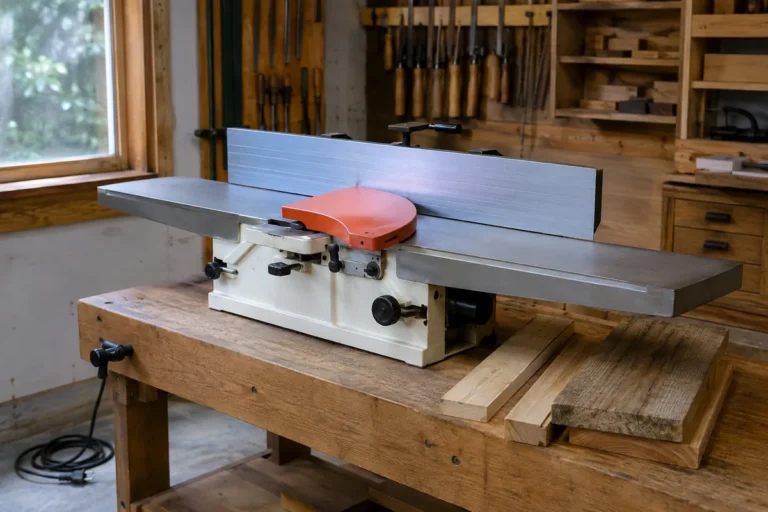
A jointer cuts one face flat, then makes an adjacent edge square to that face. Its bed supports the board before and after the cutterhead; the fence guides the edge. Bed length and width both matter. A long bed helps control bow and twist, while cutter width sets the maximum face width you can flatten in a single pass.
Live edges add complications. Bark, loose inclusions, and irregular contours can catch on the bed or fence. A board that rocks, has a severe twist, or is wider than the cutterhead is not a good candidate for a conventional face-jointing pass. Never force it through or balance it on narrow strips of wood.
Choose by board width and shape
| Board and shop situation | Practical choice | Main trade-off |
|---|---|---|
| Boards up to about 6 inches wide | 6-inch benchtop or floor-standing jointer with a long bed | Affordable and useful for ordinary lumber; limited width and often less bed length on benchtop machines |
| Boards around 8 inches wide | 8-inch floor-standing jointer | More capacity, but takes more floor space and costs more |
| Boards around 10–12 inches wide | 12-inch jointer, if the slab is stable and within capacity | Expensive, heavy, and still too narrow for many live-edge slabs |
| Boards wider than the cutterhead, or badly twisted slabs | Router sled or flattening mill; then thickness planer or drum sander | Slower setup, but avoids trying to balance an oversized board on a jointer |
Buying priorities that matter
For face work, prioritize bed length, cutter width, and a rigid fence over extra motor power. A 6-inch machine with a short bed may be harder to control on a long board than a well-supported 8-inch machine. Check the actual infeed and outfeed table lengths and whether the tables can be adjusted without excessive fuss. Outfeed-table alignment with the cutterhead is critical: if it is too low, the board dips at the end of a pass; too high, and the cut can leave a step.
Helical or spiral cutterheads use small replaceable inserts. They usually cut more quietly and leave a better finish on figured grain than straight knives, but cost more upfront and each insert must be seated cleanly. Straight-knife machines are a sensible lower-cost choice for clean, straight-grained stock; expect more tear-out on reversing grain and more care when setting or replacing knives. A 6-inch benchtop jointer is often enough for furniture parts and narrower live-edge boards, but it is not a slab-flattening machine.
Dust collection is not optional. Jointers make long, heavy chips that can clog a small collector or pile around the cutterhead. Check the port size and your collector’s capacity before buying. Also look for a full-length cutterhead guard, a usable push block, and a fence that locks securely. A small jointer can still cause serious injury if a hand reaches the cutterhead.
When the slab is wider than the jointer
Use a router sled or commercial slab-flattening setup when the board exceeds the cutter width. The slab needs to be immobilized on a flat base, with shims under low areas so it cannot rock. Take shallow passes—about 1/16 inch is a reasonable starting point—and check for movement as you work. A deep pass can chatter, pull a loose inclusion, or overload the router bit. After flattening one face, thickness the opposite face with a planer if the board fits, or use the sled again.
A router sled is slower than a jointer and leaves tracks that need sanding, but it handles widths that a jointer cannot. A slab-flattening router sled can be a better purchase than a larger jointer if wide slabs are occasional projects. For regular production, a wide-belt sander or professional flattening service may save more time than building a more elaborate jig.
Safe setup and common failures
Before jointing, remove dirt, metal, loose bark, and anything that could hit the knives. Inspect the board for nails with a detector; hidden metal can ruin knives and become a projectile. Support long stock with infeed and outfeed stands set level with the tables. Set a modest cut—1/32 inch is a sensible starting depth, and 1/16 inch is often plenty for sound stock. Repeated light passes are easier to control than trying to remove a deep cup at once.
Keep the board flat to the bed, use push blocks, and feed with steady pressure. If the board rocks, binds, or has too little safe contact area, stop and use a sled. A bowed board should be oriented so the ends contact the bed rather than rocking on a high middle; a twisted board needs its high corners assessed before cutting. Jointing an unstable face can make the board thinner without making it flat. Once one face is true, mark it and use it as the reference face for the planer.
Match the machine to the work
For live-edge boards no wider than 6 inches, a decent 6-inch jointer is the economical choice. For frequent boards up to roughly 8 inches, an 8-inch floor-standing machine offers a useful step up. A floor-standing 8-inch jointer costs more and occupies more space, so it is poor value if most work is narrow stock. If your slabs are wider than the cutterhead, buy a flattening system rather than expecting a jointer to do a job its geometry cannot handle.