How to Plane Thin Boards Safely on a Stationary Planer
What's inside
As an Amazon Associate I earn from qualifying purchases. This post may contain affiliate links at no extra cost to you.
Contents
Why thin stock is risky
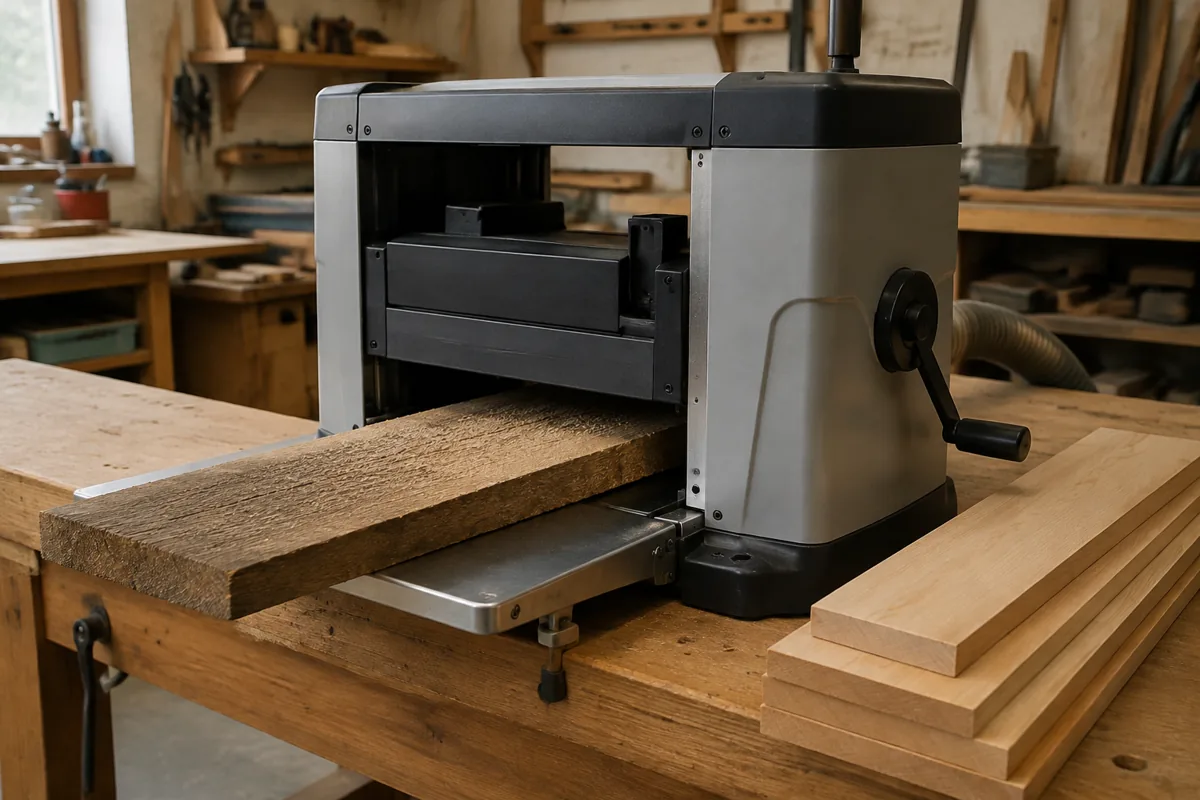
A thickness planer removes material from the top face while its feed rollers press the board against the bed. On thin stock, that pressure can bow the board down as it passes the cutterhead. The planer may then cut the board thinner in the middle than at the ends, a defect called snipe or taper, or the rollers may lose control of the board altogether.
There is no safe minimum thickness that applies to every planer. Check the machine manual first; some manufacturers specify a minimum, and some prohibit using a planer for stock below a stated thickness. Follow the stricter of the manual and the guidance here. Never put loose, narrow, warped, cracked, or very short pieces through a planer just because they fit the opening.
Check the board and machine
Measure the board’s thickness at several points and check its length, width, grain direction, and condition. Reject pieces with loose knots, splits, bark, or other defects that could break free. Remove nails, grit, and other metal. Confirm that the board is long enough for the planer’s feed rollers to maintain control as it enters and exits; the manual’s minimum length is the authority.
Use a straightedge to check for bow or twist. A planer makes faces parallel to each other; it does not reliably flatten a badly cupped or twisted board. Joint one face first if you need a flat reference surface. Set up infeed and outfeed support so the board stays level, but keep stands clear of the cutterhead and feed path. Wear eye and hearing protection, tie back hair, and avoid gloves or loose clothing that can catch. Do not reach into the machine to retrieve stock.
Choose a safe method
For stock thinner than your planer’s stated minimum, do not feed it through unsupported. A carrier board is a common option only when the planer manufacturer allows it. The carrier supports the thin piece; it does not make every board safe. The workpiece must be restrained so it cannot shift, lift, or be pulled into the cutterhead. Never rely on hand pressure to keep a thin piece in place inside the machine.
| Method | Best use | Trade-off and risk |
|---|---|---|
| Plane stock directly | Boards that meet the planer’s minimum thickness, length, and width requirements | Fast and straightforward; thin or flexible pieces may bow under roller pressure. |
| Use a carrier board | Thin stock when the manual permits carrier use and the piece can be secured reliably | Requires careful setup. A loose workpiece can shift or be ejected; added height may also exceed the machine’s capacity. |
| Use a drum sander or hand tools | Very thin, delicate, or short pieces that are unsuitable for the planer | Slower or more expensive, but avoids feeding unsupported thin stock into the planer. |
If you expect to do this often, a woodworking drum sander can be a safer, more controlled choice for thin panels. For occasional work, a sanding block or hand plane may cost less and be perfectly adequate.
Set up a carrier board
Use a flat, stable carrier that fits the planer’s width and is long enough to travel through without losing support. Check its thickness against the planer’s maximum opening with the workpiece on top. The carrier itself must be suitable for the machine; do not use a carrier with screws, protruding fasteners, loose laminations, or other parts that could contact the cutterhead or rollers.
Position the thin board on the carrier and secure it using a method approved by the planer manufacturer. Some setups use a suitable adhesive or a mechanical stop at the carrier’s end, but no fastening method is universal. Keep tape, stops, and adhesive away from the cutter path, and make sure nothing can come loose. Do not use a stop that could be struck by the cutterhead or feed mechanism. If you cannot secure the workpiece without creating a new hazard, choose another method.
Make light, controlled passes
Start with the board and carrier fully supported and aligned with the feed direction. Set the depth of cut conservatively—around 1/32 inch (0.8 mm) or less is a sensible starting point for delicate stock, but the planer manual and wood species may call for less. Use the height adjustment and depth gauge as intended; do not force the board or push it through faster than the machine feeds it.
Stand to one side of the infeed and outfeed paths, not directly behind the board. Keep your hands clear of the rollers and opening. Let the machine feed the assembly, and support the emerging end without lifting it or steering it sideways. If the board chatters, shifts on the carrier, stalls, or comes out with a sudden change in thickness, stop. Disconnect power before inspecting or clearing a jam. Never pull stock backward through a running planer.
Measure after each pass and lower the cutterhead in small increments. Stop short of the final thickness, then take a light finishing pass if the board remains stable. Avoid taking a heavy pass to save time: it increases the chance of tear-out, snipe, a stalled feed, or workpiece movement.
Common failures and alternatives
Uneven thickness often means the board flexed under roller pressure or the carrier was not flat. A piece that shifts may have inadequate restraint; do not simply tighten a setup without checking that the restraint itself cannot be caught by the machine. Tear-out is more likely when feeding against the grain, on figured wood, or with a dull cutterhead. Reversing feed direction may help only if the planer manual permits it and the grain direction is appropriate.
For short, narrow, or fragile parts, a planer is often the wrong tool even with a carrier. A hand plane is inexpensive and gives direct control for small adjustments. A thickness drum sander costs more and removes stock more slowly, but is better suited to delicate panels. If your board does not meet the planer’s limits or cannot be secured confidently, do not improvise: use a different tool or have the stock milled.