Best Drill Presses with Large Tables for Cabinet Hardware Work
What's inside
As an Amazon Associate I earn from qualifying purchases. This post may contain affiliate links at no extra cost to you.
Cabinet hardware work looks simple until a hinge cup, drawer-slide hole, or shelf-pin row ends up a fraction of an inch off. A drill press makes the job repeatable, but the machine needs more than a powerful motor. For cabinet work, table size, quill travel, depth-stop control, and low-speed stability matter more than headline horsepower.
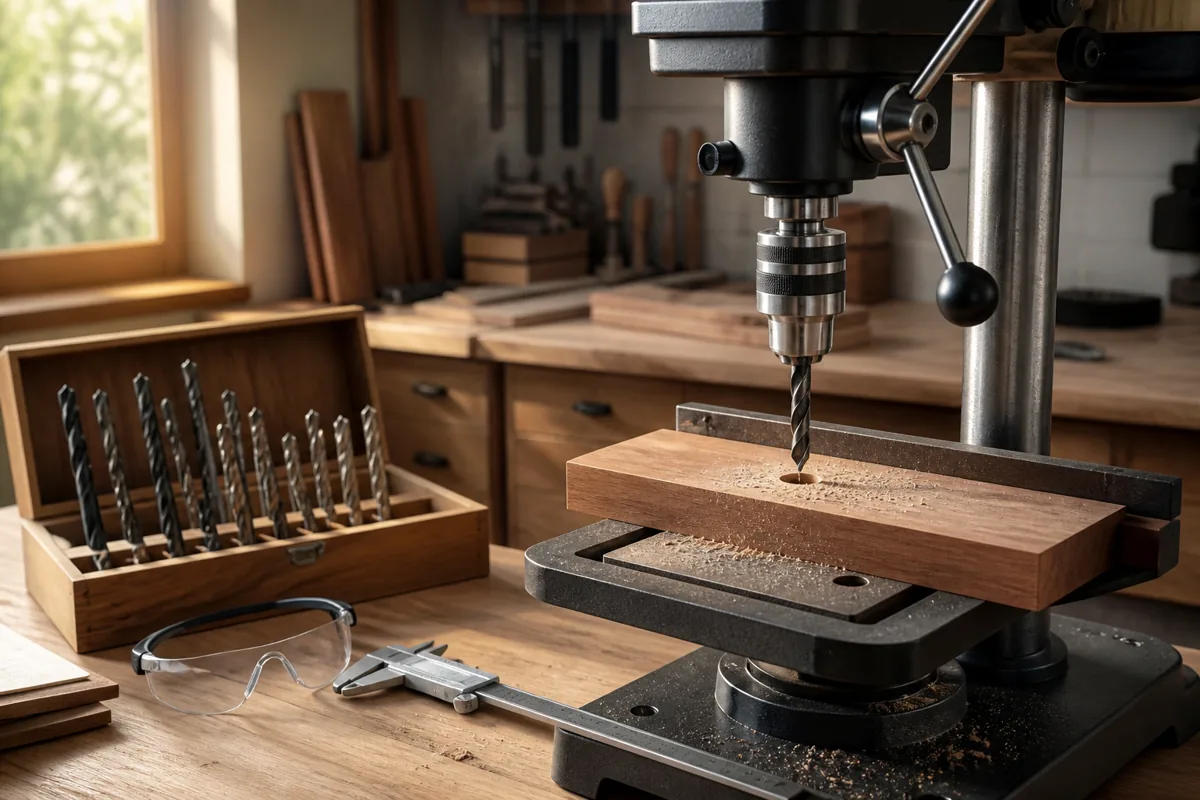
The best setup is usually a floor-standing drill press with a table at least 12 by 12 inches, or a benchtop machine fitted with a large auxiliary table. A wide table supports cabinet doors and face frames without forcing the work to balance on a small cast-iron platform. For occasional hinge installation, a good benchtop press can be enough. For production batches or large panels, a floor model is easier to use safely.
As an Amazon Associate we earn from qualifying purchases at no extra cost to you.


Contents
What Matters for Cabinet Hardware
Table area: Look for at least 12 inches square. A 14-by-14-inch table is more comfortable when drilling drawer fronts or wide face-frame parts. The stock table does not need to be enormous if it accepts a rigid auxiliary table, but a flimsy add-on defeats the purpose.
Depth stop: This is essential for hinge cups and shelf pins. A threaded stop with a positive lock is preferable to a loose collar that can creep during a batch. A typical concealed-hinge cup is bored about 12 to 13 mm deep, depending on the hinge and bit. Test on scrap before drilling a finished door.
Quill travel: At least 3 inches is useful. More travel is convenient for drilling through thicker hardwood parts, but it does not automatically improve accuracy. A smooth quill with little side play is more important than an extra inch of travel.
Speed range: Cabinet hardware usually uses Forstner bits, brad-point bits, and small twist bits. A useful range is roughly 250 to 3,000 RPM. Large Forstner bits prefer slower speeds, while small pilot bits cut more cleanly at higher speeds. Variable-speed machines save time, but a stepped pulley machine is perfectly serviceable if the speed changes are easy to make.
Runout: Excessive chuck or spindle runout makes small holes wander and can leave hinge cups oversized or rough. A practical drill press should hold the bit without visible wobble. If possible, lower the quill and check the chuck with a dial indicator or a straight shank held in the jaws. A few thousandths of an inch is desirable; obvious movement is a warning sign.
Best Drill Press Types for the Work
| Type | Best use | Advantages | Limitations |
|---|---|---|---|
| Benchtop drill press | Occasional hinges, drawer pulls, shelf pins | Lower cost, compact, easy to dedicate to small parts | Small tables, less headroom, may flex on a weak bench |
| Floor-standing drill press | Batch work and large doors or panels | Large table, better working height, more capacity | Costs more and takes significant floor space |
| Radial-arm drill press | Wide panels and offset drilling | Greater reach and adjustable head position | More expensive; alignment can be less consistent if poorly locked |
| Drill press with auxiliary table | Improving an existing machine | Large, replaceable work surface with fences and stops | Needs careful construction and secure attachment |
For most home cabinet shops, a large-table benchtop drill press is the sensible starting point. It handles hinge cups, confirmat pilot holes, shelf pins, and drawer hardware without consuming the space or budget of a floor machine. Choose one with a geared depth stop, a tilting or height-adjustable table, and a motor around 3/4 horsepower if you regularly use larger Forstner bits.
A floor-standing machine becomes worthwhile when you work on full-size doors, build several cabinets at once, or need the table to sit at a comfortable standing height. The extra column height also leaves room for a tall sacrificial fence and stop system. Look for a floor-standing drill press with a large table, but do not assume every floor model is more accurate. Some inexpensive machines have a taller column but a loose quill, coarse table adjustment, or a small table that still needs an extension.
Table and Fixture Setup
A large auxiliary table is often more valuable than a few hundred extra watts. Build one from 3/4-inch plywood or MDF, then attach a replaceable 1/4-inch hardboard surface. Leave clearance for the chuck and drill a grid of relief holes so the bit cannot strike the table. A 20-by-24-inch table gives good support for cabinet doors, but it must be attached firmly to the cast-iron table rather than simply clamped to the column.
Add a straight fence and a stop block for repeated holes. For shelf pins, use a commercial 5 mm or 1/4-inch template, or make a jig with accurately spaced holes. Do not rely on a pencil line for a long row; errors accumulate quickly. For drawer pulls, a fence and end stop are faster and more consistent than measuring each drawer front independently.
A hinge-cup jig is useful even with a drill press. It keeps the door edge at a repeatable distance from the bit and prevents the part from twisting as the Forstner bit enters. The press should control depth, while the jig controls location.
Common Failure Modes
Drilling through the door: A depth stop that slips can ruin a finished panel. Set the stop using a scrap of the same thickness and make a test hole. Remember that a sharp Forstner bit can cut aggressively once its center spur breaks through.
Out-of-square holes: A table that is slightly tilted may not matter for some through-holes, but it matters for hinge cups and shelf pins. Check the table with a square against the quill or a straight rod in the chuck. Lock the table after adjustment.
Workpiece spin: Never hold a cabinet door by hand when using a large Forstner bit. The bit can grab as it exits or hits a knot. Clamp the work against a fence, and keep hands outside the bit’s path.
Burning and tear-out: Excessive speed, a dull bit, or forcing the cut causes burning. Use a slower setting for large bits, retract periodically to clear chips, and support the exit side with scrap. On a finished door, drill from the show face only if the hinge manufacturer’s bit and procedure call for it; otherwise test both methods first.
What to Buy
Choose the benchtop drill press with the largest rigid table you can fit if cabinet work is occasional. The cheaper option is fine when you drill a few hinges or drawer fronts per project, especially if you build a good auxiliary table and use sharp bits.
Spend more on a floor-standing machine when you routinely process full-size doors, need long periods of batch drilling, or dislike working around a crowded benchtop. Prioritize low runout, a reliable depth stop, a table that locks solidly, and a useful speed range. A large motor cannot compensate for a table that moves or a spindle that wobbles.