Best Drill Presses for Accurate, Repeatable Holes in Hardwood
What's inside
As an Amazon Associate I earn from qualifying purchases. This post may contain affiliate links at no extra cost to you.
Contents
Why use a drill press for hardwood?
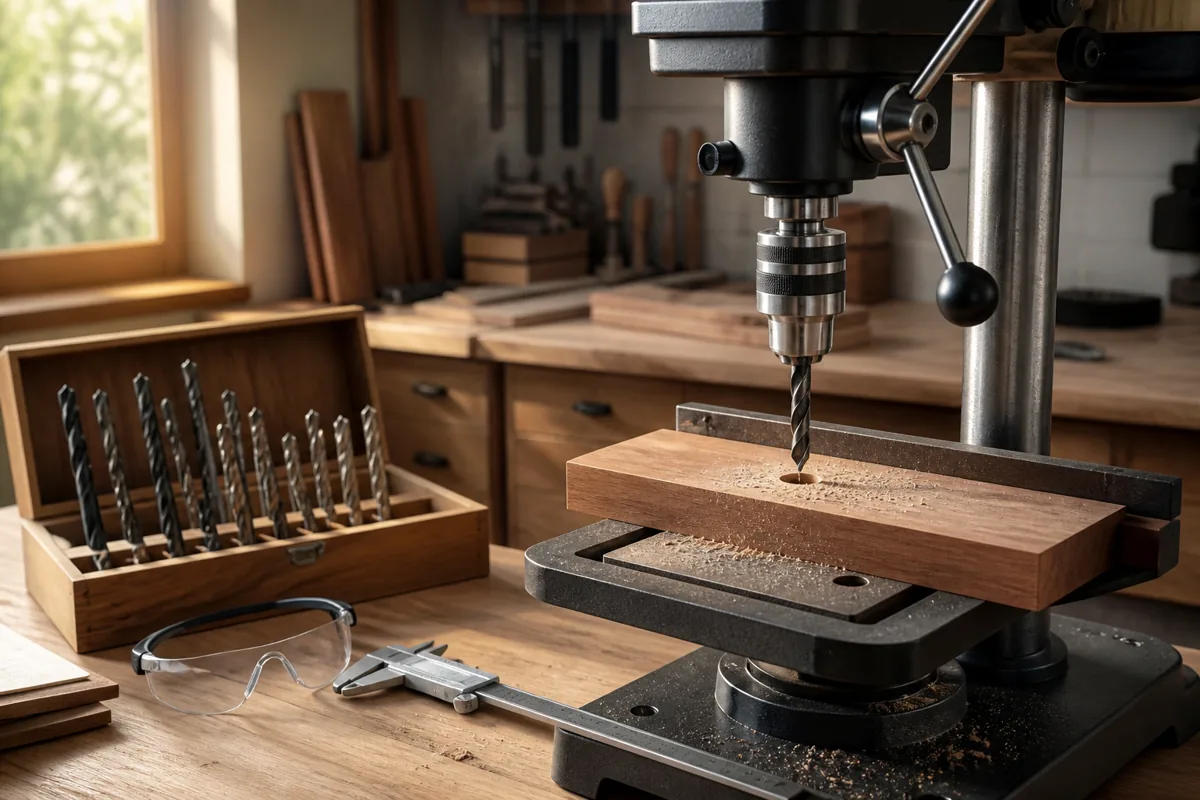
A drill press helps keep a bit square to the table and makes hole depth easier to repeat than with a handheld drill. That matters when drilling a row of shelf-pin holes, dowel joints, or deep holes for hardware. It does not guarantee accuracy on its own: a loose table, dull bit, or poorly supported workpiece can still produce a crooked or oversized hole.
For most home woodworking, the main choice is between a bench-top press and a floor model. A bench-top press costs less and takes up less space; a floor model usually offers more throat depth, travel, and headroom for tall work. Buy for the largest pieces you actually expect to drill, not for the biggest swing number on the box.
As an Amazon Associate we earn from qualifying purchases at no extra cost to you.

What to check before buying
Swing and throat depth: A press’s swing is twice the distance from the spindle center to the column. A 12-inch swing therefore reaches about 6 inches from the edge of a board to its center. Measure your typical workpieces and allow room for clamps. A larger swing is useful for wide panels, but it does not make the machine more accurate.
Quill travel: Travel is how far the spindle can descend in one stroke. Around 2 to 3 inches is enough for many joinery and hardware holes. If the hole is deeper, you may need to retract the bit, clear chips, and drill again. Forstner bits and large augers can load the machine heavily, so capacity is more than a question of whether the chuck will hold the bit.
Speed range: Hardwood and larger bits generally call for lower speeds. Small bits can run faster. A press with several belt-speed settings is adequate, but changing belts takes time. Electronic variable speed is convenient, though it can add cost and should not be treated as a substitute for a suitable motor and solid construction.
Table and adjustments: Look for a table that locks securely, tilts when needed, and has slots or a way to attach a fence. A scale for depth is useful, but verify it with a scrap test. Check whether the table can be raised high enough for your work and lowered far enough to support short pieces.
Bench-top or floor model?
| Type | Good fit | Trade-off |
|---|---|---|
| Bench-top | Small shops, dowels, hardware holes, modest stock | Less reach and often less headroom; needs a sturdy stand or bench |
| Floor | Wide boards, taller work, frequent use, heavier bits | Costs more and takes floor space; a large machine is not automatically more precise |
A well-secured bench-top press is the sensible choice for many hobby shops. Compare bench-top woodworking drill presses if your stock fits within the machine’s reach. If you regularly drill near the center of wide panels or work with tall assemblies, a floor-standing drill press may save repeated workarounds.
Accuracy: what the specs do not tell you
Chuck and spindle runout affect how much the bit wobbles as it spins. Excessive wobble can leave a hole wider than the bit, especially with small brad-point bits. If possible, test a machine with a dial indicator or have a dealer demonstrate it. Otherwise, check the chuck’s grip, spindle play, and whether the table stays put when locked. A published speed range or swing rating says little about these details.
Motor horsepower claims can also be difficult to compare across brands. Pay more attention to whether the press maintains speed in the cuts you make and whether the belt system is easy to adjust. For a small shop doing occasional 1/2-inch holes, an entry-level machine may be entirely adequate. Frequent use of large Forstner bits in dense hardwood is a stronger reason to consider a heavier press.
Drilling hardwood cleanly and consistently
Use a sharp bit suited to the hole: brad-point bits for clean, located holes; twist bits for general work; and Forstner bits for flat-bottomed recesses. Back up the work with scrap to reduce breakout, particularly when drilling through a board. For deep holes, withdraw the bit periodically to clear chips. Packed chips create heat, burn marks, and a stalled bit.
Clamp the workpiece to the table or to a fence and stop block. Never hold small stock by hand; a bit can catch and spin the piece hard enough to injure you. A sacrificial board beneath the work protects the table and supports the exit fibers. For a repeated row, set a fence and stop rather than measuring each hole independently.
Set depth with a stop or a depth collar, then test on scrap of the same thickness. Do not rely solely on a printed scale, which can be off by enough to ruin a shallow counterbore. Start with a conservative feed, especially in oak, maple, or other dense hardwood. Forcing the quill can flex the setup, overheat the bit, or pull the work into the cutter.
Setup and maintenance that protect accuracy
Mount the press firmly to a heavy bench or stand. Check that the table is square to the spindle before drilling perpendicular holes; use a reliable square or a test block rather than assuming the pointer is correct. Recheck after tilting the table, then return it to zero and lock it. Keep the table surface clean so stock sits flat.
Inspect belts for wear and keep them tensioned according to the manual. A slipping belt loses speed under load; overtightening can strain bearings. Keep the chuck clean and remove the key immediately after tightening. If holes start wandering, check bit sharpness, chuck grip, table movement, and workholding before blaming the machine.
Which one makes sense?
Choose a bench-top press if your projects are mostly joinery, small parts, and hardware holes, and you can secure it to a rigid base. Spend more for a floor model when its reach, headroom, or sturdier construction solves a real limitation in your shop. In either case, a good fence, clamps, sharp bits, and a repeatable depth stop often improve results more than moving up one size in machine.