How to Choose a Stationary Table Saw for a Professional Shop
What's inside
As an Amazon Associate I earn from qualifying purchases. This post may contain affiliate links at no extra cost to you.
A professional-shop table saw earns its floor space when it can rip full-size stock accurately, hold its settings through repeated cuts, and keep working without consuming time in adjustment and repair. The right choice depends less on a long list of features than on the material you cut, the work you do, and the electrical service and space available.
Contents
Start with the work
List the stock you routinely cut: its maximum thickness, width, and length, plus whether you work mostly with solid wood, sheet goods, or both. A cabinet shop breaking down 4-by-8-foot plywood has different needs from a furniture shop making narrow rips in hardwood. Also note whether the saw will be the primary production machine or a backup for another saw.
Most full-size saws use a 10-inch blade and cut roughly 3 inches deep at 90 degrees. That is enough for typical 4/4 and 8/4 lumber, though actual capacity varies by blade and model. Check the published rip capacity against your work: a 30-inch fence can handle many furniture parts, while frequent sheet breakdown may justify a 50-inch class saw. Wider capacity also means a larger footprint and more support space; the number alone does not make handling a full sheet safe or convenient.
Choose the saw class
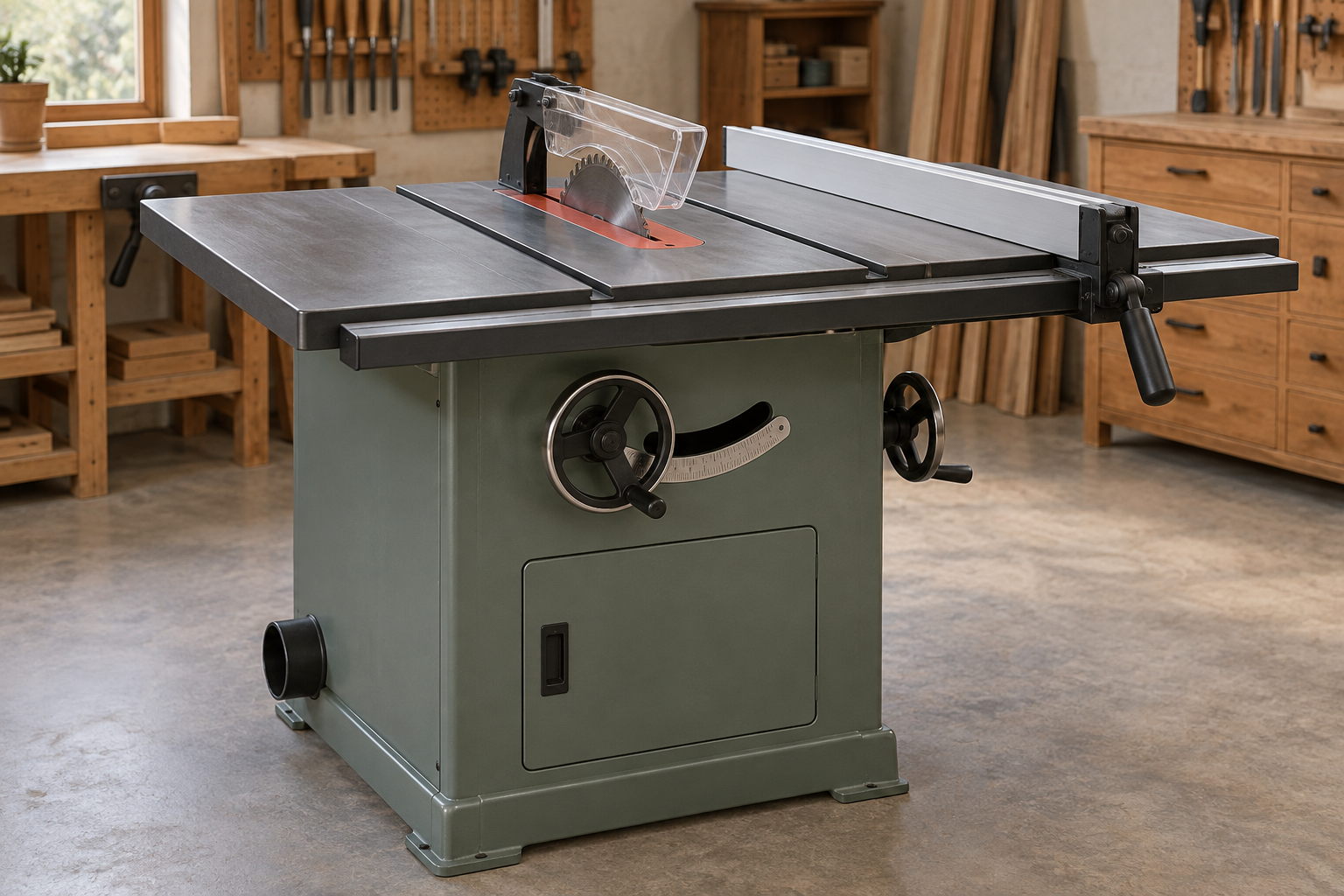
For daily production, a cabinet saw is usually the most stable choice. Its heavy cast-iron table and trunnion assembly resist vibration, and many versions use a 3-horsepower motor. That can cut thick hardwood with less strain than a typical contractor saw, but it commonly requires 240-volt power and may need a dedicated circuit. Verify the motor’s voltage, phase, and amperage against the shop’s actual service before buying.
A hybrid saw is a reasonable middle ground for a small professional shop or a lower-duty workload. It is generally less massive and may use a smaller motor than a cabinet saw, with model-dependent power requirements. It can make accurate furniture parts, but sustained heavy ripping through dense stock is more likely to expose its limits. Do not assume “hybrid” guarantees a particular voltage or performance: check the manufacturer’s specifications.
Contractor-style saws can be adequate for intermittent work, limited budgets, or shops where the machine must be moved. Their lighter frames can vibrate more, and some designs place the motor behind the saw, which can complicate dust collection or take up space. A professional who mostly makes short, light cuts may be fine with one; one cutting thick hardwood all day may pay for the lower price in slower feed rates and more frequent adjustments. Compare cabinet table saws and hybrid table saws by specifications rather than category labels.
Compare the trade-offs
| Saw type | Best fit | Typical compromise | Check before purchase |
|---|---|---|---|
| Cabinet | Frequent hardwood ripping and production work | Price, weight, and often 240-volt installation | Motor requirements, footprint, fence capacity, dust port |
| Hybrid | Professional work at moderate volume | Less reserve for prolonged heavy cuts | Motor details, trunnion adjustment, cabinet access |
| Contractor-style | Intermittent cutting or a tighter budget | More vibration or adjustment, depending on design | Fence rigidity, stand stability, dust collection |
Inspect the fence and table
The fence should lock securely at both ends, remain parallel to the blade, and move without binding. A fence that deflects under hand pressure can turn a nominally accurate saw into a source of tapered rips or burning. Ask how the fence is adjusted and whether replacement parts are available. If possible, lock it at several positions and check that it returns to the same setting.
Check the table for flatness and the miter slots for straightness and consistent width. Cast iron adds mass and can damp vibration, but it can rust if neglected. A polished surface is useful, not a substitute for a flat one. The fence scale also needs calibration: verify it with a reliable rule or setup block before trusting its readings.
Safety and dust are part of the purchase
Look for a usable blade guard, riving knife, and anti-kickback pawls, and confirm the riving knife can stay in place for the cuts you commonly make. A riving knife close behind the blade helps keep a kerf from closing onto the blade; removing it for convenience increases exposure to kickback risk. A brake system that stops the blade after contact may reduce injury severity, but it does not make hands near a moving blade safe. Check the manufacturer’s consumable and replacement costs as well as how the safety system affects blade changes.
Dust collection matters for both visibility and cleanup. A cabinet saw with a lower dust port still needs suitable extraction and a well-fitted blade guard; a single small shop vacuum may not capture dust effectively during heavy ripping. Match the saw’s port size and airflow needs to the collector you own or plan to install. A saw that produces a cloud around the blade can obscure the cut and spread fine dust through the shop.
Installation and buying checklist
Measure the machine, extension wings, fence travel, and infeed and outfeed clearance—not just the base. A 4-by-8-foot sheet needs substantial support and a safe way to control its weight; an outfeed table or roller support helps, but it must not interfere with the cut. Consider how the saw will be delivered and moved: cabinet saws can weigh several hundred pounds, and stairs or narrow doors may require planning.
Before committing, confirm electrical requirements, warranty coverage, service access, and availability of fences, guards, belts, and other replacement parts. Budget for a quality blade, a reliable push stick or push block, and setup time. A lower-cost saw is a sound buy if its capacity matches the workload and it holds alignment. It is a poor bargain if its fence slips, its motor bogs on routine stock, or parts are difficult to source. For a production shop, compare professional table saws with a riving knife against your actual cut list, power supply, and space before choosing.