
Our Top Picks
What's inside
As an Amazon Associate I earn from qualifying purchases. This post may contain affiliate links at no extra cost to you.
- Top Pick: WEN DC3401 5.7-Amp Rolling Dust Collector
- Runner-up: Shop Fox W1826 Wall-Mount Dust Collector
- Also consider: POWERTEC DC5372 1 HP Portable Dust Collector
A small workshop creates the same kinds of chips and fine dust as a big one, in a space where every square foot of floor already has a job. A full-size two-stage system rarely fits a one-car garage or basement corner, so small-shop dust collection usually comes down to three formats: a compact single-stage collector that rolls to the tool in use, a wall-mount unit that gives up no floor space, or a cyclone separator that turns an ordinary shop vacuum into a two-stage system.
As an Amazon Associate, we earn from qualifying purchases.
This guide compares five options across those formats. It also explains why the CFM figure on the box is only a starting point: hose length, fittings, and filter loading all pull the working number down. Filtration, inlet size, bag capacity, and footprint matter just as much.
This article contains affiliate links, and we may earn a commission if you buy through them at no extra cost to you.
Contents
Quick Answer
For most small shops, start with a compact single-stage collector in the 550 to 660 CFM class with a 4-inch inlet, and keep the hose run short. Choose a wall-mount model when floor space is the real problem, a portable 1 HP unit for finer 1-micron filtration, and a cyclone separator when your work centers on a shop vacuum and smaller tools.
WEN DC3401 5.7-Amp Rolling Dust Collector
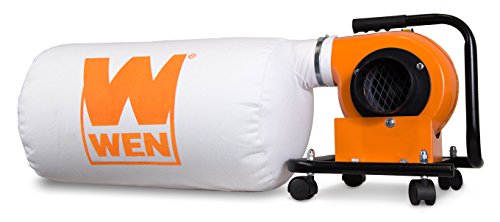
The WEN DC3401 is the smallest dust collector in this roundup, and its size is the point. A 5.7-amp brushed motor spins a 6-inch impeller that WEN rates at 660 CFM through a single 4-inch inlet, enough airflow class for one benchtop or mid-size stationary tool at a time, provided the hose run stays short. The 12-gallon bag fills quickly during planing sessions.
Its flexibility shows in storage. It rides on lockable swivel casters, has a carrying handle, and at roughly 17 pounds can be lifted onto a bench or hung on its optional wall mount when the floor needs to stay clear. The trade-offs are the brushed motor, a simpler design than the induction motors on larger units, and the 5-micron bag, the coarsest filtration in this group.
Specs
- Motor: 5.7-amp brushed
- Rated airflow: 660 CFM
- Inlet: one 4-inch port
- Collection bag: 12 gallons
- Filtration: 5-micron bag
- Mounting: casters, carrying handle, optional wall mount
- Weight: about 17 lb
Shop Fox W1826 Wall-Mount Dust Collector
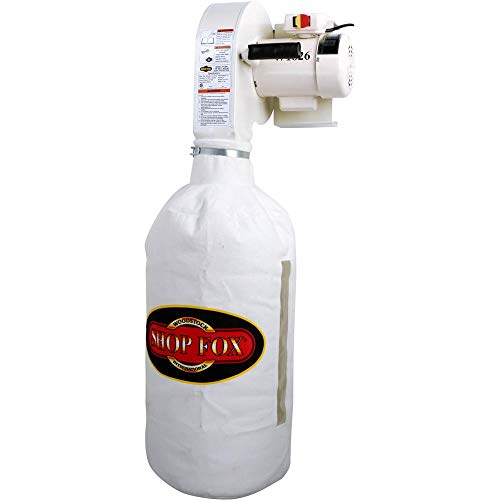
The Shop Fox W1826 takes the opposite approach to storage: it never touches the floor. This 1 HP single-stage collector hangs on a wall bracket, suiting a fixed layout where one main tool sits within a short hose run of the wall. Shop Fox rates it at 537 CFM, the lowest figure here, but it sits in a workable class for a single tool on a short hose.
Its felted collection bag does double duty, serving as both filter and chip container. It is rated at 2.5-micron filtration, finer than the WEN’s 5-micron bag, and holds about 2 cubic feet. The compromise is emptying: chips collect in the same felt bag that filters the air, and the bottom zipper opening is short, so shaking packed shavings loose is slower than swapping a plastic liner.
Specs
- Motor: 1 HP, prewired 110V, convertible to 220V
- Rated airflow: 537 CFM
- Inlet: one 4-inch port
- Collection bag: about 2 cubic feet, felted
- Filtration: 2.5-micron felted bag
- Mounting: wall bracket, no floor footprint
- Height with bag inflated: about 44 inches
See the Shop Fox W1826 on Amazon
POWERTEC DC5372 1 HP Portable Dust Collector

The POWERTEC DC5372 is a rolling single-stage collector built around filtration fineness. Its 1 HP motor is rated at 560 CFM, and the included filter bag is rated at 1 micron, the finest bag filtration here. On paper, that makes it the pick for shops where sanding dust is a big share of the workload, since sanders produce the finest particles and coarse bags pass more of them back into the room air.
The DC5372 sits on casters, ready to be pulled alongside whichever tool is running. POWERTEC does not state a bag capacity in gallons in the listing data, so judge capacity by the bag’s physical size. Note that a 1-micron bag loads faster than a coarse one, so shaking it down between heavy sessions is part of owning this style of collector.
Specs
- Motor: 1 HP, 120V/240V, 60 Hz
- Rated airflow: 560 CFM
- Inlet: one 4-inch port
- Filtration: 1-micron filter bag
- Mounting: portable base with casters
- Bag capacity: not stated
See the POWERTEC DC5372 on Amazon
BUCKTOOL DC30A-1 Wall-Mount Dust Collector with Remote

The BUCKTOOL DC30A-1 is another wall-hung single-stage design, rated at 550 CFM from a 1 HP, 6.5-amp motor, with a 2-micron filter bag that splits the difference between the Shop Fox and the POWERTEC on fineness. Its distinguishing feature is the remote control. That matters when the collector is mounted high on a wall or tucked behind a machine: starting and stopping it from the tool, without walking to a paddle switch, makes it far more likely the collector actually gets switched on for short cuts.
Like the W1826, it suits a fixed layout with tools near the mounting wall. A remote does not change the physics of long hose runs: a wall unit serving a tool across the room through long, ribbed flex hose will deliver far less than its rated airflow at the hood. Plan the mount around the dustiest tool and keep the run short.
Specs
- Motor: 1 HP, 6.5-amp
- Rated airflow: 550 CFM
- Filtration: 2-micron filter bag
- Control: remote control included
- Mounting: wall mount
- Inlet size: not stated
- Bag capacity: not stated
See the BUCKTOOL DC30A-1 on Amazon
Oneida Air Systems Dust Deputy DIY Cyclone Separator

The Dust Deputy is not a collector at all; it is a cyclone separator that sits between a tool and a shop vacuum you already own, and it changes the economics of that vacuum. Incoming air spins inside the cone, and the great majority of chips and dust drop into a container below before the airstream reaches the vacuum. The vacuum’s filter stays cleaner far longer, so suction holds up through a session instead of fading as the filter cakes.
The DIY version includes the anti-static cyclone, a gasket, and mounting hardware; you supply an airtight bucket or drum and the vacuum. Its ports fit typical shop-vacuum hoses, suiting router tables, sanders, and miter saws rather than 4-inch-port planers or jointers. A vacuum moves far less air than even the smallest collector here. What the separator changes is consistency: steady suction, cheaper filter upkeep, and a tidier bench area.
Specs
- Type: cyclone separator (vacuum and container not included)
- Model: AXD001004
- Material: anti-static resin
- Included: cyclone, gasket, mounting hardware
- Container: user-supplied airtight bucket or drum
- Hose fit: standard shop-vacuum hose sizes
- Rated airflow: depends on the vacuum used
See the Oneida Dust Deputy DIY on Amazon
How to Choose
Start with airflow honesty. A CFM rating is a maximum measured with little or no restriction attached. Every foot of hose, every elbow, and every layer of dust caked on a filter adds resistance, called static pressure, and airflow at the tool’s hood drops accordingly. A 550 CFM wall unit on six feet of hose will usually out-collect a higher-rated machine at the end of a long, corrugated run. The winning move is layout: put the collector close to the dustiest tool and keep runs short.
Match the format to the shop. Rolling collectors like the WEN DC3401 and POWERTEC DC5372 fit shops that rearrange or share space with a car, since they tuck into a corner between sessions. Wall-mount units like the Shop Fox W1826 and BUCKTOOL DC30A-1 fit fixed layouts and return their floor space permanently, but commit you to one location. A cyclone separator fits shops built around a shop vacuum and smaller tools.
Then compare filtration and inlets. Bag ratings here run from 5 microns down to 1 micron. A canister filter, offered on some competing wall-mount models, packs far more pleated surface area into the same space and holds airflow longer between cleanings; bags are simpler to replace but load faster, and a clogged filter quietly strangles airflow either way. On inlets, the 4-inch port is the small-shop standard. Stepping a 4-inch collector down to a small tool port works, but airflow falls sharply, which is why vacuum-based separation suits small-port tools better.
Finally, weigh noise and footprint together. None of these manufacturers publish a decibel rating, so assume the collector adds meaningfully to machine noise. Wall mounting removes floor footprint but needs roughly four feet of clear wall height for an inflated bag, while a rolling unit needs a parking spot.
Who Should Skip
Skip this entire category if your shop is hand tools only. A collector needs a powered tool with a dust port to earn its keep; for hand-tool work, a broom, a bench brush, and an occasional vacuum pass handle the shavings. Also skip these compact units if your shop has grown past them: a wide planer, a large jointer, or several machines plumbed in at once call for a two-stage cyclone collector with a larger impeller and proper ductwork. If your only dust source is one small tool used occasionally, the Dust Deputy route alone covers it.
FAQ
How many CFM does a small workshop actually need?
For one tool at a time on a short hose run, the 500 to 700 CFM class covers most benchtop and mid-size stationary tools. Chip-heavy machines like planers fill bags quickly and benefit from the higher end of that range. More than the headline number, what matters is keeping the run short, because hose resistance separates the rated figure from what arrives at the tool.
Is a wall-mount collector better than a rolling one?
Neither is better in general; they suit different layouts. A wall-mount unit permanently frees floor space and works well when one main tool sits nearby. A rolling unit follows the work in a shop that rearranges often. Choose by whether your layout is fixed or fluid.
Does a cyclone separator replace a dust collector?
No. A separator like the Dust Deputy removes debris from the airstream before it reaches a vacuum, keeping the vacuum’s suction consistent and its filter clean. It does not add airflow. Tools with 4-inch ports that move a lot of air, such as planers and jointers, still need a true collector; separators shine with smaller tools a vacuum already serves.
How often should the bag or filter be emptied and cleaned?
Empty collection bags before they are much more than half full, because a packed bag restricts airflow and strains the motor. Shake or brush down filter bags regularly, and more often after sanding, since fine dust cakes the fabric and quietly cuts suction.
Final Verdict
For a typical one- or two-tool garage shop, the WEN DC3401 is the easiest starting point: the highest rated airflow here in a tiny footprint. If the layout is fixed and the floor must stay clear, the Shop Fox W1826 or the remote-controlled BUCKTOOL DC30A-1 hang the same job on the wall. Choose the POWERTEC DC5372 when fine filtration is the priority. If your shop revolves around a good vacuum, the Oneida Dust Deputy keeps it pulling steadily instead of choking on its filter.
Related guides
More from Amazon
Programs that pair well with the guide above. Offers and eligibility are set by Amazon and may change.
A free business account with business pricing and bulk-buying tools for work, shop or home office.
Create a business accountFree shipping on eligible items, Prime Video and more. Eligible new members can start with a free trial.
Start a Prime free trialAudiobooks and podcasts to listen to on the go. Eligible new members can start with a free trial.
Try Audible freeAd-free music streaming. Eligible new subscribers can start with a free trial.
Try Music Unlimited freeAs an Amazon Associate we earn from qualifying purchases.








Write Your Review
No reviews yet. Be the first to share your experience!