
What's inside
- Contents
- What a wood planer actually does
- The main types of wood planers
- Thickness planer versus jointer
- Key features that matter
- Size and power explained
- Matching a planer to your projects
- Setup and tuning
- Safety
- Maintenance
- Common mistakes
- Who should choose what
- Buying checklist
- Frequently asked questions
- Conclusion
As an Amazon Associate I earn from qualifying purchases. This post may contain affiliate links at no extra cost to you.
Short answer: the best wood planer is the one that matches the job you do most often. A benchtop thickness planer suits most hobbyists who want consistent, parallel boards from rough lumber. A jointer is the partner you need for truly flat faces and square edges. A handheld electric planer is right for trimming doors and framing. A stationary planer makes sense only when you mill in volume. Start with the task, not the tool.
The phrase “wood planer” covers several different machines, and that confusion is why people buy the wrong one. This guide separates the categories, explains the specifications that matter, and walks through setup, safety and maintenance. It names no brands or models; it teaches you how to evaluate any planer you meet.
Contents
- Contents
- What a wood planer actually does
- The main types of wood planers
- Thickness planer versus jointer
- Key features that matter
- Size and power explained
- Matching a planer to your projects
- Setup and tuning
- Safety
- Maintenance
- Common mistakes
- Who should choose what
- Buying checklist
- Frequently asked questions
- Conclusion
Our Top Picks
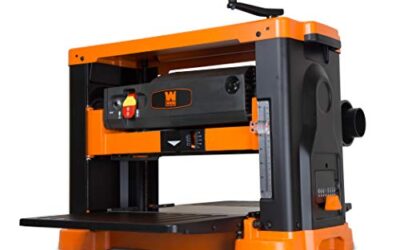
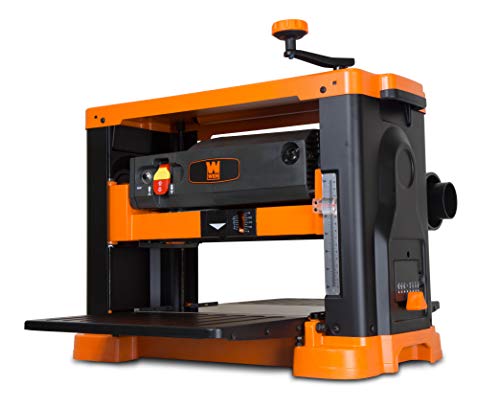 WEN PL1326 15-Amp 13-Inch Spiral Benchtop Thickness PlanerSpiral, 13-Inch, Single Speed81 poundsCheck on Amazon
Contents
- What a wood planer actually does
- The main types of wood planers
- Thickness planer versus jointer
- Key features that matter
- Size and power explained
- Matching a planer to your projects
- Setup and tuning
- Safety
- Maintenance
- Common mistakes
- Who should choose what
- Buying checklist
- FAQ
- Conclusion
What a wood planer actually does
A power planer uses a rotating cutterhead, a cylinder fitted with knives or small carbide inserts, that spins fast and shaves wood in a series of tiny scallops. The head spins so quickly and the board moves so slowly that the scallops are shallow and the surface looks smooth. How the board is supported past the head decides what the machine can and cannot correct.
Here is the concept that trips up beginners: a thickness planer makes the top face of a board parallel to the bottom face that rests on its table. It does not make a bent board flat. Feed rollers press the board down as it enters, the head removes material, and when the pressure is released the board can spring back to its curve. A cupped board can come out thinner but still cupped. Flattening a face is the job of a jointer, a hand plane, or a sled used with a planer.
Handheld power planers work the other way around. Their sole plates ride on the surface and the head removes material relative to it. They can follow a surface or flatten a small area depending on how you hold them, but they rely on your control rather than a fixed table.
Keep three jobs separate: flattening a face, squaring an edge, and bringing the board to uniform thickness. Every buying decision below follows from them.
The main types of wood planers
Benchtop thickness planers
Compact machines meant to sit on a bench or mobile stand. They accept boards of modest width and use a universal motor, which is loud but light and powerful for its size. They are the entry point for most home shops.
Stationary thickness planers
Heavier cast-iron or steel machines, usually with induction motors. Mass reduces vibration and gives smoother cuts, and the motor runs quieter and tolerates long sessions. They need dedicated floor space, often a larger electrical circuit, and a serious dust collection setup.
Jointers
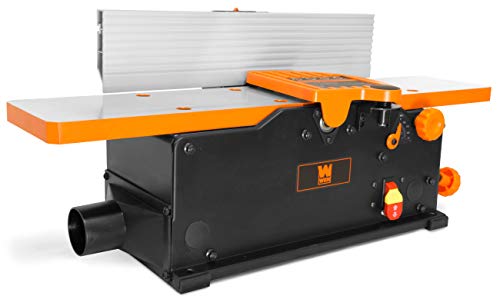
A jointer has two long tables with a cutterhead between them. You press a board face down on the infeed table and push it across the head onto the outfeed table, which sits level with the cutting edge. This removes high spots and creates a flat reference face; a second pass on edge makes a square edge. A longer bed supports long boards better.
Combination planer-jointers
These fold both functions into one footprint, usually by reconfiguring the tables. They save space and often money, but you must change the setup whenever you switch tasks. For short work sessions in a one-car garage, they can be a good compromise.
Handheld electric planers
Corded or cordless tools a little larger than a drill. Excellent for trimming doors, fitting framing and general carpentry. They are not precision machines for furniture stock, although a practiced user can get clean results.
| Type | Main job | Footprint | Noise | Best fit |
|---|---|---|---|---|
| Benchtop thickness planer | Parallel thickness, moderate widths | Small, movable | Loud | Hobby shops, small furniture |
| Stationary thickness planer | Production thickness work | Large, fixed | Moderate to loud | Serious or small commercial shops |
| Jointer | Flat faces and square edges | Long and narrow | Loud | Anyone starting from rough lumber |
| Combination planer-jointer | Both, one at a time | Medium | Loud | Tight spaces, mixed use |
| Handheld electric planer | Trimming and site carpentry | Fits in a toolbox | Loud | Carpenters, remodelers, repairs |
Thickness planer versus jointer
The two machines are complementary, and the order of operations matters. From rough lumber the standard sequence is: flatten one face on the jointer, square one edge against the fence, flip the board and run it through the planer with the flat face down, then rip to width on a table saw. Skip the jointing step and the planer faithfully copies whatever twist the board has into its second face.
If you cannot afford or house a jointer, there are workarounds. A planer sled, a flat carrier board with shims that hold the workpiece steady, lets the planer flatten the top face. You can flatten with a hand plane or a router jig. Or you can buy lumber already surfaced and use the planer only for adjusting thickness. Each option costs time or money elsewhere, which is why many woodworkers end up owning both machines.
| Problem | Planer alone | Jointer | Planer plus sled |
|---|---|---|---|
| Cupped or bowed board | Does not fix it | Fixes it | Fixes it with setup effort |
| Uniform thickness | Excellent | Not designed for it | Excellent |
| Square edge for gluing | Not possible | Excellent | Not possible |
| Boards wider than jointer | Limited by flatness | Cannot handle | Good option |
| Cost and space | Lowest | Added cost | Low, but slower |
Key features that matter
Cutterhead design. Straight knives are inexpensive and sharp, but they must be set and aligned when changed, and one nick leaves a line in every board. Spiral heads use many small carbide inserts set at a slight angle so each cuts with a shearing action. They tear less on figured wood, run quieter, and let you rotate one damaged insert instead of replacing a blade. They cost more, and the difference is most visible on curly or interlocked grain.
Depth control. A clear, repeatable scale and a smooth handwheel matter more than a long feature list. Check any scale against a measured board and trust the calipers.
Feed rollers and speed. Good rollers grip without marring. A slower feed rate means more cuts per inch and a finer surface, handy for final passes; the faster rate is for roughing.
Tables and extensions. Rigid infeed and outfeed support for long boards reduces snipe. Smooth, waxed tables glide boards; rusty ones stick.
Dust port. A planer throws out a remarkable volume of chips. A good port and hood send chips away from the head so they are not re-cut and pressed into the board as dents.
Size and power explained
Width capacity is the widest board the machine accepts. You can plane narrow boards and glue them into wide panels afterwards, so you rarely need the maximum.
Thickness capacity is how high the head rises above the table. Most home work involves boards an inch or two thick. The minimum thickness matters if you make thin parts; some machines struggle under about a quarter inch without a backing board.
Motor power is given in amps or horsepower. More power lets the machine take deeper cuts in hardwood without bogging down. Do not compare ratings across motor types, because universal and induction motors are rated differently. The practical test is behavior on your species: if it slows or marks dense hardwood, the answer is lighter passes.
Cuts per inch govern surface quality. A faster head, slower feed or more knives produce a smoother finish that needs only light sanding or a final hand plane pass.
Electrical needs should be read before purchase. Many portable machines run on a standard household circuit, while larger ones need higher amperage or 240-volt power. If unsure, ask a qualified electrician.
Matching a planer to your projects
Furniture from rough lumber. The classic use. You need flat, parallel, square boards, so a jointer and planer pair is ideal. Rough lumber is often cheaper per board foot and offers thicker stock and more species.
Reclaimed wood. Hard on machines because of hidden metal, grit and dirt. Scan with a metal detector, remove fasteners, brush off dirt, and expect to sharpen or replace cutters more often.
Cabinetry. Consistency is everything. Mill all parts to one thickness in one session, at one setting, so panels and face frames match.
Door fitting and carpentry. A handheld planer is quick for shaving a sticking door or trimming a framing member, and portable enough for a job site.
Occasional use. If you mill a few times a year, buy surfaced boards or pay a local mill. A planer that sits idle is wasted money.
Setup and tuning
- Unplug the machine before touching blades, rollers or adjustments.
- Stabilize it. Fasten a portable machine to a stand or clamp it so it cannot walk during a cut.
- Support the board path. Set roller stands or a second table level with the bed.
- Inspect the head for loose fasteners, chipped inserts or dull edges.
- Verify parallelism. Plane a test board and measure both edges and the middle with calipers; if they differ, follow the manual’s adjustment steps.
- Connect dust collection with a hose of the right diameter and no kinks.
- Test on scrap of the same species with a light pass first.
Take thin layers per pass. A light cut reduces tear-out, motor strain and snipe. Heavier cuts belong to roughing on narrow boards, since cutting force rises with width. Flip the board between passes so internal stresses relax evenly and the board is less likely to warp afterward.
Safety
- Hearing protection. Many planers are loud enough to cause damage over time. Wear earmuffs or plugs.
- Eye protection. Chips and splinters fly. Wear safety glasses.
- Respiratory protection. Fine dust accumulates quickly and some species are irritants. Combine dust collection with a well-fitted respirator.
- Kickback. A short or split board can be thrown back if it catches. Do not feed boards much shorter than the distance between the rollers, avoid loose knots and splits, and stand to the side of the feed path.
- Hands. Keep fingers away from the feed opening. On a jointer use push blocks and never pass your hand over the head.
- Foreign objects. Nails, screws and stones damage cutters and throw debris.
- Blade changes. Unplug first and wear cut-resistant gloves around sharp knives.
- Jams. Switch off and wait until the head has stopped completely before reaching in.
- Fire risk. Fine dust is combustible. Empty the collector regularly and keep sparks away.
With a handheld planer, let the head reach full speed before touching wood, clamp the workpiece, keep both hands on the tool, and set it down only after the head stops.
Maintenance
Clean after each session. Vacuum chips from the head area, rollers and table. Wipe pitch from rollers with a cleaner the manual approves, avoiding solvents that attack rubber.
Protect the bed. Cast iron rusts in humid shops. A thin coat of paste wax prevents rust and helps boards slide, which also reduces snipe.
Keep cutters sharp. Dull edges tear grain, burn the surface and overwork the motor. Replace or rotate them when lighter cuts no longer cure roughness. Replace straight knives in matched sets so the head stays balanced.
Inspect wearing parts. Check belts and cords for cracks. Universal motors have carbon brushes that wear out; heavy sparking or lost power often points to them.
Recheck alignment occasionally, especially after moving the machine.
Common mistakes
- Expecting the planer to flatten a warped board. Flatten first with a jointer, sled or hand plane.
- Cuts that are too deep. The result is tear-out, snipe and jams.
- Ignoring snipe. Support boards level on both sides, feed boards end to end, and leave extra length to cut off.
- Skipping dust collection. Re-cut chips dent boards and fine dust affects health.
- Feeding short boards. They can tip and kick back. Mill them as part of a longer board.
- Never checking parallelism. A tapered board multiplies errors in a glue-up.
Who should choose what
The weekend hobbyist with a small garage usually does best with a benchtop planer and a flattening plan, either a sled or a compact jointer.
The furniture maker who mills weekly should consider a heavier planer, a helical head and a dedicated jointer; quieter induction motors make long sessions less tiring.
The remodeler mostly needs a handheld electric planer for doors and framing, and can add a benchtop machine later.
The small production shop benefits from a wide stationary planer, a strong dust collector and spare cutters, because downtime costs more than equipment.
Buying checklist
- List your next three projects and note the widest and thickest boards in each.
- Decide whether you need flat faces, parallel thickness, square edges, or all three.
- Measure the floor space and bench height available.
- Confirm the circuit and voltage your shop provides.
- Compare cutterhead types and how replacement cutters are sold.
- Check the dust port diameter and match a collector or vacuum to it.
- Read the manual online for alignment and blade-change steps before buying.
- Budget for hearing and eye protection, a respirator and push blocks.
- Budget for spare cutters, wax and calipers.
- Confirm warranty terms and the availability of replacement parts.
Frequently asked questions
What is the difference between a planer and a jointer?
A thickness planer makes two faces parallel and reduces thickness. A jointer makes one face flat and one edge square. The jointer creates reference surfaces and the planer then brings the board to final thickness.
Can a thickness planer flatten a warped board?
Not by itself, because the board springs back after the rollers release it. Use a jointer, a stable planer sled or a hand plane first.
Is a benchtop planer good enough for furniture?
Yes for most projects, provided you take light passes, support long boards and check parallelism. Benchtop machines are louder and slightly less smooth than heavy stationary ones.
Do I need a helical cutterhead?
No. Sharp straight knives work well on many species. A helical head becomes attractive for figured grain, lower noise or easier maintenance.
How deep should each pass be?
Shallow enough that the machine does not bog down or leave rough surfaces. Treat the manual’s maximum as a ceiling, not a target.
What causes snipe?
The board tips as it enters or exits the rollers and the head cuts slightly deeper at the ends. Support the board level, wax the bed, take light passes and feed boards end to end.
Can I plane reclaimed lumber safely?
Yes if you prepare it: remove fasteners, scan for hidden metal, brush off grit, and wear full protection, since old finishes add to the dust hazard.
Do I need a dust collector or is a shop vacuum enough?
A vacuum may handle tiny jobs, but a planer produces far more chips than it copes with for long. A collector, or a separator that protects the vacuum filter, suits regular milling. Add a respirator either way.
Conclusion
There is no single best wood planer, only a best match. A benchtop thickness planer covers most home needs, a jointer or sled handles the flattening it cannot, a handheld planer serves carpenters, and stationary machines reward those who mill often.
Write down the boards you actually plan to mill, check space and power, and budget for dust collection and safety gear. Then take light passes, keep cutters sharp and measure rather than assume.
When you are ready to compare options, browse benchtop thickness planers, benchtop jointers, handheld electric planers, and dust collection gear, and test each against the checklist above.
Disclosure: As an Amazon Associate, fdwoodworking.com may earn from qualifying purchases made through links on this page, at no extra cost to you.
Related guides
More from Amazon
Programs that pair well with the guide above. Offers and eligibility are set by Amazon and may change.
A free business account with business pricing and bulk-buying tools for work, shop or home office.
Create a business accountFree shipping on eligible items, Prime Video and more. Eligible new members can start with a free trial.
Start a Prime free trialAudiobooks and podcasts to listen to on the go. Eligible new members can start with a free trial.
Try Audible freeAd-free music streaming. Eligible new subscribers can start with a free trial.
Try Music Unlimited freeAs an Amazon Associate we earn from qualifying purchases.
Write Your Review
No reviews yet. Be the first to share your experience!