Best 6-Inch Jointers for Milling Narrow Hardwood Stock
What's inside
As an Amazon Associate I earn from qualifying purchases. This post may contain affiliate links at no extra cost to you.
Contents
What a 6-inch jointer can do
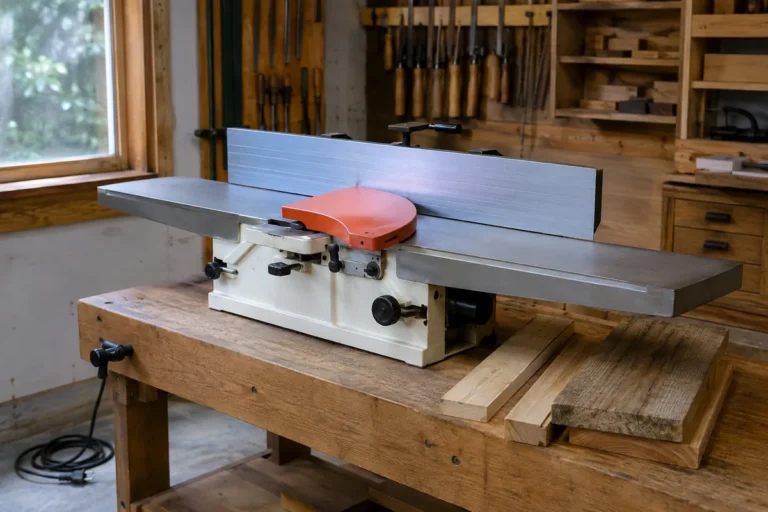
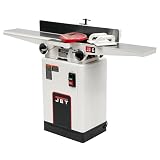
A 6-inch jointer is useful for flattening one face and straightening one edge of narrow boards before they go to a planer or table saw. Its cutterhead is only 6 inches wide, so it suits furniture parts, shelf stock, trim, and many hardwood boards sold in common widths. It is not a good machine for flattening wide tabletops: a board wider than the knives cannot be jointed across its full face in one pass.
For narrow stock, bed length and fence quality matter as much as cutter width. A longer bed supports more of a board and makes it easier to keep pressure on the infeed and outfeed tables without rocking the work. A rigid fence that stays square saves setup time and reduces the chance of tapering an edge.
As an Amazon Associate we earn from qualifying purchases at no extra cost to you.

What to look for before buying
Check the published cut width, table length, motor rating, fence dimensions, dust-port size, and whether the cutterhead uses straight knives or helical-style inserts. Specs do not tell the whole story, but they help narrow the field. A short benchtop machine can be adequate for short parts; it is less forgiving on long boards than a floor-standing jointer with longer tables.
Most 6-inch jointers use a 120-volt supply, which is convenient for a home shop. Verify the actual electrical requirements rather than assuming every machine can share a circuit with a dust collector. A circuit that trips under load interrupts work, and repeatedly resetting it is not a substitute for proper capacity.
Knife setup affects the result. Straight knives need to be sharp, aligned, and set to the same height; a nick can leave a visible ridge down the board. Insert-style cutterheads generally cost more up front, but a damaged insert can often be rotated or replaced individually. They still need maintenance, and they do not make a poorly adjusted jointer accurate.
6-inch jointer types compared
| Type | Best fit | Main trade-off |
|---|---|---|
| Benchtop | Short parts and limited shop space | Short tables offer less support; mounting and dust collection need attention |
| Floor-standing with straight knives | Regular milling on a moderate budget | Knives need careful setup and sharpening or replacement |
| Floor-standing with insert cutterhead | Frequent use or a preference for simpler cutter maintenance | Higher purchase price and insert replacement cost |
For a first machine, a 6-inch floor-standing jointer is a sensible starting point if you have room for it. It is usually easier to support longer stock than on a compact benchtop unit. If you work mostly with short pieces and need a machine you can store away, a 6-inch benchtop jointer can be enough; budget for a secure stand or bench and a way to manage chips.
Milling narrow hardwood stock without creating new problems
Start with a board that is stable enough to joint. A twisted or cupped board can be flattened, but severe defects may require substantial material removal. Check for nails, grit, and loose knots. Jointing stock with embedded metal can damage knives or inserts, and a loose knot can break out under the cutter.
Set a modest depth of cut—about 1/32 inch is a practical starting point for many hardwoods. A deeper cut removes stock faster but increases cutting load and can worsen tear-out, especially on figured grain. Make light passes until the face is flat, then put that face against the fence and joint one edge square to it. Once you have a true face and edge, use a thickness planer to bring the opposite face parallel, then rip the final width on a table saw.
Keep the board moving at a steady pace. Pausing over the cutter can leave a depression; pushing too quickly can produce a rough surface or strain the machine. Use push blocks for control, keep hands clear of the cutter opening, and do not try to joint a piece too short or too narrow for the machine’s instructions. Narrow stock can be especially awkward to hold, so consider milling it wider first and ripping it to final size afterward.
Long boards need support beyond the tables if they sag or lever against the fence. Outfeed support should be set level with the jointer table, not higher. Poorly aligned support can lift the work and create a tapered cut. Likewise, applying too much pressure near the infeed table after the leading end reaches the outfeed can prevent the board from following the newly cut surface.
Where to spend—and where to save
For occasional work on short hardwood pieces, a basic 6-inch jointer with straight knives is often the better value. Keep the knives sharp and learn to check table coplanarity and fence square. Paying extra for an insert cutterhead makes more sense if you joint often, work with figured grain, or would rather rotate an individual insert than set a full knife set. It does not justify buying a smaller or less rigid machine if your stock regularly approaches the machine’s limits.
Dust collection is not optional for comfortable, repeatable work. A jointer makes bulky chips quickly; a clogged chute can leave debris on the tables and interrupt the cut. Match the collector and hose to the machine’s port, and check the manual for the required airflow. Also check availability and cost of knives, inserts, and replacement belts before buying. A low purchase price can lose its appeal if routine parts are hard to find.
If your usual boards are wider than 6 inches, compare the cost of a wider jointer with a router sled or other flattening method before buying. A 6-inch machine remains useful for edges and narrow components, but it cannot replace a wider jointer for full-face work. For typical narrow furniture stock, though, a well-adjusted 6-inch machine can handle the job efficiently—as long as the work is supported, the cut is light, and the stock is safe to feed.