Best 12-Inch Planers for Small Professional Woodshops
What's inside
As an Amazon Associate I earn from qualifying purchases. This post may contain affiliate links at no extra cost to you.
Contents
Choosing a 12-inch planer for a small shop
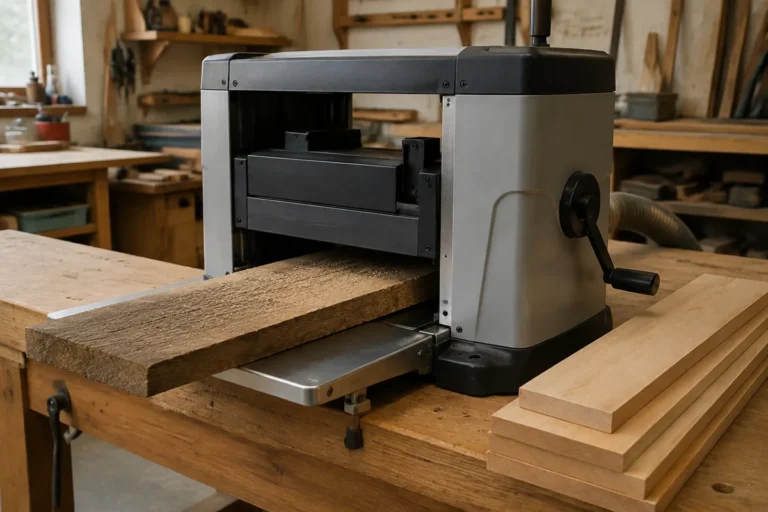
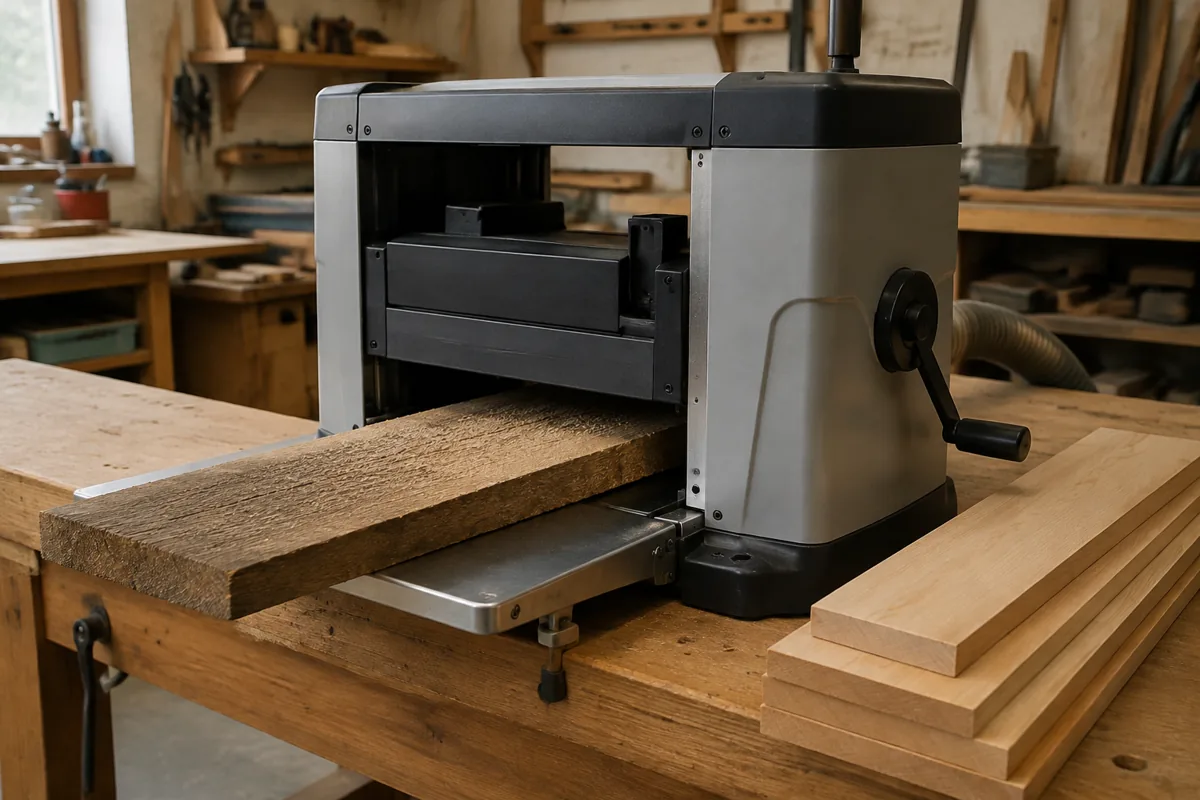
A 12-inch benchtop planer can handle most stock a one- or two-person professional shop needs to thickness: cabinet parts, door rails, table components and glue-up stock. Its width is the first limit, but capacity and feed rate are only part of the decision. Noise, chip collection, knife changes and the space needed to support long boards can matter more in daily use than a small difference in advertised horsepower.
Most machines in this class use a 120-volt motor and accept stock roughly 6 inches thick. Check the maker’s actual capacity and recommended duty cycle before buying; a portable planer is not a production machine, even if it has a strong motor. For routine work, expect to remove about 1/16 inch per pass from hardwood, and take lighter cuts when the board is wide, the grain is difficult or the surface finish matters.
As an Amazon Associate we earn from qualifying purchases at no extra cost to you.


How the main types compare
| Type | Best fit | Trade-off |
|---|---|---|
| Basic two-knife benchtop | Occasional thicknessing and cost-conscious shops | More knife maintenance and a rougher finish than helical cutters |
| Three-knife benchtop | Regular use with a tighter budget | Still requires careful knife alignment when replacing blades |
| Helical or indexed-insert benchtop | Frequent use, figured grain and reduced knife-change downtime | Higher purchase price; inserts can be costly to replace |
These categories describe cutterhead approaches, not guaranteed performance. A well-adjusted machine with sharp straight knives can outperform a neglected helical-head planer. Compare the cost and availability of replacement knives or inserts before treating a cutterhead as a long-term saving.
What to prioritize before buying
Cut quality: Snipe—deeper cuts at the ends of a board—is common in benchtop planers. Infeed and outfeed tables, solid stands and support rollers help, but technique matters too. Keep the board level as it enters and exits, and feed several boards end to end when practical. Leave an extra inch or two at each end when cutting parts to final length, then trim away any snipe.
Dust collection: A planer makes a surprising volume of chips. A small shop vacuum may clog or fail to keep up; many machines work better with a dust collector and the correct hood or adapter. Check the port size and confirm that your collector can handle the airflow the planer needs. Poor extraction can pack chips into the cutterhead area, mar the surface and create a cleanup problem.
Noise and power: Expect loud operation, especially from portable machines. Hearing protection is essential, and the planer may be unpleasant to run in a shared or residential workspace. A 120-volt circuit is convenient, but avoid running the machine on a long, light-gauge extension cord. A voltage drop can contribute to poor starting or tripped breakers. Check the manual for circuit requirements rather than assuming any outlet will do.
Support and footprint: A long board can tip or lift as it feeds, producing uneven cuts or a jam. Plan for stable infeed and outfeed support, with the boards held level with the tables. A folding stand saves floor space, but it must lock securely and sit on a level surface. If your shop regularly handles wide panels or long production runs, a larger stationary planer may be a better investment than pushing a benchtop unit beyond its intended workload.
Which planer category suits the work?
For occasional thicknessing, a basic 12-inch benchtop thickness planer can be the sensible choice. It costs less to buy, and sharp straight knives produce good results on ordinary, straight-grained stock. Budget for replacement knives and the time needed to install and align them. This is a reasonable trade if the machine runs only now and then.
If the planer is used most workdays, consider a 12-inch helical-head benchtop planer. Small indexed inserts can be rotated when an edge dulls, often without removing and aligning a full-length knife. The design can also reduce tearout on difficult grain, though it does not eliminate it. Feed direction, sharp cutters and light passes still matter. Compare insert cost and replacement availability: a cheap machine with expensive or hard-to-find inserts can be a poor bargain.
A three-knife cutterhead is a middle ground for shops that want more cutting edges than a basic two-knife design but do not need the convenience of inserts. Look for a clear knife-setting procedure and readily available replacements. In any category, verify the warranty, service access and parts supply; a planer that is down for weeks waiting on a special blade is no deal for a professional shop.
Avoiding common problems in use
Before planing, inspect stock for nails, screws, staples and embedded grit. Metal can nick knives or inserts and leave repeated defects across the next board. Remove loose bark and dirt, and do not feed a board with a loose knot that could break free. Check moisture and grain direction, too: wet or unstable stock can move after planing, while reversing grain can tear out even under sharp cutters.
Take repeated light passes instead of forcing a deep cut that stalls the motor or leaves a washboard surface. On figured hardwood, start with a very shallow pass and inspect the result before removing more. If tearout persists, try reversing the board’s feed direction, reducing the cut, or using a helical head; some highly figured stock may still need scraping or sanding afterward. Do not use the planer to flatten a twisted board. A planer makes the top face parallel to the bottom face, so first establish one flat reference face with a jointer or a suitable flattening sled.
For a small professional shop, buy for the number of hours you will actually plane, not the most demanding job you might someday run. A lower-cost knife planer is adequate for intermittent work and ordinary stock. Frequent production, difficult grain or the cost of downtime can justify paying more for indexed inserts—but no benchtop planer removes the need for sound stock preparation, dust collection and careful feeding.