Drill Press vs Handheld Drill for Repetitive Woodworking Holes
What's inside
As an Amazon Associate I earn from qualifying purchases. This post may contain affiliate links at no extra cost to you.
Repetitive woodworking holes expose the limits of a handheld drill quickly. One or two holes in a board are easy. Twenty holes that must line up, match in depth, and stay square are a different job. A drill press controls the bit with a column, table, and quill. A handheld drill depends on your wrists, your eyes, and a separate guide or jig.
For occasional shelf-pin holes or a few pilot holes, the handheld drill is usually the cheaper and faster choice. For repeated holes in joinery, hardware installation, dowel work, or production batches, a drill press earns its space by improving consistency and reducing fatigue.
As an Amazon Associate we earn from qualifying purchases at no extra cost to you.

Contents
Which Tool Controls the Hole Better?
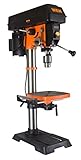
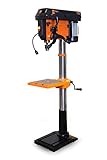
A drill press gives you three useful forms of control: the spindle stays perpendicular to the table, the depth stop limits travel, and the work can be held against a fence or clamped in a jig. Once the setup is correct, each hole follows the same path.
A handheld drill can make accurate holes, but it needs help. A square, drill guide, template, or shop-made jig can keep the drill vertical. Even then, side pressure and bit wandering are common. The first hole may be acceptable while the tenth is slightly angled or a fraction of an inch off.
For ordinary woodworking, a drill press with a 2-inch to 3-inch quill travel covers most boring tasks. A depth stop is particularly valuable for holes that must stop short of the opposite face. Without one, it is easy to break through thin stock or make a row of holes with visibly different depths.
Drill Press vs. Handheld Drill
| Factor | Drill press | Handheld drill |
|---|---|---|
| Hole accuracy | Very good after setup; stays square and repeatable | Fair to good, depending on the operator and guide |
| Repeated depth | Easy with a depth stop | Requires a stop collar, tape mark, or careful observation |
| Workpiece size | Limited by throat depth and table size | Can reach large panels and installed parts |
| Setup time | Longer initially, faster for a batch | Almost none for a small job |
| Portability | Stationary and requires floor or bench space | Portable and useful anywhere |
| Typical failure | Fence or jig shifts; bit speed is wrong | Angled holes, wandering entry, inconsistent spacing |
When a Drill Press Is Worth Buying
Buy a benchtop drill press for woodworking when repetitive accuracy matters more than portability. This includes drilling mortises with overlapping holes, making dowel joints, boring hinge cups, drilling shelf-pin rows, and preparing repeated parts for chairs, cabinets, or boxes.
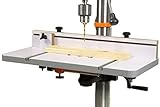
The biggest advantage is not simply that the bit is vertical. It is that the machine turns a measurement into a repeatable motion. A stop block can position the end of every workpiece. A fence can set the distance from an edge. A depth stop can produce identical blind holes. If you are making 30 parts, these features save more time than the drill’s faster setup on the first part.
Look for a table that tilts only if you need angled holes; otherwise, a solid square table is preferable. A 10-inch or 12-inch swing is enough for many furniture tasks. Variable speed is useful because large bits need slower speeds than small twist bits. A chuck that accepts bits up to 1/2 inch covers common woodworking bits, while a 3/8-inch chuck is adequate for lighter work.
Do not assume a larger motor fixes poor setup. A loose quill, inaccurate depth stop, or table that is not square can produce worse results than a carefully used handheld drill. Check that the table locks firmly and that the chuck has minimal wobble. Excessive runout leaves oversized holes, especially with small bits.
When a Handheld Drill Is Enough
Keep using a handheld drill when the job involves only a few holes, large panels, installed cabinets, or workpieces that cannot fit between a drill press column and spindle. It is also the sensible choice for pilot holes, driving screws, and drilling through-holes where the exit side will be hidden.
A handheld drill is often fine for shelf pins if you are making a small bookcase. Mark a centerline, use a brad-point bit, and clamp a guide block with a hole bored square through it. The block gives the bit a short bearing surface and prevents the usual angled entry. For a longer row, use a plywood template with accurately spaced holes rather than measuring every hole independently.
For deeper holes, wrap masking tape around the bit as a visual depth mark. This is inexpensive but not as reliable as a mechanical stop. A stop collar is better, provided it is tightened securely and does not catch on the workpiece. A handheld drill guide can improve vertical accuracy, but inexpensive guides may have play. Test one on scrap before trusting it on a finished cabinet.
Speed, Bits, and Workholding
Repetitive holes magnify small setup errors, but they also magnify heat and tear-out. Use brad-point bits for clean starts in solid wood and plywood. Forstner bits make flat-bottomed holes but create considerable heat if run too fast or forced into the work. A 1-inch Forstner bit typically needs a much slower speed than a 1/4-inch twist bit; follow the bit maker’s speed guidance rather than using one setting for everything.
Clamp the work whenever the bit can grab it. A spinning board can injure you and can also turn a clean hole into a ragged slot. Put sacrificial plywood beneath through-holes to reduce breakout. For blind holes, clear chips periodically, especially in deep holes. Packed chips increase friction and can burn both the bit and the wood.
A Practical Buying Decision
If you make fewer than about 10 similar holes at a time, a handheld drill plus a simple guide is usually the economical answer. If you routinely make 20 or more holes, need matching depth, or build multiple identical parts, a drill press will generally repay its cost in fewer rejects and less measuring.
Choose a drill press stand only if you already have a compatible drill and accept its limitations. It may provide vertical guidance, but it usually lacks the rigidity, depth control, and smooth quill action of a real drill press. For regular furniture work, a complete machine is the more dependable upgrade.
The cheapest option is fine when the hole is hidden, tolerances are loose, and the workpiece is awkward or oversized. Buy or use a drill press when repeatability is part of the finished result—not merely when you want a more powerful way to make one hole.