How to Check Drill Press Spindle Runout for Woodworking
What's inside
As an Amazon Associate I earn from qualifying purchases. This post may contain affiliate links at no extra cost to you.
Contents
Why check drill press spindle runout?
Runout is the amount the spindle or chuck wanders sideways as it rotates. Excessive runout can make a bit cut an oversized or ragged hole, leave a poor finish, or wobble enough to be unsafe. It matters most for small bits, precise dowel holes, and repeatable joinery. A little movement is normal, and a runout reading by itself does not prove the drill press is faulty: the chuck, arbor, spindle taper, or measuring setup may be responsible.
For ordinary woodworking, a clean, sharp bit and a sound chuck often matter more than chasing the smallest possible number. Check runout when a bit visibly wobbles, holes are consistently oversized, or you are comparing machines before buying. Measure near the chuck and, if possible, directly on the spindle taper to help locate the source.
Tools and setup
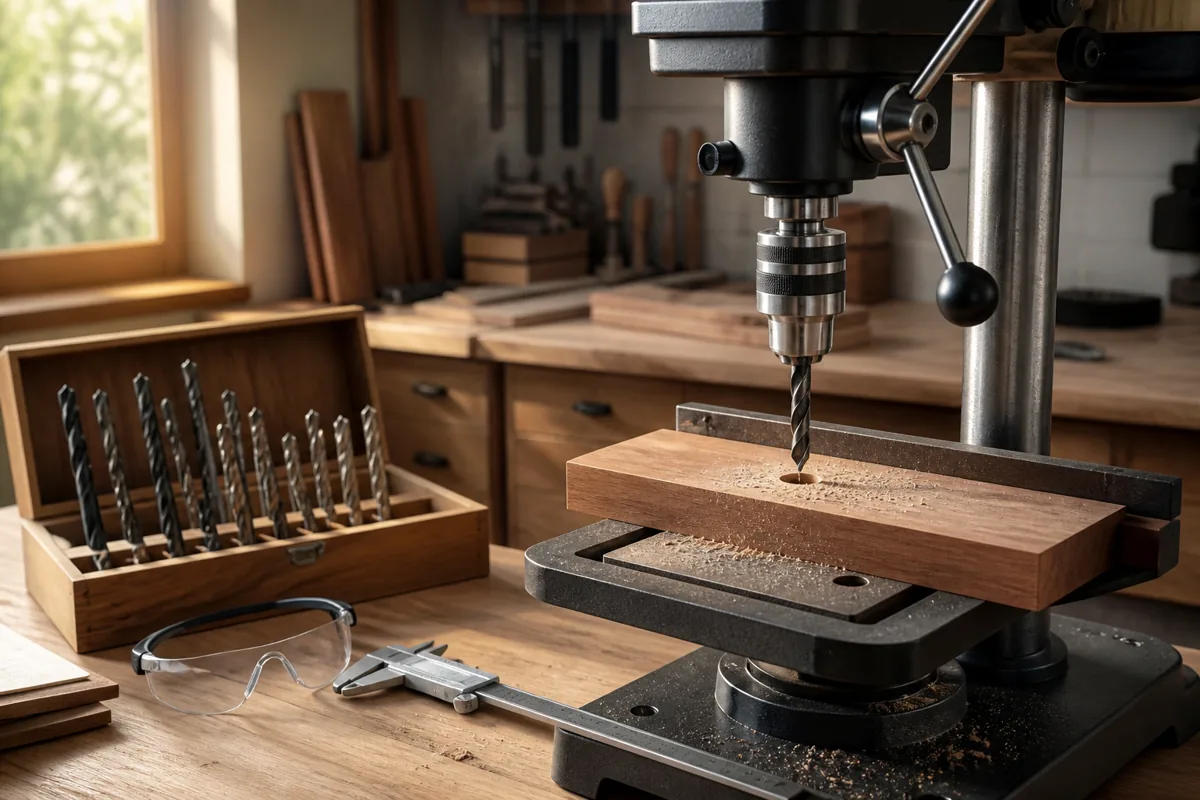
Use a dial indicator with a magnetic base or a rigid clamp, plus a straight, smooth test pin that fits the chuck. A 1/4-inch precision ground pin is a practical choice; a drill bit shank can work for a rough check, but flutes, wear, or a bent shank can mislead you. Look for a dial indicator and magnetic base if you do not already have one. A basic indicator is enough for woodworking diagnosis; a costly inspection-grade set is rarely necessary for a home shop.
Unplug the drill press before installing the indicator or changing the setup. Lower the quill, lock the table, and remove dust and pitch from the chuck and taper area. The indicator base must be fixed to the table or column, not held by hand. Bring the indicator tip against the test surface at roughly a right angle, with slight preload. Keep the setup clear of belts and other moving parts.
Measure runout at the chuck
Install the test pin in the chuck and tighten it firmly. Put the indicator tip against the pin close to the chuck jaws, then rotate the spindle slowly by hand through one full turn. Do not use the motor. Note the highest and lowest readings; the total indicator reading (TIR) is the difference between them. For example, readings from 0.001 to 0.004 inch give a TIR of 0.003 inch.
Repeat the measurement with the pin projecting farther from the chuck, perhaps 2 inches below the jaws. A larger reading farther out can point to a bent pin, a pin clamped off-center, or angular error in the chuck. Rotate the pin a quarter turn in the jaws and measure again. If the high point follows the pin, the pin may be bent. If it stays at the same spindle position, the chuck or spindle assembly is more likely involved. Re-seat and tighten the pin before drawing a conclusion.
What readings mean
There is no single runout limit that applies to every drill press, chuck, and woodworking task. As a practical shop guide, around 0.001–0.003 inch TIR at a short test pin is good for many woodworking jobs. Around 0.005 inch may still be usable for general drilling, especially with larger bits, but can show up with small bits or tight-fitting joinery. Readings above roughly 0.010 inch deserve investigation before you blame the machine or accept it for precision work.
These are diagnostic ranges, not manufacturer tolerances. A low-cost chuck can contribute more runout than the spindle, and a long pin amplifies small angular errors. For a bench built around furniture joinery or small-diameter bits, a more repeatable chuck and careful setup may be worthwhile. For rough clearance holes, spending heavily to improve a few thousandths may not change the result.
Compare the test points
| Test point | What it checks | Common limitation |
|---|---|---|
| Smooth test pin in chuck | Combined runout from chuck, arbor, spindle, and pin | Chuck jaws can clamp a pin off-center |
| Spindle taper or arbor surface | Helps isolate spindle and arbor condition | Requires access and a suitable smooth surface |
| Actual drill bit | Shows the working setup you will use | Bit shanks and cutting edges may not be straight |
If your drill press has a removable chuck, a careful taper check can help separate chuck error from spindle error. Remove the chuck and inspect the taper for rust, dust, or raised burrs; do not sand or file a precision taper. Measure a clean, accessible cylindrical arbor surface if one is present. A reading that is low at the arbor but high at the test pin points toward the chuck or its seating. A damaged taper or spindle is a service issue, not a reason to force parts together.
Common causes and fixes
Start with the cheap fixes. Clean mating tapers, reseat the chuck according to the machine instructions, and test again. Tighten the chuck with its key in each available socket position if the chuck design permits; uneven jaw wear can affect centering. Check the test pin on a flat surface by rolling it, or substitute another known-straight pin. Never strike a chuck or spindle to “straighten” it.
If runout remains high, inspect for a worn chuck, bent arbor, damaged spindle taper, or quill looseness. A replacement chuck can improve results when the spindle is sound, but chuck compatibility matters: check the arbor or taper specification and the drill press manufacturer’s instructions before buying. Compare a replacement drill press chuck only after identifying the mounting type. A bargain chuck may be adequate for general shop drilling; for small bits and repeatable joinery, a better-made chuck is easier to justify.
When to adjust, repair, or replace
Do not replace a drill press based on one high reading. Confirm it with a second pin, repeat the test close to the chuck, and inspect the taper and chuck seating. If the chuck is the source, replacing it is usually cheaper than replacing the machine. If the spindle taper is damaged, the quill has noticeable side play, or runout is high even on a clean spindle surface, repair may be uneconomical on an entry-level press.
When shopping for a used machine, bring a dial indicator if the seller allows it, or at least check for visible wobble with a straight pin at low speed. Ask whether the chuck and arbor are original and whether the quill has been serviced. A machine that drills square, holds its table securely, and has acceptable runout for your work is often a better buy than one with a premium label and unknown wear.