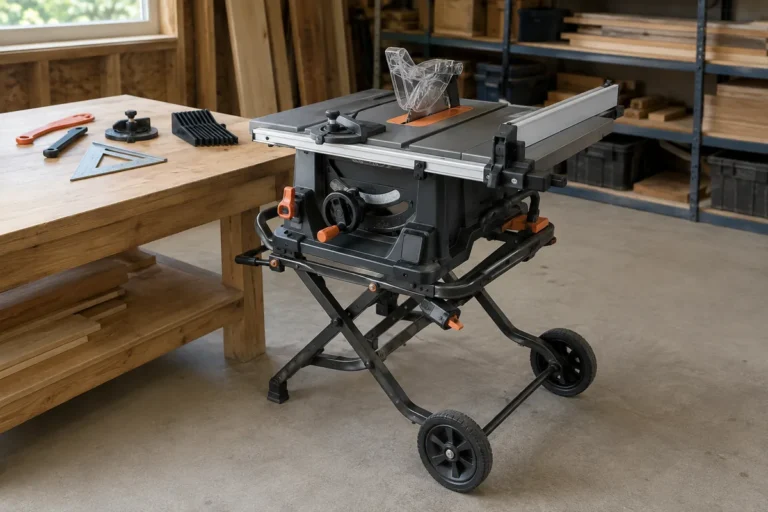
Flat-Belt vs Poly-V-Belt Drive on a Stationary Table Saw
What's inside
As an Amazon Associate I earn from qualifying purchases. This post may contain affiliate links at no extra cost to you.
A stationary table saw can use a flat belt or a poly-V belt between the motor and arbor. The belt type affects vibration, noise, grip and replacement cost, but it does not determine cutting accuracy by itself. Pulley alignment, belt condition, motor mounts and blade balance matter just as much.
As an Amazon Associate we earn from qualifying purchases at no extra cost to you.

Contents
How the belts differ
A flat belt has a broad, smooth contact surface. It runs on matching flat or slightly crowned pulleys, and its grip comes from belt tension and the contact area. A poly-V belt is also broad, but has several lengthwise ribs that engage matching grooves in the pulleys. The ribs provide grip without requiring as much belt width.
Both types can work well on a table saw. A belt that matches the saw’s pulley profile and length is the right starting point; a flat belt cannot simply be substituted for a ribbed one, or vice versa. Check the parts diagram or the markings on the existing belt before ordering.
Flat belt vs. poly-V belt
| Factor | Flat belt | Poly-V belt |
|---|---|---|
| Grip | Depends on correct tension and pulley contact | Ribs engage pulley grooves for traction |
| Vibration | Can run smoothly when aligned and in good condition | Can run smoothly; damaged ribs or a poor match can cause roughness |
| Replacement | May be harder to find in the exact size or construction | Often available by rib count and length, but those dimensions must match |
| Best fit | Saws designed around flat pulleys | Saws designed around ribbed pulleys |
| Main risk | Slip, tracking trouble or excessive tension | Wrong rib profile or count, or a belt that rides incorrectly in the grooves |
What matters during a cut
On a typical 10-inch saw, the motor may run around 3,450 rpm while the arbor runs at a lower speed determined by the pulley sizes. The belt has to transmit that power without slipping when the blade enters hardwood. A loose belt may squeal or let the blade slow under load. An over-tight belt can load the motor and arbor bearings, shortening their service life.
Vibration is often blamed on the belt when the real cause is a dirty or unbalanced blade, a pulley with built-up sawdust, a bent arbor, or a motor mount that has shifted. Before buying a belt to cure vibration, unplug the saw, inspect the pulleys and belt, and check that the blade is clean and seated correctly. A new belt will not fix a bent shaft or loose bearing.
Flat belts can be quiet and smooth, but some designs need more careful tracking and tension. Poly-V belts tend to stay engaged under load, though worn ribs, debris in the grooves or pulley misalignment can make them run unevenly. Neither type is automatically quieter or more accurate across all saws.
Choosing a replacement belt
Use the belt type specified for the saw. Record the belt’s printed part number, length and rib count if present, and compare them with the manufacturer’s parts list. If the markings are unreadable, measure the old belt and identify the pulley profile; a belt that is close in length but wrong in profile can ride high, bottom out or slip.
For a saw designed for a flat belt, choose a replacement flat belt of the specified dimensions and construction. For a ribbed drive, match the rib count, profile and length. Avoid choosing solely by a generic “table saw belt” listing. If the original belt is damaged beyond identification, the saw’s manual or parts diagram is safer than guessing from a photograph. Search listings by the actual specifications, such as replacement flat drive belts or poly-V table saw belts, then confirm compatibility before ordering.
Installation and checks
Disconnect power before opening the belt guard or adjusting the motor. Follow the saw’s instructions for motor position and tension; there is no universal deflection measurement that fits every drive. As a general check, the belt should not feel slack, but it should not be stretched drum-tight. If the motor uses a pivoting mount, its weight may set tension automatically.
Inspect pulleys for wobble, cracks, worn grooves and sawdust packed into the belt path. Align pulley faces according to the manufacturer’s guidance, then turn the blade by hand to check that the belt tracks consistently. Refit the guard before running the saw. Start it briefly with no workpiece and listen for chirping, squealing or rhythmic knocking. Stop immediately if the belt walks off, smokes or produces strong new vibration.
Which should you choose?
If you are replacing a belt, buy the type the saw was designed to use. Converting a flat-belt saw to poly-V, or the reverse, means changing pulleys and checking alignment and speed; it is rarely a sensible upgrade for a home shop saw. The conversion can cost more than the improvement is worth.
If you are choosing between otherwise comparable used saws, do not pay a premium just because one has a poly-V belt. Look instead for a straight arbor, sound bearings, stable motor mounts, available replacement parts and a blade that runs without excessive vibration. A correctly sized, intact flat belt is entirely adequate for ordinary woodworking. Replace it when it is cracked, glazed, frayed, stretched or slipping—not simply because another belt style sounds more modern.