Best Blackout Curtains for Better Sleep
What's inside
- Best Blackout Curtains for Better Sleep: Which Type Should You Choose?
- Best choices by situation
- What matters most when comparing blackout curtains
- Comparison: common blackout curtain types
- Size panels for useful coverage, not just a window match
- Decision matrix: match the curtain to the room
- Ownership details that are easy to overlook
- Best Blackout Curtains for Better Sleep: Which Type Should You Choose?
- Best choices by situation
- What matters most when comparing blackout curtains
- Comparison: common blackout curtain types
- Size panels for useful coverage, not just a window match
- Decision matrix: match the curtain to the room
- Ownership details that are easy to overlook
As an Amazon Associate I earn from qualifying purchases. This post may contain affiliate links at no extra cost to you.
Contents
- Best Blackout Curtains for Better Sleep: Which Type Should You Choose?
- Best choices by situation
- What matters most when comparing blackout curtains
- Comparison: common blackout curtain types
- Size panels for useful coverage, not just a window match
- Decision matrix: match the curtain to the room
- Ownership details that are easy to overlook
Best Blackout Curtains for Better Sleep: Which Type Should You Choose?
The best blackout curtains for better sleep are lined, generously sized panels mounted to minimize gaps at the sides and top; for most bedrooms, a medium- to heavy-weight polyester or blended-fabric pair with a separate blackout lining offers the best balance of darkness, insulation, appearance, and upkeep.
“Blackout” on a label does not guarantee a fully dark room. The fabric can block light while uncovered edges, a center seam, or a rod mounted too far from the wall still let it in. Choose by the room’s light exposure, window dimensions, and whether you also want warmth or a softer, quieter feel.
As an Amazon Associate we earn from qualifying purchases at no extra cost to you.
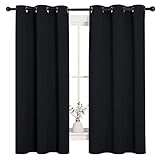


Best choices by situation
- For maximum darkness: Choose blackout-lined panels with a wide width and a wraparound or ceiling-mounted track. Add a side-return or overlap so the edges cover the wall beyond the frame.
- For a cold or drafty bedroom: Look for a dense, lined curtain that reaches close to the floor. A thermal backing can reduce heat transfer through the window, though it will not replace proper window sealing.
- For a small budget or rental: Consider ready-made polyester panels and a standard rod. Prioritize enough fabric width and a high mounting position; a budget panel that fits well can outperform an expensive one with exposed gaps.
- For a polished look: Pick a decorative face fabric with a sewn-in lining. It usually hangs more naturally than a stiff, rubbery blackout coating and keeps the functional layer out of sight.
- For a shallow window recess: Use an outside-mounted rod or track rather than a tension rod inside the frame. This gives the fabric room to cover the edges.
What matters most when comparing blackout curtains
Light blocking and edge coverage
Blackout fabric typically has an opaque lining, a coated reverse, or a tightly constructed multilayer weave. The lining is often the most useful clue, but the panel’s construction and fit matter just as much. A light-colored face can still block light if the backing is opaque; dark fabric alone does not guarantee blackout performance.
Measure the window and the area you want covered, not just the glass. For fewer side leaks, extend the curtain beyond the frame on both sides. A wraparound rod or track can bring the panel closer to the wall, while a center overlap helps prevent a bright slit between two panels.
Weight, insulation, and noise
Heavier curtains generally drape more fully and can soften some high-frequency sounds by adding fabric between the room and window. They may also reduce drafts and slow heat transfer. Neither effect makes curtains soundproof or a substitute for insulating glazing, weatherstripping, or wall insulation. Thick, well-fitted curtains with a lining are usually a more sensible choice than relying on fabric weight alone.
Weight affects installation, too. A substantial pair needs a securely anchored rod or track, especially when mounted outside the window trim. Check the maker’s stated panel weight where available, and use wall anchors or studs appropriate to the hardware and wall type.
Mounting style and fabric care
Grommet panels slide easily and create broad folds, but they can leave more light around the rod. Rod-pocket panels have a traditional gathered look but are slower to open and close. Pinch-pleat or hook-and-track styles can look tailored and work well with ceiling tracks, which are useful when you want to cover a wider area or reduce light above the window.
Check the care label before buying. Some lined curtains are machine washable; others need gentle cleaning or professional care. Coated backing can crack, peel, or become damaged by high heat, so avoid assuming that a curtain can go in a hot dryer. Dust the top folds and hardware periodically, and open the panels during the day when practical to let the window area air out.
Comparison: common blackout curtain types
| Type | Typical construction | Typical pair width | Best for | Trade-off |
|---|---|---|---|---|
| Blackout-lined decorative panels | Face fabric with sewn-in opaque lining | 80–120 in total | Bedrooms where appearance and light blocking both matter | Bulkier to wash and hang than unlined curtains |
| Coated blackout panels | Fabric with an opaque coating on the reverse | 80–100 in total | Lower-cost setups and rooms where the back is not on display | Backing may be stiff; check care instructions carefully |
| Thermal or insulated curtains | Dense fabric, often with a backing or interlining | 80–120 in total | Drafty windows and bedrooms that need heavier drape | “Thermal” does not always mean fully blackout |
| Ceiling-track curtain panels | Panels suspended from hooks or gliders on a track | Selected to suit track length | Wide windows, wall-to-wall coverage, or a neat, close-to-ceiling fit | Requires careful track placement and secure installation |
These widths are common planning ranges, not guarantees: ready-made sizes vary by brand and region. Confirm whether a listed width applies to one panel or the full pair before ordering.
Size panels for useful coverage, not just a window match
For curtains that look full when closed, aim for a combined panel width around 1.5 to 2 times the width of the rod or track. Use the higher end if you want deeper folds or the curtains will often be closed. Then check the finished length against your chosen mounting height.
Worked sizing example: Suppose your rod spans 60 inches. At 1.5 times fullness, you need 60 × 1.5 = 90 inches of total panel width; at 2 times fullness, you need 120 inches. Two 50-inch panels provide 100 inches total, a reasonable middle ground. If each panel is only 50 inches wide, do not mistake that for 100 inches per panel.
Measure from the top of the rod or track to the desired endpoint. Curtains that just reach the sill may leave light below a window; floor-length panels offer more coverage but should not drag if the floor is dusty or the fabric is likely to be cleaned often. If the window is unusually tall or wide, confirm custom sizing and mounting hardware before choosing the fabric.
Decision matrix: match the curtain to the room
| Situation | Recommended setup | Why it fits |
|---|---|---|
| Bright streetlight or early morning sun | Lined panels, outside mount, wraparound rod or track | Addresses both fabric transparency and edge leaks |
| Cold window in a bedroom used nightly | Heavy lined panels, full-height coverage, secure hardware | More fabric can help soften drafts and improve comfort |
| Rental with limited drilling | Ready-made panels on an approved existing rod; verify rod capacity | Keeps installation simple without sacrificing panel width |
| Wide window or glass door | Ceiling track or a long, well-supported rod with multiple panels | Supports broader coverage and makes daily opening easier |
| Frequent washing needed | Machine-washable lined fabric with clear care instructions | Avoids buying a coating or lining that cannot tolerate routine care |
Ownership details that are easy to overlook
Before ordering, check the panel count, finished dimensions, lining description, and cleaning method. “Pair” may mean two panels, while some listings price or size a single panel. Also confirm that the rod, brackets, and wall fasteners can support the combined curtain weight.
Common problems are sizing panels to the glass instead of the rod, placing the rod too close to the frame, and choosing a stiff coated curtain without checking how it hangs. If full darkness is essential, consider a snug-fitting shade behind the curtains or side channels designed to reduce gaps. The curtain fabric can block light; only the complete installation can address the room’s remaining leaks.