Best 12-Inch Home Subwoofers for Deep Bass
What's inside
- Best 12-Inch Home Subwoofers for Deep Bass (2026 Picks)
- Quick Spec Comparison
- Match the Subwoofer to Your Room
- Amplifier Power: What the Wattage Numbers Actually Mean
- Home Theater vs. Music: Pick by Low-Frequency Extension
- Decision Matrix
- Placement and Setup: Getting the Extension You Paid For
- Ownership Realities
- FAQ
- Best 12-Inch Home Subwoofers for Deep Bass (2026 Picks)
- Quick Spec Comparison
- Match the Subwoofer to Your Room
- Amplifier Power: What the Wattage Numbers Actually Mean
- Home Theater vs. Music: Pick by Low-Frequency Extension
- Decision Matrix
- Placement and Setup: Getting the Extension You Paid For
- Ownership Realities
- FAQ
As an Amazon Associate I earn from qualifying purchases. This post may contain affiliate links at no extra cost to you.
Contents
- Best 12-Inch Home Subwoofers for Deep Bass (2026 Picks)
- Quick Spec Comparison
- Match the Subwoofer to Your Room
- Amplifier Power: What the Wattage Numbers Actually Mean
- Home Theater vs. Music: Pick by Low-Frequency Extension
- Decision Matrix
- Placement and Setup: Getting the Extension You Paid For
- Ownership Realities
- FAQ
Best 12-Inch Home Subwoofers for Deep Bass (2026 Picks)
The best 12 inch home subwoofer for most rooms is the SVS PB-1000 Pro — it reaches a genuine 17 Hz, pairs a 325W RMS amp with a ported cabinet tuned for output, and costs less than most competitors with comparable extension. But the right pick depends on your room size and what you’re watching: sealed boxes win for music in small rooms, ported designs win for home theater impact in medium-to-large spaces. Here’s how the top options compare.
Quick Spec Comparison
| Model | Type | Amp Power (RMS) | Rated Low End | Cabinet (H×W×D) | Weight | Best For |
|---|---|---|---|---|---|---|
| SVS PB-1000 Pro | Ported | 325W | ~17 Hz | 18.9×15×20 in | ~65 lb | Home theater, medium-large rooms |
| SVS SB-1000 Pro | Sealed | 325W | ~24 Hz | 13.5×13×14.8 in | ~26 lb | Small rooms, music-first setups |
| Rythmik F12 | Sealed, servo | 370W | ~14 Hz (custom EQ) | ~16×16×17 in | ~65 lb | Critical music listening |
| Klipsch SPL-120 | Ported | 300W | ~24 Hz | ~18.9×14×17.7 in | ~45 lb | Value home theater, horn-loaded speaker systems |
| Polk HTS 12 | Ported | 200W | ~28 Hz | ~16.6×15.1×16.1 in | ~40 lb | Budget setups, small-medium rooms |
| ELAC Debut 2.0 SUB3030 | Sealed + passive radiator | 250W | ~25 Hz | ~17×17.5×17.5 in | ~49 lb | App-driven EQ, compact footprint |
Numbers are manufacturer-published figures; real-world in-room extension typically runs a few Hz deeper thanks to room gain, especially below 30 Hz.
As an Amazon Associate we earn from qualifying purchases at no extra cost to you.

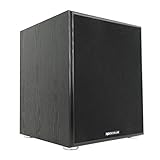
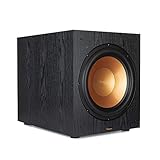

Match the Subwoofer to Your Room
Room size is the single biggest factor in choosing a 12-inch sub — more important than the driver itself. A ported 12 that over-pressurizes a 10×10 bedroom sounds bloated; a sealed 12 in a 500-square-foot open-plan living room runs out of steam on movie nights.
- Under ~1,500 cubic feet (typical bedroom or den, up to ~12×14 ft): a sealed 12 like the SB-1000 Pro or Rythmik F12 is ideal. Sealed boxes roll off gently (~12 dB/octave), which pairs naturally with the boost small rooms give low frequencies.
- 1,500–3,000 cubic feet (standard living room, ~15×20 ft): this is the sweet spot for a ported 12 such as the PB-1000 Pro or SPL-120. Port gain doubles output near tuning frequency, filling the volume without pushing the amp into clipping.
- Over ~3,000 cubic feet or open floor plans: a single 12 will strain. Either step up to a 15-inch or run two 12s — dual subs also smooth out seat-to-seat bass response, which a single sub can’t do regardless of size.
Amplifier Power: What the Wattage Numbers Actually Mean
Ignore peak wattage — the RMS (continuous) figure is what determines clean output before compression or distortion. In this class, RMS ratings run 200–370W, and the differences matter less than you’d think because driver excursion, not watts, usually limits deep-bass output. A 325W amp feeding a long-throw 12-inch driver will outperform a 400W amp behind a short-throw woofer at 20 Hz.
What to look for instead:
- Class D amplification — standard now, efficient and cool-running.
- App or DSP control — the SVS and ELAC models let you tune crossover, phase, and parametric EQ from your phone, which is worth real money versus fixed knobs you’ll never adjust correctly by ear.
- Servo feedback (Rythmik) — a sensing coil measures cone motion and corrects it, cutting distortion roughly in half at demanding levels. It costs more and adds weight, but it’s the closest thing to measured accuracy in a consumer sub.
Home Theater vs. Music: Pick by Low-Frequency Extension
For movies, extension below 25 Hz is what produces the physical slam in explosions and LFE tracks — that’s where ported subs earn their size. The PB-1000 Pro reaching ~17 Hz covers essentially all movie content; a sub rated to 28 Hz will audibly roll off on films mixed for infrasonic bass.
For music, almost nothing below ~30 Hz exists outside of pipe organ and electronic genres, so sealed subs’ tighter transient response and lower group delay matter more than raw extension. The Rythmik F12 is the enthusiast pick here; the SB-1000 Pro is the budget-friendlier version of the same idea.
Decision Matrix
| Your Situation | Pick | Why |
|---|---|---|
| Movie nights in a ~15×20 ft living room, budget ~$600–800 | SVS PB-1000 Pro | Deepest extension per dollar; app EQ handles room peaks |
| Bedroom or apartment, neighbors matter | SVS SB-1000 Pro | Compact, sealed control, less port chuff or wall-shaking output |
| 2-channel music system, accuracy over slam | Rythmik F12 | Servo control, lowest measured distortion in class |
| First sub, tight budget under ~$400 | Polk HTS 12 | Adequate output; upgrade path is adding a second one later |
| Small footprint, want room EQ without measuring gear | ELAC SUB3030 | Auto-EQ via phone mic built into the app |
Placement and Setup: Getting the Extension You Paid For
Placement affects in-room bass more than any spec on the box. A practical sequence:
- Do the subwoofer crawl. Put the sub at your main seat, play bass-heavy content, crawl the room perimeter, and mark where bass sounds fullest. Put the sub there — corners give ~6 dB free output but often excite boomy modes; along-wall midpoints are smoother.
- Set the crossover at 80 Hz in your AVR and let the receiver handle bass management. Setting it lower “to blend better” usually leaves a gap your mains can’t fill.
- Run room correction, then trim. After Audyssey/Dirac/YPAO, check the sub trim — if it landed below −6 dB, raise the sub’s gain knob and re-run so the AVR isn’t boosting a noisy signal.
- Level-match, don’t max. Use an SPL meter or app: the sub should measure ~3–5 dB hotter than your speakers at the seat. Cranking the gain knob to max causes amp clipping on transients, which is the most common way these subs get damaged.
Ownership Realities
- What wears first: the foam or rubber surround (10–15 years in normal use), and amp capacitors in cheap plate amps. Servo designs add electronics but Rythmik’s plate amps have a solid longevity record.
- Port noise: ported subs chuff when pushed near max output below ~20 Hz. If you hear it, back off 2–3 dB or engage the low-cut rather than blaming the driver.
- Isolation matters: on suspended wooden floors, decouple the cabinet with isolation feet or a granite pad — otherwise room rattles get mistaken for distortion.
- Common mistake: buying one large sub for an open-plan space instead of two smaller ones. Two modest 12s placed apart almost always beat one premium sub on evenness of bass across seats.
FAQ
Is a 12-inch subwoofer enough for a large living room?
For a sealed room up to ~3,000 cubic feet, yes — a good ported 12 like the PB-1000 Pro fills it at movie levels. Beyond that, or in open floor plans, plan on dual subs or a 15-inch.
Ported or sealed for mixed music and movies?
Ported, if you watch a lot of movies — the extra output below 25 Hz is hard to give up once you’ve heard it, and modern DSP keeps ported subs tight enough for music. Choose sealed only if music is clearly the priority or space is tight.
How much should I spend?
Meaningful deep-bass extension starts around $400–500. Below that, most 12-inch subs are really 30 Hz speakers in a big box. The $600–900 tier is where genuine 17–20 Hz performance lives; above ~$1,200 you’re paying for output headroom that mainly benefits large rooms.
Do I need the app-controlled models?
Not strictly, but parametric EQ and variable phase from your seat solve real problems (a 10 dB room peak at 45 Hz is common) that fixed knobs can’t. If your AVR has good room correction already, you can skip the app features and save money.