Armor B7-IL Auto-Adjust In-Line T-Track Clamp Review
What's inside
- Armor B7-IL Auto-Adjust In-Line T-Track Clamp Review
- What the B7-IL is designed to do
- Automatic adjustment range: the feature that matters most
- Holding force and pressure control
- T-track compatibility: check the slot before buying
- Handle clearance and ergonomics
- Build quality and ownership realities
- Who should buy the Armor B7-IL?
- Verdict
- Armor B7-IL Auto-Adjust In-Line T-Track Clamp Review
- What the B7-IL is designed to do
- Automatic adjustment range: the feature that matters most
- Holding force and pressure control
- T-track compatibility: check the slot before buying
- Handle clearance and ergonomics
- Build quality and ownership realities
- Who should buy the Armor B7-IL?
- Verdict
As an Amazon Associate I earn from qualifying purchases. This post may contain affiliate links at no extra cost to you.
Contents
- Armor B7-IL Auto-Adjust In-Line T-Track Clamp Review
- What the B7-IL is designed to do
- Automatic adjustment range: the feature that matters most
- Holding force and pressure control
- T-track compatibility: check the slot before buying
- Handle clearance and ergonomics
- Build quality and ownership realities
- Who should buy the Armor B7-IL?
- Verdict
Armor B7-IL Auto-Adjust In-Line T-Track Clamp Review
The Armor B7-IL Auto-Adjust In-Line T-Track Clamp is a good choice when you need fast, repeatable clamping in a T-track but do not want to stop and reset a threaded clamp for every workpiece; it is less compelling for heavy-duty edge-gluing or unusually deep work.
Its main advantage is the automatic adjustment mechanism. Instead of winding the clamp screw through the full distance between the track and the work, you position the clamp near the material, let the mechanism take up the slack, and then apply final pressure with the handle. That makes the B7-IL particularly useful for jigs, router tables, drill-press fixtures, and repeated cuts where workpiece thickness changes within a moderate range.
As an Amazon Associate we earn from qualifying purchases at no extra cost to you.

What the B7-IL is designed to do
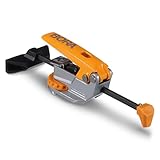
The B7-IL is an in-line clamp: the pressure pad, body, and track fastener work along the same general axis. This keeps the clamp relatively compact and leaves less hardware projecting sideways than a traditional hold-down with a long arm. The trade-off is that it needs a suitable T-track position directly beneath or alongside the area being clamped.
The clamp is intended for standard woodworking T-track workholding rather than metalworking or high-force fabrication. It is best viewed as a quick-positioning accessory that supplements ordinary track clamps, toggle clamps, and bench dogs.
| Evaluation point | Practical result | Why it matters |
|---|---|---|
| Adjustment method | Automatic coarse adjustment plus threaded final tightening | Reduces repositioning time between workpieces |
| Track requirement | Compatible with common 3/4-inch T-track systems when the supplied fastener fits the slot | Track-slot dimensions vary, so compatibility should be checked before purchase |
| Useful material range | Best suited to approximately 1/2 to 2-1/2 inches of combined workpiece and fixture height | Gives enough room for common boards, templates, and jigs without excessive screw travel |
| Handle clearance | Allow roughly 3 inches of operating space above the clamp handle | Important beneath router tables, shelves, and enclosed fixtures |
| Construction | Metal clamp body, threaded steel hardware, and replaceable or removable contact pad | More durable than plastic-bodied quick clamps, but exposed threads need maintenance |
| Best use frequency | Repeated setup and teardown, from several cycles per session to daily shop use | The automatic adjustment has its greatest value when the clamp is moved often |
The dimensional figures above are working-planning figures rather than a substitute for the current Armor Tool instruction sheet. Measure the track slot, fixture thickness, and available clearance before installing a permanent track.
Automatic adjustment range: the feature that matters most
The automatic adjustment is useful because it separates two jobs that a conventional screw clamp combines: reaching the work and applying pressure. With a standard clamp, a large thickness change means winding the screw several turns or sliding the clamp to a new position. The B7-IL can be brought close to the work more quickly, then tightened for the final hold.
Its range should not be interpreted as unlimited. The mechanism works best when the clamp is positioned reasonably close to the material. If the gap is near the end of the available travel, the clamp may feel less convenient than a long screw clamp, and the final tightening portion becomes relatively small. A good setup leaves enough thread engagement for firm pressure while avoiding a nearly bottomed-out or barely engaged mechanism.
A simple fit check
Suppose a fixture is 18 mm thick and the workpiece is 32 mm thick. Their combined height is 50 mm, or about 2 inches. Add a thin sacrificial pad and a small allowance for positioning, and the clamp still sits comfortably inside the practical working range shown above. If the combined height rises to 70 mm, or about 2-3/4 inches, the clamp may still be usable depending on the exact track and hardware arrangement, but it leaves less adjustment margin.
For workpieces that vary from 20 to 45 mm in thickness, one B7-IL can cover a 25 mm variation without repeatedly resetting a conventional clamp. That is where the automatic system pays for itself in time rather than in maximum clamping force.
Holding force and pressure control
The B7-IL should provide ample holding force for routing templates, sanding fixtures, drill-press stops, and assembly aids when the track is properly installed. Its threaded final adjustment also gives better pressure control than a basic spring clamp. You can stop as soon as the work is secure instead of relying on a fixed spring load.
It is not the right tool for using brute force to correct a warped board or substitute for proper joinery clamping. Excessive tightening can compress soft pine, dent a finished surface, strip a track fastener, or pull a lightly mounted T-track out of its substrate. Use a flat pressure pad or a scrap of hardwood when the workpiece is delicate.
For routing, holding force is only part of the equation. The T-track must be anchored to a sufficiently thick, flat base, and the cutter’s feed direction must not tend to lift or rotate the workpiece. Two clamps placed on opposite sides of a fixture are often safer and more stable than one clamp tightened harder.
T-track compatibility: check the slot before buying
“T-track compatible” does not mean universally compatible. T-track systems differ in slot width, slot depth, entry opening, and the size of the sliding nut or bolt head. The B7-IL is most likely to suit common 3/4-inch woodworking T-track, but the actual fastener must pass through the track opening and then rotate or slide beneath the lips without binding.
- Measure the track’s top opening, not just its outside width.
- Check whether the supplied fastener uses a T-nut, a sliding nut, or a T-bolt.
- Confirm that the track is deep enough for the fastener head.
- Leave room for the clamp body to slide into position before tightening.
- Do not force a mismatched fastener; damaged track lips are difficult to repair.
If your table uses a proprietary or unusually narrow track, plan on replacing the fastener with a correctly sized compatible one only if the clamp’s thread size and shoulder geometry allow it. A random hardware-store bolt may fit the thread but still fail to seat correctly in the track.
Handle clearance and ergonomics
The in-line layout is a practical advantage in crowded fixtures. Compared with a clamp that swings through a large arc, the B7-IL needs less lateral clearance. That makes it easier to use around router-table fences, drill-press columns, and narrow assembly jigs.
Vertical clearance still matters. The tightening handle needs room to rotate, and a low shelf or fence can prevent a full turn. Allowing approximately 3 inches above the handle is a sensible planning margin. If that space is unavailable, the clamp may still work through partial turns, but adjustment becomes slow and awkward.
The handle should be tightened with controlled hand pressure. If the handle repeatedly contacts a fence or fixture, relocate the track rather than accepting a compromised grip. A clamp that is technically usable but difficult to tighten is unlikely to be used consistently.
Build quality and ownership realities
The metal construction is appropriate for a shop clamp that will be moved frequently. The parts most likely to show wear are not the main body but the exposed threads, the sliding or automatic-adjustment surfaces, the track fastener, and the contact pad. Dust mixed with lubricant can make the adjustment mechanism sticky, especially near a router table.
Maintenance routine
- Brush or blow wood dust from the threads and moving adjustment surfaces after dusty sessions.
- Wipe the threads with a dry cloth before applying a small amount of light machine oil.
- Inspect the track fastener for burrs that could scrape the T-track.
- Check the pressure pad for hardening, cracks, or embedded grit.
- Store the clamp with the mechanism slightly relaxed rather than fully tightened.
Avoid heavy grease around the automatic mechanism. It can attract abrasive dust and create more resistance than it removes. Also avoid clamping directly onto freshly finished surfaces until you have checked that the pad is clean.
Who should buy the Armor B7-IL?
| Your situation | Recommendation | Reason |
|---|---|---|
| Frequent repeated cuts or drilling operations | Strong fit | Fast repositioning saves time over many cycles |
| Occasional general woodworking on a tight budget | Conditional | A conventional screw clamp may offer more versatility for less money |
| Small router table or crowded jig | Good fit | In-line operation limits side clearance requirements |
| Very thick work or deep edge-gluing | Look elsewhere | A longer-reach or dedicated bar clamp is more suitable |
| Soft woods or finished panels | Good with a protective pad | Controlled tightening reduces damage, but the pad must be clean |
| Nonstandard T-track | Verify first | Fastener fit determines whether the clamp is usable |
Verdict
The Armor B7-IL Auto-Adjust In-Line T-Track Clamp makes the most sense as a speed and repeatability upgrade. Its automatic adjustment reduces setup time, the in-line form works well in confined spaces, and the threaded finish gives useful control over pressure. It is not a replacement for a high-reach clamp, a heavy-duty edge clamp, or a properly engineered fixture.
Buy it when your work involves a compatible T-track, moderate thickness changes, and frequent repositioning. Before ordering, verify the track fastener dimensions and measure the handle clearance. Those two checks matter more than the clamp’s headline feature, because a quick-adjust clamp is only useful when it can actually reach the work and operate freely in your jig.