Kreg AccuCut Review: Circular Saw Guide Performance Compared
What's inside
As an Amazon Associate I earn from qualifying purchases. This post may contain affiliate links at no extra cost to you.
The Kreg AccuCut earns its place in a small-shop toolkit because it delivers most of a track saw’s straight-line accuracy for a fraction of the cost — typically under $70 versus $500 or more for a dedicated track saw — provided you already own a circular saw and take the time to set it up correctly. This review breaks down how it performs on the criteria that actually matter: cut accuracy, rail alignment, maximum cut length, portability, and which saws it fits.
As an Amazon Associate we earn from qualifying purchases at no extra cost to you.



Contents
What the AccuCut Actually Is
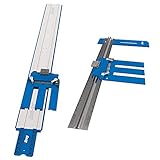
The AccuCut (often searched as “accucut kreg”) is a rail-guided cutting system that clamps a universal sled to the base of almost any circular saw. Unlike Kreg’s simpler Straight Edge Guide, the AccuCut uses two 26.5-inch aluminum track sections that lock together to give you roughly 50 inches of guided cutting — enough to break down a full sheet of plywood crosswise, but not lengthwise on an 8-foot sheet in one pass.
The saw rides in a sled that mates to a blue anti-slip guide strip along the track edge. You make a trim cut the first time you use it, which trims the strip to match your blade position exactly — that edge then becomes your zero-reference line for every future cut.
Setup: What First-Time Users Should Expect
Kreg AccuCut setup takes 20–30 minutes the first time and under two minutes after that. Here’s the process and why each step matters:
- Assemble the track: Join the two rail sections with the steel connectors and tighten the set screws. A loose joint introduces a visible step in long cuts — check the joint by running a finger across it.
- Mount the sled: Slide the saw base into the sled’s clamps, keeping the blade parallel to the guide edge. The clamps accommodate most saw base shapes, including left- and right-blade saws.
- Make the trim cut: Cut through the blue guide strip with a scrap board underneath. This calibrates the strip edge to your exact blade kerf — skip this and your measurements will be off by the blade-to-base distance.
- Mark the strip: From then on, you align the strip edge directly on your cut line. No measuring offset required, which is the biggest workflow advantage over a clamped straightedge.
Common setup mistakes: joining the rails on an uneven surface (misaligns the joint), and clamping the sled while the saw base rocks (the clamps need both contact points seated). Recalibrate the strip if you change blades with a different kerf.
Accuracy and Rail Alignment in Practice
The honest performance picture: across a 4-foot crosscut on 3/4-inch plywood, the AccuCut consistently produces cuts within about 1/32 inch of straight when the rails are joined well. That’s cabinet-adjacent accuracy — good enough for shelving, cabinet carcasses, and panel breakdown, though a dedicated track saw holds tighter tolerances over repeated cuts because its saw-to-track fit is machined rather than clamped.
The weak point is rail deflection. The two-section rail flexes slightly more than a single-piece track, especially near the joint. Laying the track fully supported on the workpiece — not bridging gaps — keeps deflection negligible. The anti-slip strips underneath grip well on smooth plywood but benefit from a clamp on dusty OSB or slick melamine.
AccuCut vs. AccuCut XL vs. a Track Saw
| Feature | Kreg AccuCut | Kreg AccuCut XL | Track Saw (typical) |
|---|---|---|---|
| Max cut length | ~50 in | ~100 in | 55–118 in (per rail) |
| Crosscut full sheet (48 in)? | Yes | Yes | Yes |
| Rip 8-ft sheet lengthwise? | No | Yes | Yes (with rail) |
| Saw included? | No — uses your circular saw | No — uses your circular saw | Yes |
| Splinter-free edge | Near (trimmed strip) | Near (trimmed strip) | Yes (zero-clearance rail) |
| Weight / portability | ~4 lbs, packs flat | ~8 lbs, packs flat | 9–14 lbs saw + rail |
| Typical price range | $50–$80 | $130–$180 | $350–$700+ |
| Setup per cut | Align strip edge to line | Same | Align rail to line |
Saw Compatibility
The universal sled fits most 6.5-inch and 7.25-inch circular saws, corded or cordless, including left-blade and right-blade models from the major brands — DeWalt, Makita, Milwaukee, Ryobi, Craftsman, and Bosch saws generally mount without issue. Exceptions exist: saws with very narrow or heavily sculpted bases may not clamp securely, and worm-drive saws are usually too long and heavy for the sled. Check Kreg’s compatibility notes if your saw has an unusual base shape, and expect a slightly awkward balance with heavier cordless saws running large batteries.
Which Should You Buy? A Decision Matrix
| Your situation | Best fit |
|---|---|
| Occasional plywood breakdown, own a circular saw, budget under $100 | AccuCut |
| Regularly rip 8-ft sheets lengthwise | AccuCut XL |
| Weekly cabinet work, need flawless splinter-free edges and plunge cuts | Track saw |
| Only cut small panels under 24 in | Straight-edge guide or table saw instead |
| Mobile work, carry kit between sites | AccuCut (lightest packable option) |
Cost-per-use math is favorable: at roughly $60, a DIYer breaking down 20 sheets a year pays about $0.30 per sheet-year over a decade of use — versus a track saw that only pencils out if you’re cutting dozens of sheets monthly or selling finished cabinetry.
Durability and Ownership Realities
What wears first is the blue guide strip — it frays gradually at the trimmed edge and loses its zero-reference precision after heavy use, and replacement strips are a genuine consumable cost. The track sections themselves are durable anodized aluminum but can bend if stored leaning in a corner; store flat. Keep the sled’s clamp screws snug — vibration loosens them over a long cutting session, which shifts your cut line mid-project. Sawdust buildup under the anti-slip strips reduces grip, so wipe them before laying the track on finish-grade material.
One realistic limitation: no plunge capability. Your circular saw can’t start a cut mid-panel the way a track saw can, so interior cutouts still require a jigsaw or a started kerf.
Verdict
The Kreg AccuCut is the right tool when you want track-saw-style cuts at straightedge prices and you already own a compatible circular saw. Its roughly 50-inch reach handles the most common task — crosscutting sheet goods — accurately to about 1/32 inch, and the trimmed-strip zero-reference makes repeat cuts fast. Choose the AccuCut XL if you need full-length 8-foot rips, and step up to a true track saw only when splinter-free finish edges, plunge cuts, and daily-use precision justify the five-to-tenfold price jump.