Best Clamp Tables for Secure, Flexible Woodworking Setups
What's inside
- Which clamp table is right for your shop?
- What a clamp table actually does differently
- Clamp table comparison: the four main types
- Compatibility: will your existing clamps work?
- Decision matrix: pick by situation
- What wears out first (and how to make it last)
- A quick cost-per-use sanity check
- Setup tips that save real time
- Bottom line
- Which clamp table is right for your shop?
- What a clamp table actually does differently
- Clamp table comparison: the four main types
- Compatibility: will your existing clamps work?
- Decision matrix: pick by situation
- What wears out first (and how to make it last)
- A quick cost-per-use sanity check
- Setup tips that save real time
- Bottom line
As an Amazon Associate I earn from qualifying purchases. This post may contain affiliate links at no extra cost to you.
Contents
- Which clamp table is right for your shop?
- What a clamp table actually does differently
- Clamp table comparison: the four main types
- Compatibility: will your existing clamps work?
- Decision matrix: pick by situation
- What wears out first (and how to make it last)
- A quick cost-per-use sanity check
- Setup tips that save real time
- Bottom line
Which clamp table is right for your shop?
The best clamp table for most woodworkers in 2026 is a folding steel-frame table with an integrated track or dog-hole grid in the top — it gives you repeatable, square clamping pressure without building a permanent assembly table. But the right pick depends on your space, budget, and how often you clamp up panels versus holding small parts for routing or sanding.
Below, we break down the decision criteria that actually matter, compare the main styles on real specs, and match each type to a specific shop situation.
As an Amazon Associate we earn from qualifying purchases at no extra cost to you.
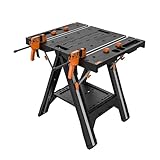


What a clamp table actually does differently
A regular workbench holds weight. A clamp table holds work — vertically, horizontally, and at angles — using a top designed around work table clamps rather than a flat slab you improvise on. The defining features:
- Dog holes or T-track in the top, spaced in a grid (typically 25mm or 20mm holes at 96–100mm spacing, or aluminum tracks at 3–4 inch centers)
- Edge clamping surface — a skirt or channel around the perimeter so a clamp for table-edge work (sanding, routing edges) has something to bite
- Rated load capacity — usually split between static load (what sits on top) and clamping load (force the frame can resist without racking)
- Folding or modular legs — the portability trade-off most listings gloss over
If you’ve been making do with a clamp on table setups — C-clamps hooked onto a random flat surface — you’ll notice two immediate gains: clamping direction is no longer limited to “down,” and thin stock stops bowing because the top is engineered flat, not just flat-ish.
Clamp table comparison: the four main types
| Type | Typical top size | Clamping system | Load capacity | Folded profile | Market price range |
|---|---|---|---|---|---|
| Folding multi-function table (e.g., Worx Pegasus-style) | 31″ × 25″ | Integrated quick-clamps + dog holes for bar clamps | ~300 lbs top / ~1,000 lbs clamped load | ~5″ thick, ~30 lbs | $100–$160 |
| CNC-style dog-hole worktop (e.g., Bora Centipede + dog top) | 24″ × 48″ or 30″ × 48″ | ¾” or 20mm dog holes on grid | 1,500–3,000 lbs static | Table top + folding stand, ~50–60 lbs total | $200–$450 |
| T-track workbench (e.g., Kreg Mobile Project Center-style) | 27″ × 41″ | Aluminum T-tracks + bench dogs + Automaxx-style clamps | ~350 lbs | Folds to ~6″ thick | $200–$350 |
| Assembly/clamping table (e.g., Kreg or Rockler panel tables) | 36″ × 60″ and up | Open frame for face-frame and panel clamps | ~400–600 lbs | Fixed or knock-down legs | $350–$800 |
The numbers that matter most aren’t the static load ratings — a 30-lb folding table rated at 300 lbs tops out because of leg stability, not the work surface. The spec to check is the clamping grid density and hole/track standard, because that determines which clamps you already own will work.
Compatibility: will your existing clamps work?
This is where product listings are vague and buyers get surprised. Three standards dominate:
- 20mm dog holes (Festool/MFT pattern): compatible with Festool clamps, Bessey MFT accessories, most third-party “system” dogs and holdfasts. The tightest ecosystem, and accessories cost more.
- ¾” (19mm) dog holes: the American bench standard. Works with inexpensive bench dogs, Wonder Dogs, and holdfasts. Slightly loose fit for 20mm accessories — don’t mix systems.
- T-track: accepts T-bolts and track-specific hold-downs; machine table clamps and toggle clamps mount directly. Most flexible for jigs, least flexible for deep-reach bar clamps.
If you own standard bar clamps and F-clamps, a dog-hole top wins — F-clamps drop through the holes and clamp vertically through the table plane, which T-track can’t do. If you mostly hold small parts for machining or sanding, T-track with toggle clamps is faster and cheaper.
Decision matrix: pick by situation
| Your situation | Best type | Why |
|---|---|---|
| Apartment / garage with no permanent bench, occasional DIY | Folding multi-function table | Folds behind a door, sets up in seconds, under $160 |
| Serious hobbyist, panel glue-ups and casework | T-track workbench or ¾” dog-hole top | Square clamping reference + room for 24″+ panels |
| On-site work, installs, shared shop space | CNC-style folding stand + dog top | Highest load rating, sets up solo in under a minute |
| Permanent shop building face frames and cabinets weekly | Assembly/clamping table | Open frame accepts face-frame clamps from all sides |
| Mostly routing, sanding, holding small parts | Vice clamp table style (benchtop vise on compact top) | Vise + dogs beats tracks for small-stock grip |
What wears out first (and how to make it last)
Ownership realities that listings don’t mention:
- MDF and melamine tops wear at the dog holes. Repeated clamping in the same holes mushrooms the edges. Rotate your clamping positions and, on MDF tops, expect the top to be a consumable — budget a replacement or a hardwood insert strip every few years of heavy use.
- Folding leg hinges and lock tabs are the first mechanical failure point. Wipe sawdust out of hinge points; grit accelerates wear noticeably.
- T-tracks deform under overtightened bolts. Use a torque-light touch — a T-bolt snugged by hand holds fine; reefing on it pulls the track out of the dado.
- Common mistake: clamping at the table’s edge on a folding model. The cantilevered load can tip the table. Keep clamping force over the leg footprint, or weigh the legs down.
A quick cost-per-use sanity check
A $250 T-track bench used for two glue-ups a week over five years costs roughly $0.48 per clamping session. A $130 folding table at the same use rate costs $0.25 — but only if its ~300 lb rating actually covers your projects. If you’re regularly clamping up 40-lb panels with 300+ lbs of clamp pressure, the cheaper table racks out of square and you’ve paid twice. Match the rating to your real clamping force, not your aspirations.
Setup tips that save real time
- On a dog-hole top, mark a primary fence line with masking tape — clamping against a repeatable reference is faster than re-squaring every panel.
- For a clamp table top edge job (edge banding, flush-trimming), two dogs and one F-clamp beats four clamps for speed.
- On folding models, set the table on a rubber mat — the feet walk sideways under clamping torque on smooth concrete.
Bottom line
For small spaces and mixed DIY, a folding multi-function table covers 90% of needs. For furniture and casework, a ¾” or 20mm dog-hole top is the better long-term buy because it works with the widest range of clamps. Choose your hole standard before you buy the table — the clamps you already own should dictate the grid, not the other way around.