Kreg Accu-Cut Review: Is This Circular Saw Guide Worth Buying?
What's inside
As an Amazon Associate I earn from qualifying purchases. This post may contain affiliate links at no extra cost to you.
The Kreg Accu-Cut is worth buying if you want clean, repeatable cuts with a circular saw you already own—but only if your typical cuts are under about 48 inches. It’s a legitimate budget alternative to a track saw for most cabinet and furniture plywood work, with real limitations around maximum cut length, edge-guide flex on deep cuts, and the occasional alignment fiddliness that listings gloss over.
As an Amazon Associate we earn from qualifying purchases at no extra cost to you.


Contents
What the Kreg Accu-Cut Actually Is
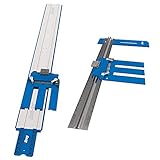
The Kreg Accu-Cut circular saw guide is an aluminum-edge guide system: your circular saw rides in a plastic sled that tracks along a blue guide strip attached to a metal rail. Unlike Kreg’s earlier Rip-Cut (which rides along a factory edge of the sheet), the Accu-Cut clamp-locks to your workpiece at both ends, so it works on cut edges, warped sheet goods, and long rips where the Rip-Cut can’t help. The standard version covers cuts up to about 50 inches; the Kreg Accu-Cut XL uses longer rails to reach roughly 100 inches, which covers full 8-foot sheet goods.
That’s the core pitch: track-saw-like results for a fraction of the $300–$600 a dedicated track saw costs. The question is whether it actually delivers.
Cut Accuracy: Close to a Track Saw, With Caveats
When properly set up, the Kreg Accu-Cut circular saw guide produces cuts within roughly 1/32 inch of dead straight over 4 feet—accurate enough for cabinet carcases, shelves, and furniture panels. The anti-slip pads under the rail grip plywood reasonably well without clamps on flat sheet goods, though clamping takes seconds and removes doubt.
Where it differs from a real track saw:
- Chip-out on the offcut side. The saw’s blade trims the guide strip on first use, creating a zero-clearance edge on the waste side only. The keeper side relies on your blade’s tooth pattern, so a coarse blade on melamine will chip.
- Mid-span flex. On maximum-length cuts the rail can bow slightly if you press sideways. Keep pressure downward, not lateral.
- Square depends on you. A track saw’s rail self-squares to a degree; with the Accu-Cut, you’re marking and aligning to a pencil line. Squaring the rail to a factory edge with a framing square adds 20 seconds and eliminates most crosscut error.
Setup Time: The Honest Number
First-time assembly—attaching the sled to your saw’s baseplate and zeroing the guide strip—takes 15–25 minutes. After that, positioning the rail on a marked line and clamping takes 30–60 seconds per cut, comparable to a track saw. Where you lose time versus a track saw: the rail doesn’t have a splinter strip you can sight along by eye quite as intuitively, and repositioning for bevel cuts requires more care since the sled sits flat on the shoe.
The one-time setup steps that matter most:
- Mount the sled to your saw base. Loosen the sled’s alignment tabs, sit the saw on it, and snug the tabs against the baseplate edges. A misaligned sled is the #1 cause of “inaccurate” Accu-Cut complaints.
- Trim the guide strip. Make one pass along scrap material. This calibrates the blue strip’s edge to your exact blade—after this, the strip edge IS your cut line.
- Mark the sled position. A pencil line on the sled where the saw front sits helps you check for drift mid-cut on long rips.
Saw Compatibility: Fits Most, Not All
The sled accommodates most sidewinder (sidewinder-style) circular saws with flat baseplates up to about 7-1/4 inch blade size—DeWalt, Makita, Milwaukee, Skil, Ryobi, and similar left- and right-blade models generally fit. Saws that give trouble:
- Worm drive saws (Skilsaw 77-style): the wider, offset motor makes these awkward; some fit, many don’t sit level.
- Cordless saws with sculpted baseplates: some compact 6-1/2 inch models have baseplates too short or oddly shaped for the sled tabs to grip evenly.
- Corded 8-1/4 inch saws: often exceed the sled’s baseplate width limits.
Realistic depth of cut with the sled mounted is roughly 1-3/4 inches at 90°—fine for sheet goods and 2x material, but check your saw before assuming it handles thicker stock.
Standard vs. XL: Which to Buy
| Spec | Kreg Accu-Cut (standard) | Kreg Accu-Cut XL |
|---|---|---|
| Max cut length | ~50 in (4 ft) | ~100 in (8+ ft) |
| Rail sections | 2 joined sections | 4 joined sections |
| Blade size supported | Up to 7-1/4 in | Up to 7-1/4 in |
| Sled material | Molded polymer | Molded polymer (same unit) |
| Typical street price | $70–$100 | $130–$170 |
| Storage footprint | Fits flat on a shelf | Needs 4+ ft of wall or shelf space |
Buy the standard version if you mainly cut 4-foot crosscuts on plywood (the most common breaking-down operation), make shelving, or do occasional cabinet work. Buy the XL if you regularly rip full 8-foot sheets lengthwise or build large case goods—joining multiple standard rails to fake the length introduces cumulative misalignment at each joint, which is the failure mode nobody warns about.
Who Should Buy It (and Who Shouldn’t)
- DIYer / hobbyist, occasional sheet goods: Yes—the standard Accu-Cut is the best value in this category. You’ll save a tablesaw or track saw purchase for years.
- Growing shop cutting sheets weekly: The XL makes sense, but at 2–3 sheets a week the friction of rail setup starts costing real time; this is the point where a used or entry track saw (~$250–$400 for saw-plus-rail kits) competes.
- Pro cutting panels daily: Skip it. A track saw’s plunge action, dust port, and self-indexing rail pay for themselves in setup speed and chip-free cuts within months.
- Tight space, no tablesaw: One of its best use cases—the rail stores flat and the saw you’re using is the saw you already have.
Ownership Realities: What Wears and What Breaks
The consumable is the guide strip itself—each time you change blades or recalibrate, you re-trim the edge, and the strip gradually narrows. Replacement strips are inexpensive but plan on one every year or two of regular use. The anti-slip pads lose grip if they collect sawdust or MDF dust; a wipe with a damp cloth restores them. The most common mistake is storing the rail leaned against a wall where it can bow over months—hang it or store it flat, because a warped rail cuts a warped line and there’s no fix.
Second most common mistake: assuming the zero-clearance edge protects both sides of the cut. It doesn’t. For chip-prone materials, put the keeper on the strip side or score the line first.
FAQ
Does the Kreg Accu-Cut work for ripping full plywood sheets?
Only the XL reaches 8 feet. The standard model tops out around 50 inches, so full-length rips require repositioning mid-cut—possible but error-prone.
Is it as accurate as a track saw?
Within about 1/32 inch over 4 feet in typical use—close enough for furniture work. Where it loses to a track saw is plunge cutting, dust collection, and cut-speed on repetitive work.
Will it fit my cordless saw?
Most 6-1/2 to 7-1/4 inch sidewinders fit if the baseplate is flat. Check baseplate length against Kreg’s compatibility guidance before buying, especially for compact or worm-drive saws.
Bottom line: the Kreg Accu-Cut turns a decent circular saw into a genuinely accurate sheet-goods system for under $100, and the XL extends that to full sheets. If a track saw’s price tag has kept you cutting crooked lines with a straightedge clamp, this is the tool to buy first.
