Best Makita Cordless Track Saws: Models, Kits, and Buying Advice
What's inside
As an Amazon Associate I earn from qualifying purchases. This post may contain affiliate links at no extra cost to you.
Contents
Best Makita Cordless Track Saws: Models, Kits, and Buying Advice
The best Makita cordless track saw for most sheet-goods work is the 40V max XGT SP001GZ, while the 18V LXT DSP600ZJ is the better fit if you already own LXT batteries and want to keep your kit on one platform. Both use two batteries at once; neither is a single-battery saw.
Makita cordless models compared
Makita’s principal cordless plunge-cut track saws are the 40V max XGT SP001G and the 18V LXT DSP600. Model suffixes vary by market and package: a bare-tool code generally means the saw is sold without batteries or a charger, while a kit or case bundle may include different accessories. Check the exact listing before buying.
As an Amazon Associate we earn from qualifying purchases at no extra cost to you.
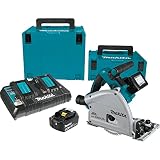


| Model | Battery platform | Maximum cutting depth at 90° | Maximum cutting depth at 45° | Blade | Practical fit |
|---|---|---|---|---|---|
| SP001G | 40V max XGT; two 40V max batteries | 56 mm (2-3/16 in.) | 40 mm (1-9/16 in.) | 165 mm (6-1/2 in.) | More depth margin and an XGT platform for frequent or demanding work |
| DSP600 | 18V LXT; two 18V batteries | 56 mm (2-3/16 in.) | 40 mm (1-9/16 in.) | 165 mm (6-1/2 in.) | A sensible cordless option for shops already invested in LXT |
Published capacities are not the same as the thickness you can cut cleanly in every setup. Blade geometry, the rail, bevel angle, and the material all affect usable depth. For a typical 18 mm (3/4 in.) cabinet panel, either saw has ample capacity; the choice is more about batteries, workload, and the cost of entering a platform than nominal depth.
Choose by your sheet-goods workflow
| Your situation | Best starting point | Why |
|---|---|---|
| You own two compatible 18V LXT batteries and cut panels occasionally | DSP600 bare tool or an LXT bundle | Uses the battery system you already have; verify that the package includes a rail if you need one. |
| You are buying into Makita cordless from scratch | Compare complete SP001G and DSP600 kits by total contents | Price the saw, two batteries, charger, rail, and case together. A bare tool can look cheaper but leave essential items to buy. |
| You cut full sheets regularly or need a cordless shop setup | SP001G with two suitable XGT batteries | It offers the newer 40V max platform. Battery capacity and workload still determine how often you stop to recharge. |
| You work mainly on a bench near power and use the saw only now and then | Consider whether cordless is worth the premium | A corded track saw may be more economical if battery mobility is not useful in your workspace. |
Battery compatibility and runtime
The DSP600 requires two 18V LXT batteries, and the SP001G requires two 40V max XGT batteries. The platforms are not interchangeable. A battery from one system cannot power a saw from the other, so account for the cost of a matched pair, charger, and any extra batteries before choosing.
Makita does not give one dependable runtime figure for all jobs. Cuts per charge vary with battery capacity and condition, blade sharpness, material, cut length, feed pressure, and whether the saw is making long continuous cuts or short crosscuts. Cutting a full sheet of dense material under load is not comparable to trimming a few shallow cuts in plywood. For production work, plan around spare charged batteries rather than a claimed number of cuts.
Both saws are designed to use their respective battery pair together; do not assume that one battery will provide normal operation. Use matched batteries of the same platform and, where applicable, similar capacity and condition. This makes charging and rotation simpler and avoids building a workflow around an incompatible spare.
What should a Makita cordless track saw kit include?
A makita cordless track saw kit can mean different things depending on the seller and region. Before paying for a bundle, confirm whether it includes:
- The saw, and whether it is the XGT SP001G or LXT DSP600.
- Two compatible batteries and a charger—or no batteries and charger at all.
- A guide rail. The saw alone does not guide a long, straight sheet cut.
- A rail connector or clamps, if your cuts require extra rail length or secure workholding.
- A case, blade, and any dust-collection adapter you need for your extractor.
For breaking down full-size panels, a rail long enough for the intended cut is essential. A short rail may work well for cabinet parts, but it cannot make a continuous cut longer than its guided reach. If you plan to join rails, check connector availability and alignment; a small step at the joint can mark the edge or pull the cut off line.
Depth, setup, and cut quality: details that change the decision
Both models share the same stated maximum depth, so choosing XGT does not automatically buy extra capacity over LXT. The useful question is whether the saw can cut through your stock with the rail and bevel setting you actually use. For example, a 45-degree bevel reduces maximum depth to 40 mm (1-9/16 in.), leaving less margin for thick stock than a square cut.
For repeatable panel work, set the depth just beyond the material thickness rather than leaving the blade exposed farther than necessary. Support the offcut so it cannot pinch the blade, secure the sheet against movement, and make a test cut on scrap when changing blades or bevel settings. A sharp, material-appropriate 165 mm blade matters as much as motor power: a dull or unsuitable blade increases effort, worsens edge quality, and can drain batteries faster.
Ownership costs and upkeep
Track-saw rails and blades are consumables in the broader sense: they need care and eventual replacement, and their condition directly affects accuracy. Keep the rail’s guide surfaces and anti-slip strips clean, check that the splinter strip is still aligned to the blade’s cut line, and remove resin and dust from the saw’s sliding and dust-extraction areas. A dirty rail or damaged splinter strip can cause more visible tear-out or alignment trouble than a difference between these two saw platforms.
Common avoidable problems include forcing the saw through a cut, using a blade intended for rough framing on finished cabinet material, and allowing a long sheet to sag or shift. Feed steadily, support both sides of the cut, and keep the rail from moving. If the saw begins to labor, stop and check for a dull blade, binding, a pinched offcut, or inadequate support instead of simply pushing harder.
Bottom line
Choose the DSP600 if your shop already runs on 18V LXT and your panel-cutting demands fit its two-battery setup. Choose the SP001G if you want Makita’s 40V max XGT platform and are prepared to buy into it with two batteries and a charger. For either model, compare the complete package—not just the saw—and make sure the rail length, battery count, and blade suit the sheet sizes and materials you cut most often.