Makita SP6000J Plunge Saw Review: Cut Quality, Power, and Track Fit
What's inside
As an Amazon Associate I earn from qualifying purchases. This post may contain affiliate links at no extra cost to you.
Contents
Makita SP6000J Plunge Saw Review: Cut Quality, Power, and Track Fit
The Makita SP6000J is a strong choice if you want a corded makita plunge saw for clean sheet-goods cuts and need its full 55 mm cutting depth—but its splinter-free results depend on a sharp blade, careful setup, and the right track fit. It suits cabinet and furniture work better than occasional rough cutting; buyers who need a complete setup should check exactly what comes in a makita plunge saw kit, since the saw and guide rail are often sold separately.
What the SP6000J offers
The SP6000J is a 1,300 W corded saw with a 165 mm blade, variable speed, and a published maximum cutting depth of 55 mm at 90 degrees. Depth falls to 39 mm at 45 degrees. Those figures are useful, but the actual usable depth over a rail is slightly less: the saw sits above the workpiece, so confirm the combined saw-and-rail capacity before planning a cut through thick stock.
As an Amazon Associate we earn from qualifying purchases at no extra cost to you.
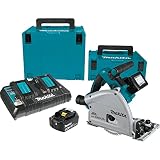


Its corded motor avoids battery-runtime limits during long rip cuts, and the variable-speed control is helpful when adapting feed rate to the material. The trade-offs are the cord to manage and a plunge saw’s more involved setup compared with a basic circular saw.
| Specification | Makita SP6000J | Why it matters |
|---|---|---|
| Input power | 1,300 W | Continuous corded power for long cuts |
| Blade diameter | 165 mm | Use the specified size and compatible bore |
| Maximum depth at 90° | 55 mm | Published capacity; check depth when mounted on a rail |
| Maximum depth at 45° | 39 mm | Less capacity for bevel cuts through thick panels |
| Speed control | Variable, approximately 2,000–5,200 rpm | Lets you adjust cutting speed to material and blade |
| Power source | Corded | No battery purchase or charge planning; cord management required |
Cut quality: melamine and oak veneer plywood
On melamine-faced board, a plunge saw can produce a clean edge, but “splinter-free” is not an unconditional guarantee. The SP6000J’s scoring function makes a shallow first pass before the full-depth cut, helping sever the surface layer instead of tearing it. For best results, use a sharp, fine-tooth blade intended for laminate or fine panel work, keep the rail’s splinter strip in good condition, and make the scoring pass at the marked setting rather than plunging straight through at full depth.
Oak veneer plywood needs similar care. The veneer is thin, and a dull or unsuitable blade can chip it even when the saw is running accurately. Support the sheet fully, place the rail on the waste side of the cut, and let the saw reach speed before feeding steadily. Avoid forcing the saw through a slow section; a change in feed pressure can leave a rougher edge or burn marks.
For especially fragile faces, test the blade and settings on an offcut from the same sheet. The rail’s rubber splinter strip is a consumable: it gradually wears, can be nicked, and may no longer support the cut line after blade or rail adjustments. Trim or replace it as appropriate for the rail system, then recalibrate it with a shallow cut before relying on it for visible work.
Does it run true on Makita and third-party rails?
On a compatible Makita guide rail, the saw is designed to track along the rail’s guide ribs. Set the saw’s fit adjusters so it slides smoothly without noticeable side play. Too loose, and the blade can wander; too tight, and the saw may bind or feel jerky. Check the rail is straight, clean, and firmly supported before cutting.
Some third-party rails use a profile compatible with Makita-style plunge saws, but compatibility is not universal. Even rails that appear to fit can differ in rib dimensions, clamp clearance, connector alignment, or splinter-strip position. A small amount of lateral play can show up as a tapered or inaccurate cut over a long run. Before buying a second-brand rail, check its stated compatibility with the SP6000J and test the fit across the full length. Make a trial cut and measure both ends rather than assuming a close-looking profile will run true.
Rail connectors deserve attention too: a joined pair can introduce a step or slight angle if the ends are not aligned. For long panels, check alignment with a straightedge and verify the joined rail on scrap before cutting a finished sheet.
Which setup fits your work?
| Your situation | Practical choice | Reason |
|---|---|---|
| Frequent cabinet or furniture work | SP6000J, compatible rail, and a fine-finish blade | Clean guided cuts and corded power suit repeated sheet processing |
| Occasional DIY panel cuts | Compare the saw-only price with a kit that includes a rail and case | A lower saw price may not include the parts needed to cut accurately |
| Already own a third-party rail | Verify profile compatibility and test the fit first | Small differences in rail fit can affect accuracy and ease of travel |
| Need to cut thick material at a bevel | Check the 39 mm bevel capacity against the actual workpiece | The 55 mm headline depth applies to a 90-degree cut, not a bevel |
| Very limited storage or mostly rough cuts | Consider whether a track system is worth the space and setup | A plunge saw earns its keep through guided, repeatable panel cuts |
Buying and ownership details
Kit contents vary by market and seller, so read the included-items list rather than assuming “kit” means saw, rail, clamps, and blade. A makita plunge saw kit may include a case and saw but no guide rail, or bundle a rail separately. As a general market guide, the bare saw commonly sits in the several-hundred-dollar range, while a setup with a rail and useful accessories costs more; exact prices vary by region and promotions.
Before the first precision cut, check the blade is secure, the base and rail are free of debris, and the depth is set for the intended pass. Keep the rail’s sliding surfaces clean: fine sawdust can make the saw drag and encourage uneven feeding. Inspect the cord for damage, and replace a worn or damaged blade rather than compensating with extra force. These small checks help preserve accuracy and reduce avoidable wear.
Verdict
The Makita SP6000J makes sense for woodworkers who regularly break down plywood, trim doors, or cut cabinet panels and want a corded tool with a useful 55 mm straight-cut capacity. Its scoring mode and compatible rail can help produce crisp melamine and veneer edges, provided the blade and splinter strip are in good condition. The main buying cautions are the reduced 39 mm bevel capacity, rail fit on third-party systems, and the possibility that a saw-only package leaves you buying essential accessories separately. For occasional rough cuts, it may be more track system than you need; for repeatable sheet work, it is a capable option.