Best Planers with Quiet Cutterheads for Indoor Workshops
What's inside
As an Amazon Associate I earn from qualifying purchases. This post may contain affiliate links at no extra cost to you.
A planer is one of the loudest machines in a small workshop, and the noise is not limited to the motor. Conventional straight knives strike the wood across their full width, producing a sharp impact with every rotation. A planer with a helical or spiral cutterhead uses many small carbide inserts instead. It still makes noise, but the sound is lower, less harsh, and easier to tolerate indoors.
For most home shops, the best choice is a benchtop thickness planer with a helical cutterhead and a reliable dust hood. Larger stationary planers run more smoothly and take wider boards, but they cost considerably more and still need dust collection. The cutterhead reduces the character of the noise; it does not turn a planer into a quiet machine.
As an Amazon Associate we earn from qualifying purchases at no extra cost to you.

Contents
What a quiet cutterhead actually changes
A straight-knife cutterhead has two or more long knives that hit the workpiece in a single event. This creates a high-pitched chopping sound and makes defects especially unpleasant. A helical head uses rows of small, square or rectangular carbide inserts set at an angle. Each insert removes a smaller shaving, so the cutting action is more progressive.
Expect a noticeable reduction in harshness rather than silence. Many benchtop planers still measure roughly 85 to 95 decibels at the operator’s position, depending on the wood, depth of cut, and room. A concrete-walled basement will sound much louder than a garage with exposed framing and acoustic materials. Hearing protection remains mandatory.
The inserts also improve failure behavior. A nail or hidden staple may damage one small edge instead of ruining a full-width knife. Tearout is often reduced on figured grain, although feed direction and cutting depth still matter. Inserts are not immune to damage: a buried screw can chip several of them, and replacing carbide inserts costs more than sharpening a pair of straight knives.
The best planer types for indoor workshops
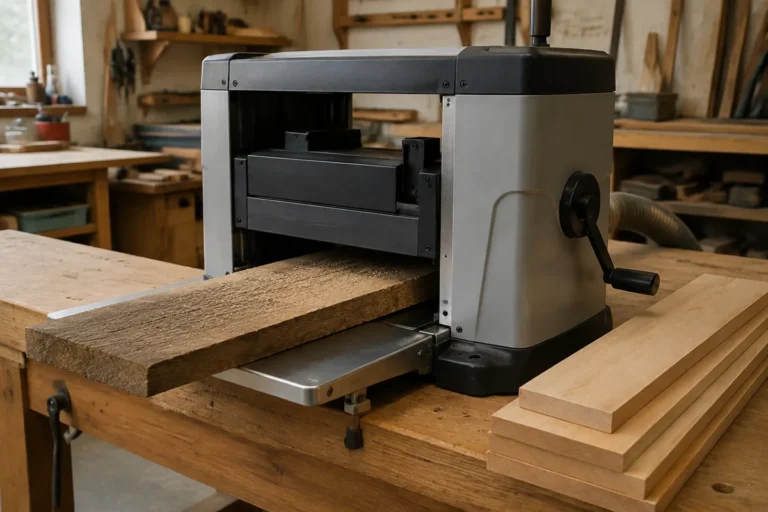
For occasional furniture projects, a helical cutterhead benchtop planer is usually the sensible starting point. These machines commonly handle stock up to 12 or 13 inches wide and remove about 1/16 inch in one pass under favorable conditions. They are compact enough to store, but they require a solid stand and enough outfeed space to prevent boards from dropping and snipe from worsening.
A heavier stationary planer is better for repeated work, wide panels, and long boards. Look for a machine in the 15-inch class if your projects regularly exceed 12 inches in width. It will generally have a more powerful motor, longer beds, and better feed stability. The trade-off is weight, price, and electrical requirements. Moving a 400-pound planer through a basement is a project in itself.
If your existing planer has straight knives, an aftermarket spiral planer cutterhead can be worthwhile. Check compatibility carefully. Some conversions require a new pulley, belt, bearings, or a different dust hood. Installation also takes time, and the final cost can approach that of a new machine. Conversion makes the most sense when the planer already has a good table, strong feed rollers, and a motor in good condition.
| Planer type | Best use | Typical limitation | Noise expectation |
|---|---|---|---|
| Straight-knife benchtop | Low-cost, occasional work | Harsh noise and more tearout | Highest and sharpest |
| Helical benchtop | Indoor hobby shops and furniture parts | Limited width and modest bed length | Lower, less piercing |
| Stationary helical | Frequent work and wide boards | High cost, weight, and space needs | Lower tone, still loud |
| Aftermarket conversion | Upgrading a sound existing planer | Fitment and installation risk | Depends on the base machine |
Features worth paying for
Prioritize cutterhead design, feed consistency, and dust handling over decorative controls. A two-speed feed system is useful when you want a smoother finish on figured wood, but it is not essential for ordinary boards. A depth-of-cut gauge is convenient, yet you should verify the actual cut with calipers because many built-in scales are approximate.
Look for a cutterhead with carbide inserts that can be rotated. Four-sided inserts provide several fresh edges before replacement. Confirm that replacement inserts are readily available and that the machine uses a common size. Proprietary inserts can turn a small maintenance job into an expensive delay.
Bed length matters more than many buyers expect. Short beds are more prone to snipe at the leading and trailing ends of a board. Hinged extension tables help, but they must be level with the main bed. A sturdy stand is also important. If the planer vibrates on a folding stand, the noise increases and the cut can develop ridges.
Dust collection is not optional indoors. A planer can fill a shop with chips in seconds, and a clogged hood increases noise while reducing chip evacuation. Pair the machine with a 2 HP woodworking dust collector if you use a stationary machine regularly. A small shop vacuum may work with a benchtop unit for short runs, but its filter can clog quickly with planer chips. Use a separator if your collector supports one.
How to reduce noise during use
Run the planer on a rigid, level surface and keep extension tables aligned. Feed boards at a steady rate rather than forcing them. A dull insert, overloaded motor, or board with varying thickness will produce more noise than normal. Taking 1/32-inch passes often sounds calmer and gives a better finish than repeatedly pushing the machine to its maximum depth.
Place the machine away from shared walls, and avoid operating it in a bare concrete room. Rubber isolation pads can reduce vibration through the floor, but they should not make the planer unstable. Close the dust port and cutterhead cover properly before starting. Wear both earplugs and earmuffs for extended sessions, and keep bystanders out of the room.
When the cheaper option is fine
A straight-knife planer remains a reasonable buy if you only mill construction lumber, work outdoors, or use the machine a few times each year. It is cheaper to purchase, and knives are inexpensive to replace or sharpen. For an indoor workshop where noise, figured wood, and cleanup matter, the extra cost of a helical head is easier to justify.
Do not buy the largest planer simply because it is quieter on paper. A well-supported 12-inch helical benchtop machine is often a better fit than an oversized stationary unit that cannot be moved, connected to adequate dust collection, or supplied with the required power. Choose the cutterhead first, then match width, bed length, and feed capacity to the boards you actually build with.