Table Saw Arbor Size vs Dado Blade Compatibility
What's inside
As an Amazon Associate I earn from qualifying purchases. This post may contain affiliate links at no extra cost to you.
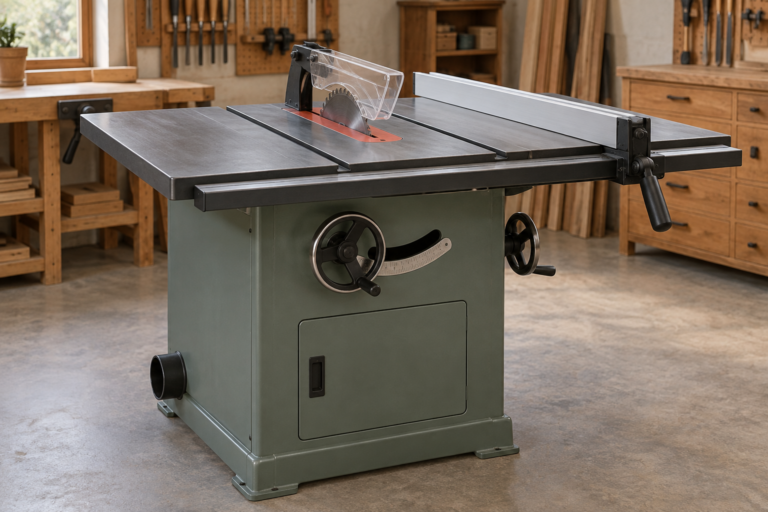
A table saw’s arbor diameter is only one part of dado blade compatibility. The dado set must also fit the arbor length, clear the saw’s throat plate, stay within the manufacturer’s approved width, and work with the saw’s brake and guard system. A blade can have the correct center hole and still be unsafe or unusable.
As an Amazon Associate we earn from qualifying purchases at no extra cost to you.


Contents
Common table saw arbor sizes
Most portable and contractor-style table saws use a 5/8-inch arbor. Many larger cabinet saws also use 5/8 inch, although some heavy-duty machines use a 1-inch arbor. The arbor diameter is the diameter of the hole in the blade or dado chippers.
| Arbor size | Typical machines | Dado compatibility | Main concern |
|---|---|---|---|
| 5/8 inch | Portable, jobsite, contractor, and many cabinet saws | Most 5/8-inch dado sets, if the saw approves dado use | Limited arbor length on some compact saws |
| 1 inch | Some large cabinet and industrial saws | 1-inch dado sets or approved adapters, depending on the saw | Fewer consumer dado choices and stricter fit requirements |
Measure the arbor rather than guessing from the saw’s appearance. A 5/8-inch arbor measures approximately 0.625 inch across, while a 1-inch arbor measures approximately 1.000 inch. Do not enlarge a blade’s hole, use loose reducing rings, or stack random washers to make a set fit. The blade needs to register squarely and concentrically on the arbor.
Dado width and arbor length
Standard stacked dado sets commonly adjust from about 1/4 inch to 13/16 inch, with 8 inches being a common diameter. They usually contain two outside blades, several chippers, and thin shims. The exact maximum width varies, so check the set’s specification rather than assuming every set reaches 13/16 inch.
The arbor must be long enough for the complete stack, plus the flange and arbor nut. This is where many portable saws fail the compatibility test. A 5/8-inch arbor may accept a single blade comfortably but leave too little thread exposed when loaded with two outside blades, four chippers, and shims.
Never remove the inner flange to gain space unless the saw manufacturer specifically permits it. The flange supports the blade and helps keep the assembly running true. A dado stack that leaves only a few threads engaged, prevents the nut from seating fully, or extends beyond the threaded portion is not acceptable.
Before buying, compare the saw manual’s maximum dado width with the dado set’s required stack width. If the manual does not list dado capacity, treat that as a warning rather than permission. Some compact saws have short arbors specifically because they were designed for a single thin-kerf blade.
Check the saw before buying a set
The saw’s manual is the controlling document. It should state whether dado blades are permitted, the maximum diameter and width, and whether a special dado throat plate is required. In the United States, some saws with active safety-brake systems have additional restrictions. A brake designed to detect a standard blade may not operate correctly with a stacked dado assembly.
Some safety systems require a specific dado brake cartridge, while others do not support dado blades at all. Bypassing a brake, defeating a safety interlock, or installing a non-approved cartridge is a serious trade-off, not a routine setup step. If the manufacturer prohibits dado use, choose a different cutting method or a saw designed for dados.
The factory throat plate is usually too narrow for a dado wider than the standard blade. You will need a dado insert with an opening wide enough for the stack. The insert should support the work close to the cut and sit flush with the table. Some saws accept an aftermarket zero-clearance insert; others need a manufacturer-specific plate because of their riving-knife or brake design.
Search for an table saw dado throat plate only after confirming the plate fits your exact saw. A generic insert that fits the opening but interferes with the riving knife or blade guard is not a suitable substitute.
Choosing the right dado set
Buy a set with the same arbor diameter as the saw and a maximum width within the saw’s rating. For a 5/8-inch saw, a 5/8-inch stacked dado blade set is the normal choice. For a 1-inch saw, use a 1-inch set unless the manufacturer explicitly approves another arrangement.
A stacked set is more versatile than a single wobble dado blade. You can tune the cut with shims and vary the width in small increments. Chippers with more teeth generally leave a cleaner bottom, especially in plywood and hardwood, although they cost more. A cheaper set can be perfectly adequate for occasional dados in softwood, shelving, or utility work if its plates are flat and its chippers are properly designed.
Single wobble blades are compact and often cheaper, but they produce a slightly curved-bottom groove and can create more vibration. They also do not solve an arbor-length problem; the blade still needs to be approved for the saw. For clean joinery, a stacked set is usually the better purchase.
Installation and test-cut checks
Unplug the saw before removing the blade. Install the dado components in the order specified by the set manufacturer, with the teeth staggered as directed. The outside blades normally face outward, and the chipper teeth should not touch or line up in a way the instructions prohibit.
Rotate the assembly by hand before switching on the saw. Confirm that the teeth clear the throat plate, the arbor nut tightens fully, and the stack does not contact the insert. Set the blade height only slightly deeper than the desired groove; for a 3/4-inch board, a common dado depth is around 1/4 inch, but the joint design determines the final measurement.
Make a test cut in scrap of the same material. Measure the groove with calipers or test the mating piece. If the fit is too tight, add a shim rather than forcing the joint. If the saw vibrates, the cut is uneven, or the arbor nut will not seat correctly, stop and remove the stack. Those symptoms indicate a setup or compatibility problem, not something to correct with faster feed pressure.