Table Saw Dust Hood vs Overarm Dust Collection for Fine Chips
What's inside
As an Amazon Associate I earn from qualifying purchases. This post may contain affiliate links at no extra cost to you.
For fine chips from a table saw, the choice is not simply between “more suction” and “less suction.” A below-table dust hood and an overarm collector capture different parts of the dust stream. The hood handles chips and dust falling below the blade. The overarm handles the cloud thrown upward and forward by the exposed portion of the blade. In a shop where airborne dust matters, the most effective setup is usually both. If you are choosing only one, the right option depends on your saw, dust collector, and the kind of work you do.
As an Amazon Associate we earn from qualifying purchases at no extra cost to you.


Contents
What Each System Captures
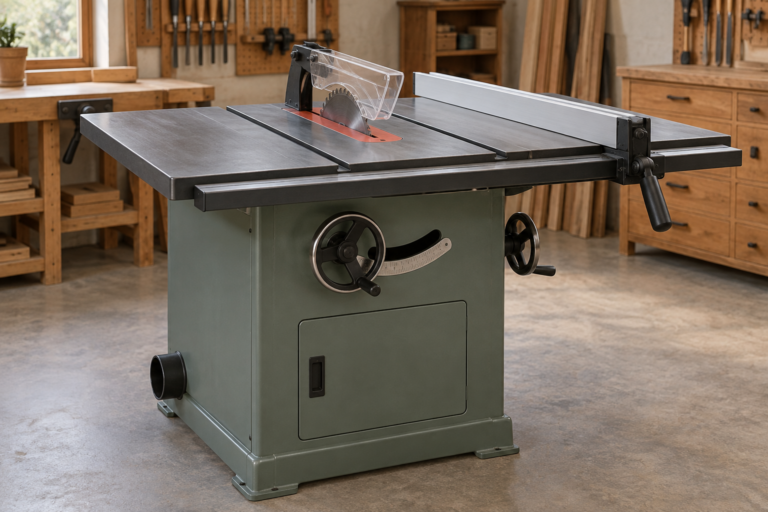
A table saw dust hood encloses or partially encloses the underside of the blade. It connects to a 4-inch hose or duct and relies on the saw cabinet, throat plate, and blade guard to keep air moving through the cutting area. It is good at capturing the larger chips that drop below the table and much of the dust produced inside a cabinet saw.
An overarm system places a hood above the blade, usually attached to the riving knife, fence rail, or a separate arm. The hood surrounds the upper part of the blade without blocking the cut line. It captures dust immediately after it leaves the kerf, before the blade can fling it across the shop. Some overarm hoods also provide a guard, but dust collection and guarding are separate design concerns.
Fine chips are difficult because they remain airborne longer than ordinary shavings. A 1/16-inch particle can travel well beyond the saw before settling, and a below-table hood cannot collect dust that has already escaped above the table. This is why a table saw can look clean underneath while still producing a visible haze around the operator.
Dust Hood vs. Overarm Collection
| Feature | Below-table dust hood | Overarm dust collection |
|---|---|---|
| Main target | Falling chips and dust below the blade | Dust thrown upward from the exposed blade |
| Typical airflow | 300–600 CFM at the machine, depending on ducting | 100–250 CFM can be useful because the hood is close to the source |
| Installation | Usually straightforward on a cabinet saw | More involved; requires clearance, mounting, and adjustment |
| Cut visibility | Usually unaffected | Can be reduced if the hood is bulky or poorly positioned |
| Best value | General sawing and chip control | Fine dust reduction near the operator |
| Common failure | Leaks around the throat plate, blade tilt, or cabinet doors | Hood gets bumped out of position or interferes with stock |
When a Below-Table Hood Is Enough
A good hood is often sufficient for a cabinet saw used with a sharp blade, a riving knife, and a properly fitted blade guard. It is the sensible first purchase if your saw has no collection at all. A sealed cabinet with a 4-inch port and a dust collector rated around 1,000 CFM or more will usually provide useful airflow at the blade. Do not treat the rating as airflow at the saw; that number is commonly measured with no hose, filter, or duct resistance.
For a contractor saw with an open stand, a hood under the blade is less effective because air leaks in every direction. A retrofit enclosure can improve it, but the cabinet must still allow the motor to cool and the blade to tilt. A small table saw dust collection hood can be a cheap improvement, but avoid designs that leave the blade-change opening permanently exposed.
The cheaper option is fine when your main problem is chips on the floor, you mostly cut solid lumber, and the saw is in a well-ventilated area with a separate air cleaner. It is also the better choice if an overarm hood would interfere with wide panels or frequent angled cuts.
When an Overarm Collector Pays Off
An overarm hood earns its place when you cut plywood, MDF, melamine, or dry softwood regularly. These materials produce a higher proportion of fine dust, and the upper side of the blade is the source of much of the airborne plume. It is especially helpful for the person standing at the saw, since the dust stream often travels toward the operator’s breathing zone.
Position matters more than raw airflow. The hood should sit roughly 1/2 to 1 inch above the stock and remain centered over the blade. If it is 3 inches high to clear thick material, capture drops sharply. The connection should be short and smooth; a 2 1/2-inch hose is common for an overarm hood, although some systems use 4 inches. A dedicated overarm table saw dust collector is easier to adjust than a homemade hood attached rigidly to the ceiling.
The main trade-off is access. You must be able to move the hood aside for blade changes, dado work, and bevel cuts. A weak arm will sag or vibrate, and a hood that touches the workpiece can mark the surface or become a safety hazard. Check that it cannot contact the blade at full bevel and maximum height before connecting the collector.
Airflow and Filtration
Fine-chip collection needs both adequate airflow and fine filtration. A 2-horsepower collector with a 1-micron or finer cartridge filter is a reasonable baseline for a cabinet saw, but a restrictive 25-foot hose can reduce real airflow enough to defeat the improvement. Keep the run short, use smooth ducting, and avoid sudden reductions near the inlet.
A cyclone separator helps protect the filter from large chips, but it does not replace the filter. For a small shop, a fine dust collector cartridge filter can make a bigger difference than adding a second hood to an underpowered collector. Use a respirator rated for fine particulate during cutting and cleanup; collection systems reduce exposure but do not make dust harmless.
A Practical Buying Decision
Start by sealing and improving the lower collection path. Check the throat plate fit, cabinet doors, blade-tilt opening, and hose connections. If chips still escape above the table or you see a dust plume around the blade, add an overarm hood. If your saw already has a sealed cabinet and a capable collector, the overarm addition is the upgrade most likely to reduce fine airborne dust.
For the best result, use a below-table hood on a 4-inch line and a separate 2 1/2-inch overarm line, with blast gates so unused branches do not waste airflow. If budget or workspace rules out both, choose the hood first for general chip control, then improve filtration and room ventilation before spending on accessories.