Best Planers for Milling Wide Cabinet Side Panels
What's inside
As an Amazon Associate I earn from qualifying purchases. This post may contain affiliate links at no extra cost to you.
Wide cabinet side panels expose the main limitation of most thickness planers: capacity. A typical benchtop planer handles boards about 12 or 13 inches wide, while common stationary machines handle 15 or 20 inches. A full-height cabinet side may be 24 to 30 inches wide, so the “best planer” is often not the largest planer you can afford. It is the machine and process that can flatten the panel without creating a ridge, snipe, or dangerous imbalance.
Contents
What Capacity You Actually Need
Measure the panel before shopping, and separate finished width from rough-board width. If you are gluing a side panel from several boards, a 15-inch planer may be sufficient because each board can be milled individually before glue-up. If you are working with a single slab or a wide glued panel, the planer must accept the entire piece, with additional width for safe support.
| Panel situation | Most practical machine | Main limitation |
|---|---|---|
| Individual boards for a glued panel | 12- or 13-inch benchtop planer | Limited width and less rigid infeed support |
| Panels up to roughly 15 inches | 15-inch stationary planer | Heavy, expensive, and still too narrow for many cabinet sides |
| Panels up to roughly 20 inches | 20-inch planer | High cost, substantial power requirements, large footprint |
| Panels wider than the planer capacity | Router sled or wide-belt sanding service | More setup time or outsourcing cost |
Do not assume that a machine advertised as 15 inches will comfortably process a 15-inch panel. You need room for edge clearance, support, and accurate alignment. A panel that is exactly as wide as the cutterhead opening can rub the housing or tip at the infeed and outfeed tables.
The Best Planer Types for Cabinet Panels
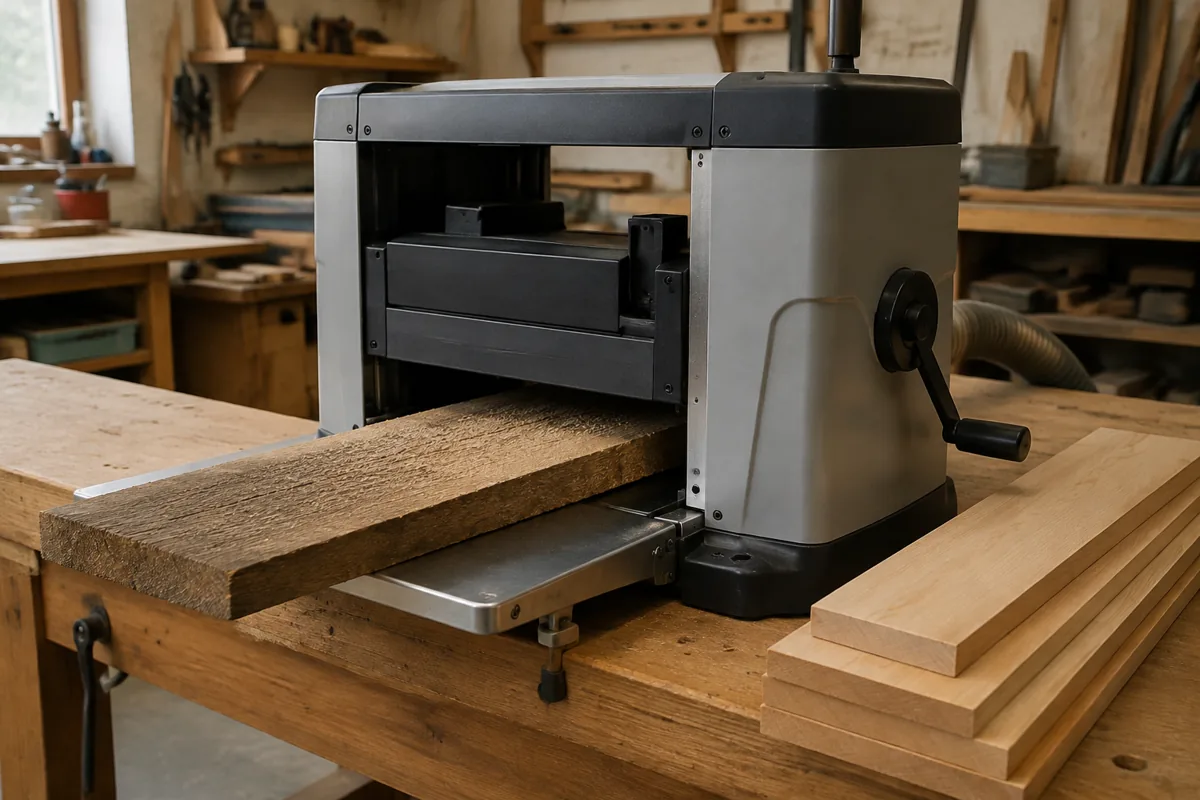
For most home shops, a 13-inch thickness planer is the sensible choice when the cabinet side will be made from narrower boards. It is relatively affordable, can run on ordinary shop power, and is useful for shelves, face-frame stock, and solid-wood edging. The cheaper option is fine if you mill the boards before glue-up and do not need to flatten wide slabs.
A 15-inch stationary planer is a better step up for a small professional shop. It generally has a heavier cutterhead, stronger feed rollers, longer tables, and a more rigid stand than a benchtop model. Those improvements matter when processing thick hardwood repeatedly. They do not solve the width problem for a 24-inch panel, however. You would still need to mill the panel in sections or use another flattening method.
A 20-inch planer makes sense when you regularly process broad stock and have the electrical service, dust collection, and floor space. Look for a helical or segmented carbide cutterhead if noise, tear-out, and knife changes are concerns. It costs more initially, but individual inserts can be rotated or replaced instead of replacing a full set of knives. The trade-off is that a 20-inch machine remains a thicknessing tool, not a true panel flattener.
For unusually wide work, a router sled for flattening wide panels is often the practical answer. A sled rides over rails and removes material from the high spots. It handles a 24- to 30-inch cabinet side with the right rail length, but it is slower, louder, and leaves machining marks that require sanding. It also demands a flat reference surface and careful cutter-depth control.
Features That Matter More Than Marketing
Feed consistency is critical. A planer that slows under load can leave washboarding, especially in dense hardwood. A typical cabinet panel may need only 1/32 inch removed per pass, and taking 1/16 inch or more from hard stock can overload the motor and increase tear-out.
Long infeed and outfeed tables reduce tipping at the ends. If the tables are short, support the panel with level auxiliary tables or roller stands. A panel that rises into the cutterhead at the infeed can produce a deep gouge; one that drops at the outfeed can create snipe. Snipe commonly affects the first or last 2 to 6 inches, depending on the machine and setup.
Dust collection is not optional for wide panels. A planer produces chips quickly, and a clogged hood can force chips back onto the workpiece. Use a collector capable of moving roughly 800 to 1,200 CFM at the machine, with a short, adequately sized hose. A shop vacuum may work for light benchtop use but often struggles with continuous planer output.
For the cutterhead, straight knives are cheaper and can leave a clean surface when sharp. Helical heads are quieter and usually handle reversing grain better, but they do not eliminate tear-out. The correct feed direction, shallow cuts, and sharp edges still matter.
How to Mill a Wide Panel Safely
Flatten one face first. A thickness planer references the bottom face, so feeding a cupped or twisted panel directly into it will usually reproduce the defect rather than remove it. Use a sled with shims, a router sled, or a jointer when the panel fits. Once one face is flat, plane the opposite face in several light passes.
For a glued-up cabinet side, mill each board to consistent thickness, joint one straight edge, and assemble the panel with the grain direction considered. After glue-up, scrape or lightly sand the seams instead of trying to force the entire panel through an undersized planer. Running one edge through repeatedly can create an uneven thickness across the width.
If you must use a planer narrower than the panel, avoid overlapping passes as a final surface operation. The cutterhead can leave a raised strip or visible step between passes. A router sled or wide-belt sander is more reliable for the final flattening stage.
Buying Recommendation
Buy a 15-inch stationary thickness planer if you routinely prepare solid-wood parts and can mill cabinet panels from individual boards. Choose a 20-inch machine only when its capacity will be used often enough to justify the price, space, and dust collection demands. If your normal work involves finished panels wider than 20 inches, spend the money on a solid flattening setup or local wide-belt sanding instead of expecting a planer to do a job outside its design.
The most economical setup for many cabinet builders is a reliable 13-inch planer, a good jointer or jointing sled, and a router sled for occasional oversized panels. That combination handles ordinary stock efficiently without turning a rare 28-inch side panel into a reason to buy a massive machine.


