Best Band Saws with Foot Brakes for Professional Woodshops
What's inside
As an Amazon Associate I earn from qualifying purchases. This post may contain affiliate links at no extra cost to you.
A foot brake is one of the most useful upgrades on a professional bandsaw, especially when the machine has a heavy flywheel and takes several seconds to coast down. It lets you stop the blade without reaching across the table or waiting through an unloaded shutdown. That matters when a cut goes wrong, a workpiece binds, or you need to clear a small offcut near the blade.
The best choice is not simply the saw with the largest motor. A reliable brake, rigid frame, adequate resaw capacity, and a table that stays square are more important in daily shop work. Before buying, confirm that “foot brake” means a true blade-stopping brake, not just a large paddle switch or a foot-operated power switch.
Contents
What a Foot Brake Actually Does
On a professional bandsaw, the foot pedal usually activates a mechanical or electrical braking system. Depending on the design, it may apply a brake to the lower wheel, disconnect power and engage a brake, or use a dedicated braking mechanism tied to the motor. The result should be a controlled stop in roughly 2 to 5 seconds, rather than a 15- to 30-second coast.
Do not assume the brake makes the machine safe instantly. Keep your hands away from the blade until it has stopped, and make sure the brake does not cause the blade to jump off the wheels. A poorly adjusted brake, worn belt, loose wheel bearing, or incorrect blade tension can turn a normal stop into a tracking problem.
The Best Bandsaw Types for Professional Shops
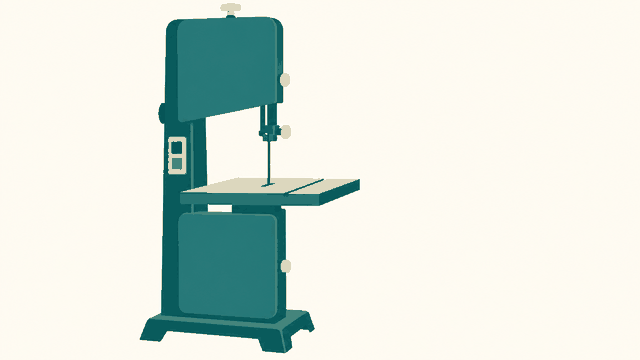
For most professional woodshops, a 17- to 20-inch floor-standing bandsaw is the practical sweet spot. These saws usually provide 12 to 16 inches of resaw capacity, tables large enough for cabinet parts, and motors in the 2 to 3 horsepower range. They handle thick hardwood without being as expensive or space-hungry as industrial production machines.
A 14-inch saw with a foot brake can be a good fit for a small cabinet shop, school, or furniture studio. It normally offers about 10 inches of resaw height and 1.5 to 2 horsepower. That is enough for curved parts, veneers, and moderate resawing, but it has less reserve when cutting 10-inch maple or walnut continuously.
For high-volume resawing, look at a 20-inch or larger machine with a 3 horsepower or bigger motor, a cast-iron or welded steel frame, and a heavy lower wheel. These machines are more stable and recover speed better, but they require more floor space, a larger electrical circuit, and better dust collection. A brake is particularly valuable here because large wheels store more energy and coast longer.
Use this professional 17-inch bandsaw with foot brake search as a starting point, but verify the manufacturer’s specifications. Marketplace listings often use “brake” loosely.
What to Compare Before Buying
| Feature | Good professional target | Why it matters |
|---|---|---|
| Motor | 2 to 3 hp for general work | Maintains blade speed in hardwood and during resawing |
| Resaw capacity | 12 to 16 inches | Provides room for furniture parts and veneer work |
| Brake stopping time | About 2 to 5 seconds | Reduces waiting and improves response to mistakes |
| Table size | At least 20 by 20 inches | Supports large panels and keeps cuts controlled |
| Blade guides | Ceramic or quality ball-bearing guides | Controls blade deflection without excessive friction |
| Dust port | 4-inch port, preferably with lower pickup | Captures dust from the lower wheel and blade exit |
| Electrical supply | 120V for smaller saws; 240V for larger motors | Avoids nuisance tripping and voltage drop |
Brake Design and Safety Details
Look for a brake that fails in a predictable way. If the pedal linkage breaks, the saw should still shut off normally from the main switch. The foot control should be easy to hit from either side of the operator’s stance and should not sit where it can be pressed accidentally while moving stock.
Check whether the brake is intended for repeated stops. Some systems are fine for occasional use but heat up when an operator stops the saw after every cut. Ask about replacement brake pads, switches, cables, and adjustment procedures. A brake that requires a proprietary part can create more downtime than a simple mechanical pedal.
It is also worth checking whether the brake works during a power failure. An electrically released brake may engage when power disappears; another system may simply let the blade coast. That difference affects both safety and machine placement. A saw near a high-traffic aisle benefits more from a fast automatic stop than one used occasionally in a private studio.
Blade and Resaw Performance
A foot brake cannot compensate for an unsuitable blade. For straight resawing, use a wide blade with a coarse tooth pitch—often 3 or 4 teeth per inch—and set the fence parallel to the blade’s actual drift. For curves, switch to a narrower blade, commonly 1/4 to 1/2 inch, with more teeth per inch. Forcing a fine blade through thick stock overheats the teeth and can cause the blade to wander.
Blade tracking is another common failure point. If the blade repeatedly comes off the wheel when braking, check tension, wheel coplanarity, tire condition, and guide settings before blaming the pedal. The upper guides should sit close to the workpiece, usually within about 1/4 inch, while the thrust bearings should remain just behind the blade during cutting.
A heavier saw is generally better for resawing, but weight alone does not guarantee accuracy. A rigid fence, square table trunnion, and stable guide post are more useful than decorative castings. Look for a fence that locks without shifting and a table that can be tilted and returned to zero reliably.
When a Cheaper Saw Is Fine
A lower-cost 14-inch bandsaw is reasonable if you mostly cut curves, small parts, and stock under 6 inches thick. If it lacks a factory foot brake, you may still be satisfied with a large paddle switch and disciplined shutdown habits. The savings are meaningful when the saw will run only a few hours per week.
Do not choose the cheaper option if employees share the machine, the saw sits beside a production path, or you routinely cut thick hardwood. In those situations, the faster stop, stronger frame, and better guide system can justify the added cost. Browse 14-inch bandsaws with foot brakes if your work is primarily general-purpose cutting.
A Practical Buying Checklist
Before ordering, confirm the brake is factory-installed and included, not an optional accessory. Check the stopping-time specification, motor voltage, maximum blade width, resaw height, table dimensions, dust-port size, and replacement-blade availability. Make sure the machine can pass through your doors and that the floor can support its weight.
For a shop that resaws weekly, prioritize a 2 to 3 horsepower motor, 12 inches or more of capacity, a rigid fence, and a dependable foot brake. For lighter work, spend less on capacity and more on accurate guides and easy blade changes. If the listing is vague about the brake mechanism, treat that as a warning and choose a model with a published manual and readily available service parts.