Best Band Saws for Cutting Small Curves in Hardwood Parts
What's inside
As an Amazon Associate I earn from qualifying purchases. This post may contain affiliate links at no extra cost to you.
Small curves in hardwood are a demanding band saw job. The cuts are slower than ripping straight stock, the blade can wander when the curve tightens, and a poorly supported part may rotate or lift into the blade. The best machine is not necessarily the largest one. For furniture parts, box components, brackets, and small shaped blanks, control, blade setup, and a compact table often matter more than maximum resaw capacity.
As an Amazon Associate we earn from qualifying purchases at no extra cost to you.

Contents
What Matters Most for Small Curves
Start with the blade, not the horsepower. A narrow blade follows a tighter radius because less steel has to bend through the turn. A 1/4-inch blade is a useful general choice for small hardwood curves, while a 1/8-inch blade can handle tighter turns if the saw accepts it and the material is not too thick. A 3/8-inch blade is more stable for broad curves but becomes frustrating in tight inside corners.
Tooth count also affects control. For hardwood parts up to about 1 inch thick, a blade in the 6-to-10 teeth-per-inch range is a sensible starting point. Use a finer 10-to-14 TPI blade for thin stock and cleaner edges. Coarser blades clear dust better in thicker parts, but they can leave a rougher surface and are more likely to grab during a tight turn. A skip-tooth pattern is usually more forgiving than an aggressive hook tooth for curved work.
Look for a saw with a rigid table, reliable blade tracking, and guides that can be adjusted close to the work. A table that flexes when you push a hardwood blank through a curve is more damaging than a small motor. The upper guide assembly should move smoothly and lock without shifting sideways. Keep it roughly 1/8 inch above the workpiece; raising it several inches reduces support and makes wandering more likely.
Choosing Saw Size and Capacity
For small hardwood parts, a compact 10-inch or 12-inch band saw is often enough. A 10-inch machine typically has a throat capacity around 9 to 10 inches and a cutting height around 3 to 4 inches. A 12-inch saw usually gives roughly 11 to 12 inches of throat and 4 to 6 inches of cutting height. Those figures are more than adequate for most curved furniture components.
A larger 14-inch saw becomes worthwhile when you also need to resaw boards, cut thick blanks, or use wider blades. It usually offers a heavier frame, larger table, and more stable wheels, but it takes more floor space and costs more. For thin parts and tight curves, its extra capacity does not automatically improve results. A 14-inch saw fitted with a wide blade can actually be less pleasant for small-radius work than a smaller saw set up with a narrow blade.
Motor power is another commonly overstated specification. Around 1/2 horsepower is generally sufficient for controlled cuts in hardwood parts under 1 inch thick. A 3/4-horsepower machine gives more reserve when feeding thicker stock, but feed rate still matters. Forcing the work faster than the blade can cut causes deflection, overheats the teeth, and may stall a small saw. If you regularly cut 2-inch hardwood blanks, prioritize a rigid frame and a suitable blade over a large advertised motor number.
Best Band Saw Types for the Job
| Type | Best use | Advantages | Limitations |
|---|---|---|---|
| 10-inch benchtop | Small parts, thin hardwood, limited shop space | Compact, affordable, easy to place near the workbench | Less table area, lighter frames, limited blade choices |
| 12-inch floor or benchtop saw | General furniture parts and occasional thicker stock | Better stability, more throat depth, usually better guides | Costs more and needs a sturdy stand or floor space |
| 14-inch floor saw | Curves plus resawing and large workpieces | Rigid, versatile, broad blade capacity, larger table | More expensive, larger footprint, unnecessary for small parts alone |
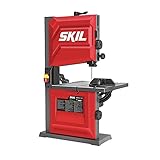
A 10-inch woodworking band saw is the cheaper option that makes sense when your parts are under about 1 inch thick and your curves fit within its throat. It is also easier to install in a small shop. Check reviews and specifications for guide quality and blade compatibility rather than choosing solely by nominal wheel diameter.
Choose a 12-inch woodworking band saw if you want a more forgiving general-purpose machine. The added table space helps when turning a template against the blade, and the heavier frame usually reduces vibration. This is the best middle ground for many hobbyists who make hardwood parts regularly.
Blade Setup for Tight Curves
Install the narrowest blade that will comfortably handle the curve, then tension it according to the manufacturer’s guidance. Do not rely on a generic “pluck” test alone; blade widths and steel types vary. The teeth should point downward and the blade should track near the center of the upper and lower tires. Set the side guides just behind the tooth gullets, not against the teeth, and position the thrust bearing slightly behind the blade.
Use a new or properly sharpened blade. A dull blade often looks like a machine problem because it requires extra feed pressure and drifts away from the layout line. If the cut wanders consistently, check blade tension, tracking, guide adjustment, and tire condition before blaming the saw. If the blade wanders only while turning, the radius may simply be too tight for its width.
For hardwood parts, a 1/4-inch band saw blade for wood is a practical starting point. Keep a finer blade available for thin stock. A blade that is too fine can pack with dust in thick hardwood, while a blade that is too coarse may tear fibers on the exit side of the cut.
Cutting Technique and Common Failures
Support the work flat on the table and keep both hands well away from the blade. Feed slowly enough that the blade cuts without bending. For a tight curve, make relief cuts from the waste area toward the layout line. These kerfs remove waste and prevent the blade from binding when the part changes direction. Stop each relief cut short of the finished line so it does not show on the part.
Never twist a thick blank sharply while pushing forward. That pinches the blade and can throw the workpiece backward. Instead, use short relief cuts, rotate the stock gradually, and back out only when the blade is fully stopped. A zero-clearance insert can help support small offcuts, but it must not pinch the blade or block dust below the table.
Dust collection is worthwhile, especially with dry hardwood. Connect a collector at the lower port and clean packed dust from the guides and wheel housing. If you need extremely tight radii in thin parts, consider a scroll saw for small hardwood curves instead. It is slower and less useful for thick stock, but its reciprocating blade can turn much tighter corners than a band saw.