Best Jointers for Flattening Narrow, Long Hardwood Strips
What's inside
As an Amazon Associate I earn from qualifying purchases. This post may contain affiliate links at no extra cost to you.
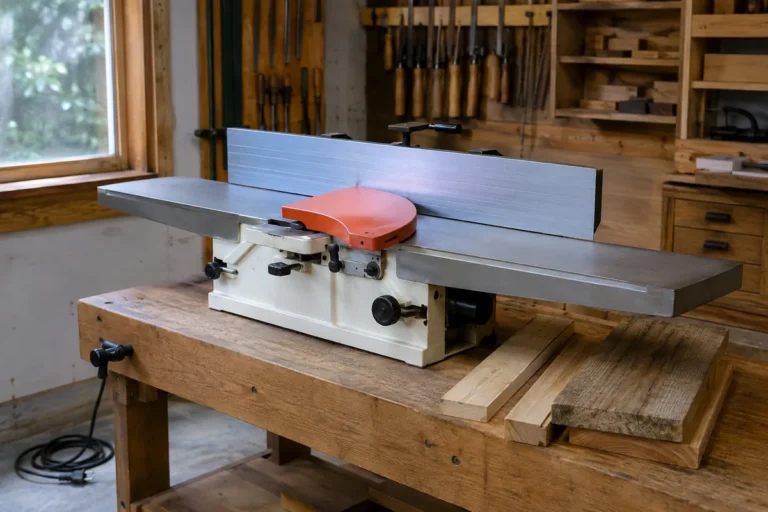
Flattening a narrow, long hardwood strip is one of the jobs that exposes a jointer’s weaknesses. The cutterhead may be wide enough, but the strip can be difficult to control, especially when it is only 1 to 3 inches wide and several feet long. A good machine needs a reasonably long infeed and outfeed bed, a fence that stays square, and enough cutterhead width to handle the stock without awkward passes.
For most woodworkers, the best choice is a 6-inch benchtop or floor-standing jointer with beds at least 40 inches long. If the strips are long, badly bowed, or wider than 6 inches, an 8-inch floor-standing jointer is a better investment. A planer alone will not flatten one face unless you first create a reference surface, so the jointer remains the simplest tool for correcting a rough, twisted face.
As an Amazon Associate we earn from qualifying purchases at no extra cost to you.

Contents
What Makes a Jointer Good for Long, Narrow Stock
Bed length matters more than maximum width for this particular job. A 6-inch cutterhead can flatten a 2-inch strip, but a short benchtop machine may allow the stock to tip as it crosses the cutter. That produces a tapered or scalloped face instead of a flat one.
Look for a total bed length of roughly 40 to 60 inches. A longer bed supports the work before and after the cutterhead, making it easier to keep the strip level. A short bed can still work for 24- to 36-inch pieces, but long flooring parts, table edging, and cabinet components are more demanding.
The infeed table must adjust smoothly and lock without movement. A loose table changes the depth of cut during the pass. The outfeed table should be coplanar with the cutterhead’s highest knife point; if it is low, the trailing end of the strip drops into the cutter and creates a snipe-like depression.
The Best Jointer Types
| Jointer type | Best use | Main advantage | Main drawback |
|---|---|---|---|
| 6-inch benchtop | Short strips and occasional flattening | Lowest cost and easy storage | Short beds and lighter construction |
| 6-inch floor-standing | Most general shop work | Better bed length, fence, and stability | Uses more floor space |
| 8-inch floor-standing | Long, wide, or difficult hardwood | Long beds and greater capacity | Higher price, weight, and power requirement |
| Spiral or helical cutterhead | Figured, brittle, or tear-out-prone wood | Cleaner cuts and quieter operation | Higher initial cost and replacement expense |
A 6-inch benchtop jointer is fine if the strips are short, the wood is reasonably straight, and you are willing to support the work carefully. It is usually the cheaper option and can produce excellent results on smaller parts. Do not choose one solely because its cutterhead is 6 inches wide; check the actual bed length and fence size.
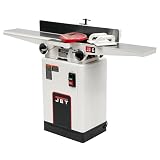
A floor-standing 6-inch machine is the practical sweet spot for most shops. Its heavier base reduces vibration, and its longer tables make a noticeable difference on 5- to 8-foot stock. For frequent hardwood work, a 6-inch floor-standing jointer is generally a better buy than an elaborate benchtop model.
Move to an 8-inch machine when the strips are wider, severely twisted, or routinely longer than 6 feet. The extra width is not needed just because the workpiece is long, but 8-inch jointers often come with longer, more rigid beds. They are also more capable of removing a substantial amount of material in controlled passes.
Spiral Versus Straight Knives
Straight knives are inexpensive and leave a good surface when they are sharp and properly aligned. They are also easy to sharpen or replace. For straight-grained maple, oak, ash, and similar stock, a conventional knife cutterhead is entirely adequate.
A spiral or helical cutterhead uses many small carbide inserts. It tends to reduce tear-out in curly maple, reversing grain, and figured hardwoods. It also makes a narrower strip less likely to catch a large section of damaged knife edge. However, it does not correct poor technique or a misaligned table. A helical-head 8-inch jointer is worthwhile for difficult wood and regular production, but it is unnecessary for occasional straight-grained stock.
How to Flatten Narrow Strips Safely
Inspect the strip first. Remove nails, grit, bark, and loose knots. Mark the high spots with a pencil and place the board’s hollow or concave face down for the first passes. Set the cut to about 1/32 inch. On very twisted stock, start with 1/64 inch; heavy cuts increase the chance of kickback and make it harder to maintain control.
Use push blocks that keep your hands above the cutterhead. Keep firm downward pressure over the infeed table at the beginning of the cut, then move that pressure to the outfeed table as soon as enough material has passed over it. Do not press hard directly above the cutterhead, where the strip can flex into the knives.
Long strips need support. Infeed and outfeed rollers or stable extension tables prevent the work from dropping at either end. Make sure the supports are level with the jointer bed. A support that is even 1/16 inch high can lift one end of a narrow board and create a hollow face.
Take repeated light passes until the pencil marks disappear. If the strip rocks on the bed, do not force it flat with hand pressure. That simply machines the shape you are holding into the board. Remove only the high areas first, then establish a continuous reference face.
When a Jointer Is Not the Best Choice
Very narrow strips can be awkward on any jointer. If a piece is less than about 1 inch wide, a carrier board or jointing sled can provide a safer, more stable base. Secure the strip to the carrier with carpet tape or clamps positioned away from the cutter path, and take shallow passes. Never run a loose, flexible strip if it cannot remain flat against the bed.
For edge-jointing strips that are already flat on one face, a table saw with a straight-line ripping jig may be more consistent. A router table with a flush-trim or jointing setup is another option for short parts. These alternatives are not replacements for a jointer when a board’s face is twisted, but they can be safer for very narrow pieces.
Before buying, measure your longest typical stock, check available floor space, and confirm the machine’s dust port and electrical requirements. For occasional short work, save money with a benchtop unit. For long hardwood strips, prioritize bed length and stability first, cutterhead width second, and specialty cutterhead features third.