Best Jointers with Helical Heads for Figured Hardwood
What's inside
As an Amazon Associate I earn from qualifying purchases. This post may contain affiliate links at no extra cost to you.
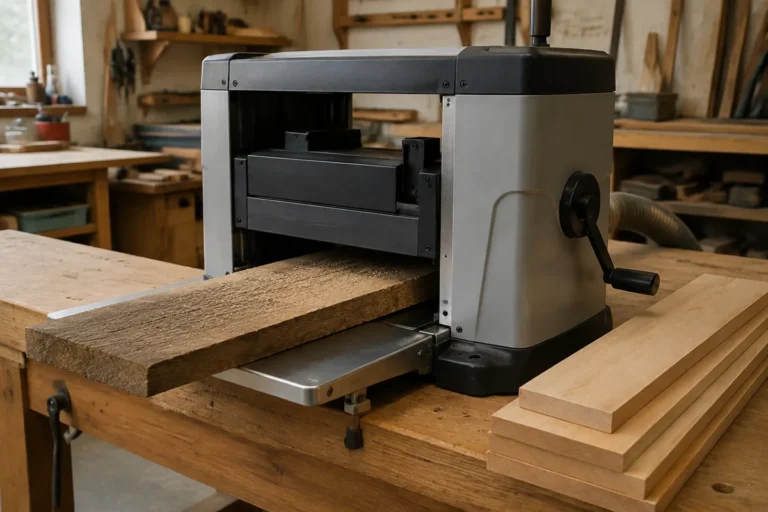
A helical-head jointer can make figured hardwood less prone to tearout, but the cutterhead is only part of the decision. Bed length, fence rigidity, knife layout, and how you feed the board matter too. For furniture parts and short stock, a compact benchtop machine may be adequate. For long, wide boards, a heavier floor-standing jointer is easier to control and more likely to leave a straight reference edge.
As an Amazon Associate we earn from qualifying purchases at no extra cost to you.

Contents
Why helical heads help with figured hardwood
On a conventional straight-knife jointer, each knife takes a full-width bite as it crosses the board. Against reversing grain, that cut can lift fibers ahead of the knife and leave deep tearout. A helical or spiral head uses small carbide inserts set at an angle, so each insert cuts a narrower section and engages the wood progressively. The result is often a cleaner surface, particularly on curly maple, figured cherry, and other stock with changing grain direction.
“Helical” does not guarantee a perfect finish. Some heads use staggered rows of square inserts; others use longer, knife-like segments. Insert geometry, cutterhead diameter, feed rate, and the board’s grain all affect the cut. A board can still tear out if you take too deep a pass or feed it in the wrong direction. Start with a light cut—about 1/32 inch is a sensible first pass on difficult stock—and reduce it further if the grain is especially wild.
Carbide inserts can be rotated when an edge dulls, which is convenient compared with setting long knives. They do not make the machine maintenance-free: inserts can chip, screws can collect pitch, and a damaged insert may leave a repeating mark in the surface.
Choose the machine for the boards you actually joint
Jointer width sets the maximum board width you can flatten in one pass, but bed length matters just as much. A short bed makes it harder to keep long stock flat through the cut. For boards around 4 feet long and under 6 inches wide, a compact machine can do useful work. If you routinely prepare 6- to 8-foot furniture parts, a longer-bed floor model is more stable. A 6-inch jointer is enough for many cabinet parts; an 8-inch machine handles wider stock but costs more and takes up more space.
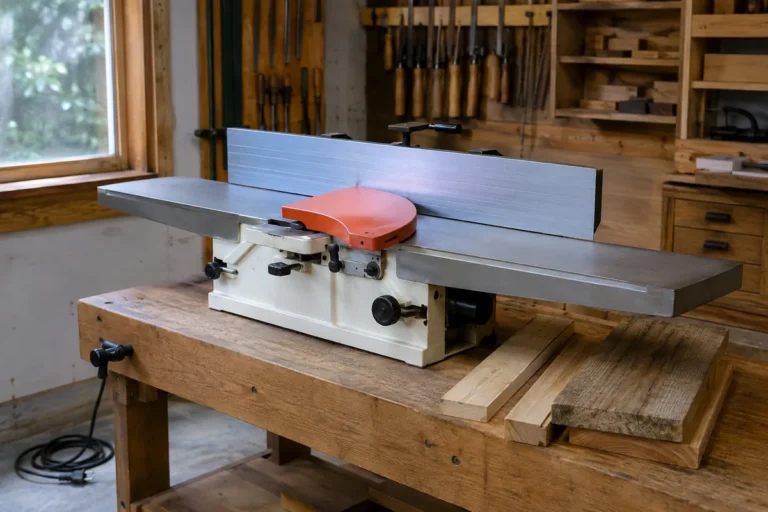
Benchtop jointers are lighter and easier to store, but their short beds and smaller fences require more careful handling. They suit hobbyists jointing narrow pieces, small panels, or stock that will be brought to final dimension on a planer. Floor-standing machines are heavier, typically have longer beds, and are less likely to shift during a cut. They are the better choice for frequent use and longer boards, provided the shop has room and a suitable dust collector.
When comparing machines, look for a fence that locks square at both ends, accessible insert screws, a useful depth-of-cut scale, and enough cutterhead clearance to inspect and rotate inserts. A dust port in the 4-inch range is common on larger jointers; small benchtop machines may use a smaller port and need an adapter. Dust collection matters because chips around the cutterhead can interfere with feeding and make the shop hazardous.
Compare common choices
| Machine type | Best fit | Typical compromise | Buying priority |
|---|---|---|---|
| Compact benchtop, 6-inch class | Short, narrow parts and limited shop space | Short beds make long boards difficult to register | Rigid fence, stable mounting, insert availability |
| Floor-standing, 6-inch class | General furniture and cabinet work | Cannot flatten boards wider than its capacity | Bed length and fence alignment |
| Floor-standing, 8-inch class | Wider stock and frequent milling | Higher price, larger footprint, greater dust demand | Long beds, solid tables, serviceable cutterhead |
What to check before buying
Compare total cost, not just the machine price. Replacement inserts should be easy to source, and the manufacturer should specify their size and screw type. Some heads use many small inserts; others use fewer larger ones. More inserts can mean a smoother cut, but also more fasteners to inspect and more replacement parts to keep on hand. Check whether the machine ships with spare inserts and the correct Torx driver.
Read the stated cutting width and bed length, then compare them with your usual rough lumber. Do not assume that a machine’s advertised width means it can comfortably flatten a board at that full width: a bowed or cupped board near capacity can be awkward to control. If you mainly work with stock under 6 inches wide, paying extra for an 8-inch machine may be less useful than buying a better-built 6-inch model.
For a small shop, a 6-inch benchtop helical-head jointer can be a reasonable entry point. It is not a substitute for a long-bed machine when preparing long boards, but it can joint short parts accurately when secured to a rigid stand or bench. Buyers who mill furniture stock regularly should compare 6-inch floor-standing helical-head jointers for longer beds and steadier support.
How to joint figured stock without avoidable damage
Inspect the grain before cutting and mark the direction that gives the cleanest test cut. With figured wood, grain direction can change across the width, so no feed direction may be ideal everywhere. Take a shallow pass and check the surface under raking light. If tearout appears, lower the cut, try feeding from the opposite end, or use a scraper or hand plane for the final surface.
Use push blocks, keep hands away from the cutterhead, and never joint stock shorter than the machine’s stated minimum length. The manual’s limit takes precedence; on many jointers, short pieces become difficult to control well before they seem dangerous. Joint one face flat first, then run that face against the fence to make an edge square. A jointer does not make a board a uniform thickness—that is the planer’s job.
Do not use the jointer to remove a large bow or twist in one aggressive pass. Deep cuts increase tearout and can pull the board out of control. Remove high spots gradually, keeping pressure over the infeed table at the start and shifting it to the outfeed table as the board advances. For very thin, narrow, or highly figured strips, use a safer milling method such as a planer sled or a hand plane rather than forcing unstable stock over the cutterhead.
When straight knives are still the sensible buy
If most of your work is straight-grained pine, poplar, or construction lumber, a straight-knife jointer may leave a perfectly usable surface for less money. Knife changes and setup take more care, but replacement knives are widely available. The helical-head premium makes the most sense when tearout is a recurring problem, cutterhead noise matters, or you value rotating carbide inserts over sharpening and setting long knives. For a shop that only joints occasional, forgiving stock, spending that money on a longer bed, better dust collection, or a solid stand may improve results more.