Best Planers for Narrow Furniture Rails and Stiles
What's inside
As an Amazon Associate I earn from qualifying purchases. This post may contain affiliate links at no extra cost to you.
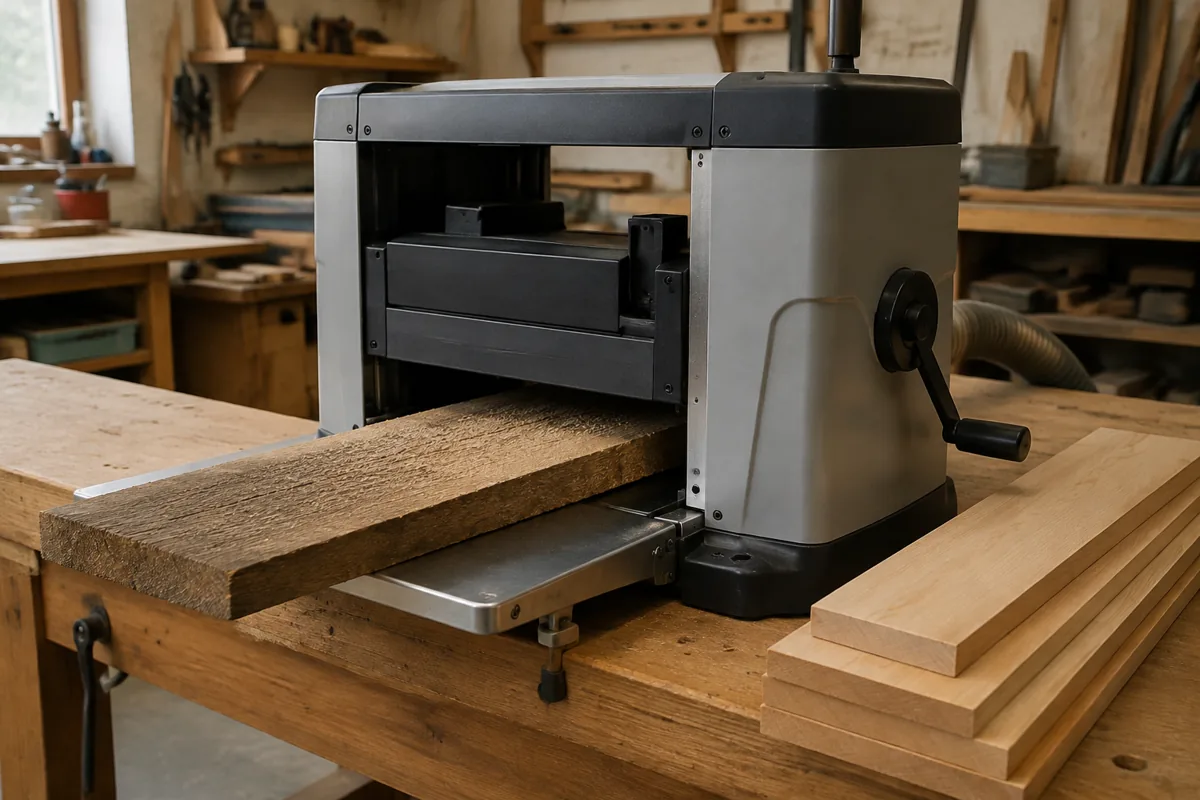
Planing narrow furniture rails and stiles is a small-stock problem, not simply a search for the widest machine. A lunchbox planer can thickness parts accurately, but short or narrow pieces may tip, chatter, or get pulled into the cutterhead. For most furniture work, a benchtop planer paired with a safe carrier sled is the practical choice. A floor-standing planer makes sense when you routinely mill larger batches or wider stock.
As an Amazon Associate we earn from qualifying purchases at no extra cost to you.



Contents
What matters with narrow parts
Check the planer’s minimum workpiece length and thickness, not just its maximum capacity. Many portable planers are intended for stock around 12 inches or longer, but the actual limit varies by machine. A short stile below that limit can be grabbed unevenly at the infeed rollers. Narrow parts also have little surface area supporting them, so a bowed or twisted blank can rock as it passes through.
Use a flat carrier sled when the workpiece is too short, too narrow, or unstable to feed safely on its own. Secure the part against lateral movement with wedges or hot-melt glue, and keep fasteners well clear of the cutter path. The sled must be long enough for the planer’s rollers to grip it before they reach the workpiece and continue gripping after the workpiece exits. Follow the machine manual’s rules for carrier boards; not every planer allows them.
Which planer type to buy
| Type | Best for | Trade-off for narrow rails and stiles |
|---|---|---|
| Benchtop, two-knife | Occasional milling and modest furniture batches | Lower initial cost, but more knife marks and often more noise |
| Benchtop, helical-style cutterhead | Regular shop use, figured wood, quieter cutting | Usually costs more; small inserts still require careful setup and feed |
| Floor-standing planer | Frequent production and wider stock | More capacity and mass, but higher cost and little benefit if parts are narrow |
For a home shop making doors or face frames now and then, a capable benchtop machine is usually enough. Compare benchtop thickness planers by minimum stock length, cutterhead type, bed support, dust collection, and the availability of replacement knives or inserts. A wider cutting capacity does not make a machine better at gripping a narrow part.
Cutterhead and surface quality
Traditional straight knives are affordable to replace and can leave a clean finish when sharp and aligned. They are also sensitive to nicks: one damaged edge can leave a repeated ridge along the board. Helical-style heads use multiple small inserts, which can reduce tear-out on figured grain and make insert replacement local rather than requiring a full knife change. They cost more, and “helical” does not guarantee a flawless finish.
For rails and stiles that will be painted, a light sanding after planing may be all that is needed. For clear finishes, test the machine on the same species and grain direction as the project. Planing against reversing grain can tear fibers even with a premium cutterhead. Take shallow finishing passes—about 1/32 inch is a reasonable starting point—and inspect the surface rather than trying to remove all the material in one pass.
Feed narrow stock without snipe or kickback
Do not put a loose, short piece through the planer just to see whether it feeds. The rollers may pull it in crooked, leave a deep bite, or eject it. Keep hands clear of the opening and never use fingers to guide stock near the cutterhead. A carrier sled helps support the piece, but it does not override the manufacturer’s minimum-length restriction or replace guarding and safe feed practice.
Support long sleds at both ends so they stay level with the planer bed. If the leading end dips, the cutterhead may take a deeper cut near the beginning; a similar dip at the exit can cause snipe. Joint one face of the blank first, then plane the opposite face. A thickness planer references the face against its bed—it does not flatten a twisted board by itself.
Leave extra length on rails and stiles when the design allows. Plane them in longer blanks, then crosscut to final length. This is often safer and gives more consistent results than trying to thickness very short parts. For a batch, keep pieces of similar thickness together and feed them with even spacing, following the manual’s instructions for minimum spacing and stock dimensions.
A practical buying checklist
Before choosing a machine, measure the shortest parts you expect to plane and compare them with the manual’s minimum length. Check whether the machine accepts a carrier sled, how quickly knives or inserts can be replaced, and whether you have adequate dust collection. Planers produce a large volume of chips; a small shop vacuum may clog or fail to keep up. If you are comparing cutterhead options, browse benchtop planers with helical-style heads, but verify the specific model’s capacity and service parts before buying.
Spend extra on a larger floor-standing machine only if its capacity, duty cycle, or stability solves a real shop need. For occasional furniture parts, the cheaper benchtop planer is fine when paired with sound milling practice and a properly supported sled. If the parts are consistently shorter than the machine’s permitted minimum, choose a different method—such as thicknessing longer blanks before crosscutting—rather than forcing the planer to do a job it was not designed to handle.