Best Planers for Small Furniture Shops Processing Rough Lumber
What's inside
As an Amazon Associate I earn from qualifying purchases. This post may contain affiliate links at no extra cost to you.
Small furniture shops usually need a thickness planer that can turn rough boards into consistent stock without consuming the budget or the entire workshop. The right choice depends less on maximum cutting width than on how much lumber you process, how rough it is, and whether you already have a jointer. A compact benchtop planer can be excellent for occasional hardwood work, while a heavier stationary machine pays for itself when you are flattening boards every week.
Contents
What a planer does—and what it does not do
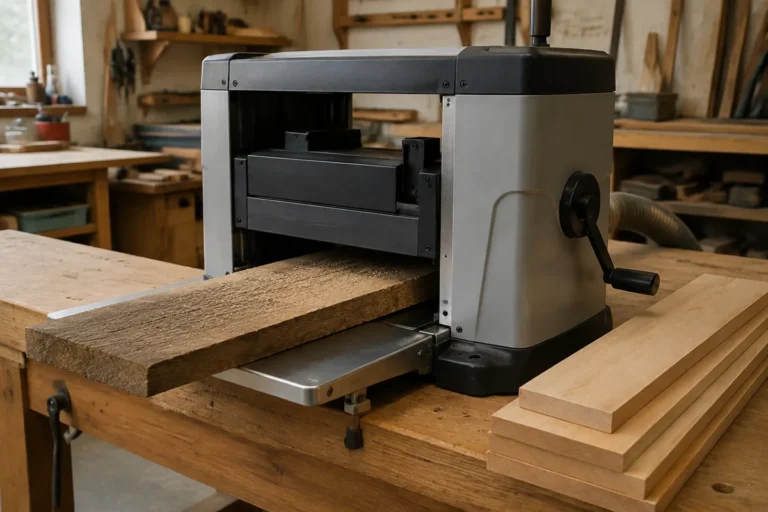
A thickness planer makes the top face parallel to the bottom face and brings boards to a repeatable thickness. It does not flatten a badly cupped or twisted board by itself. One face must first be made reasonably flat, usually with a jointer, sled, or router-based flattening setup. Feeding a rocking board directly into a planer often produces a board that is uniformly thin but still twisted.
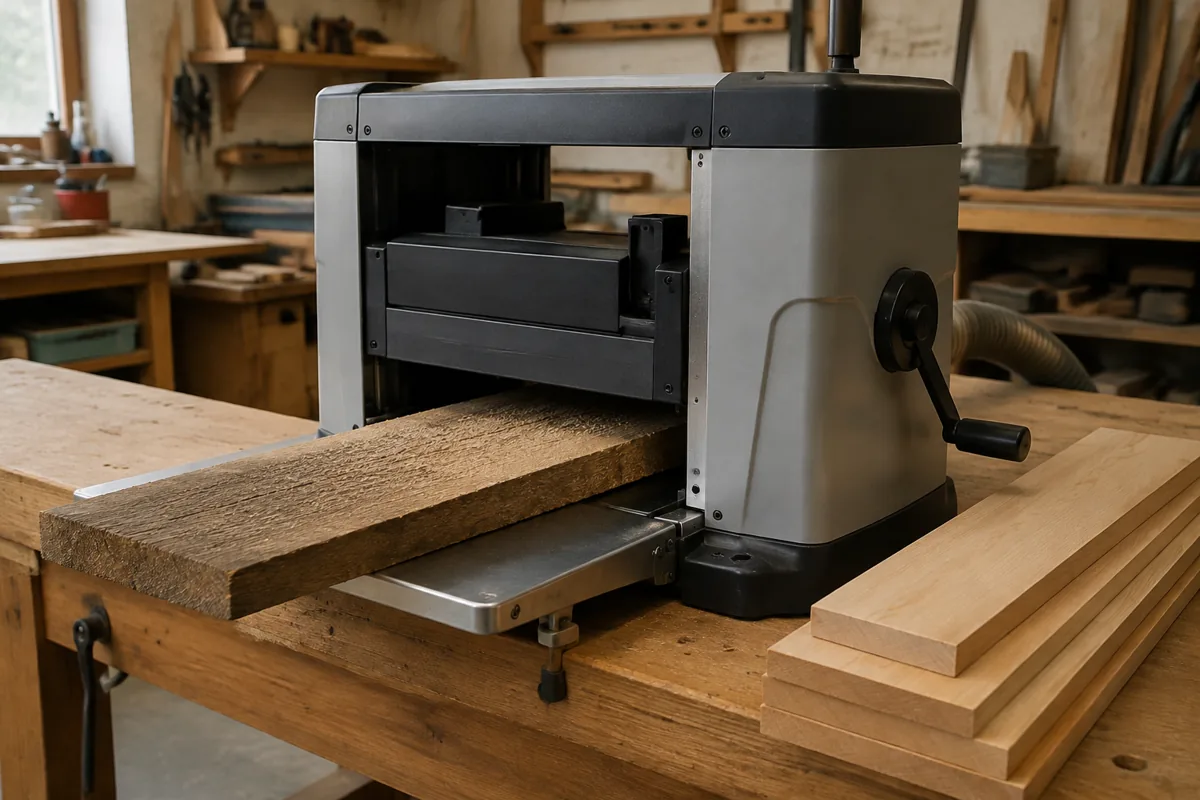
For small furniture shops, a benchtop thickness planer is normally the starting point. Most accept stock around 12 to 13 inches wide and roughly 6 inches thick. That covers table aprons, cabinet parts, shelves, and many boards sold as 8/4 lumber. Wider 15-inch machines are more capable but need more floor space, stronger dust collection, and a higher electrical and purchase budget.
The best planer types for a small shop
| Planer type | Typical capacity | Best use | Main compromise |
|---|---|---|---|
| Portable benchtop | 12–13 inches wide; about 6 inches thick | Occasional furniture parts and modest production | More noise, vibration, and snipe |
| Benchtop with helical or segmented cutterhead | 12–13 inches wide | Hardwood, figured grain, and cleaner finish | Higher purchase price; inserts need care |
| 15-inch stationary planer | 15 inches wide; often 6 inches thick or more | Regular production and wider panels | Heavy, expensive, and dust-collection hungry |
| Industrial floor planer | 15–24 inches wide or more | Continuous commercial work | Usually excessive for a small furniture shop |
For most one- or two-person shops, the practical sweet spot is a 12- or 13-inch machine with a helical or segmented cutterhead. A conventional straight-knife head is cheaper and can cut quickly, especially in straight-grained softwood. However, knives dull faster when processing reclaimed lumber or abrasive species, and a nick in one knife leaves a visible line across every board.
Helical cutterheads use many small inserts. They generally reduce tear-out in difficult grain, run more quietly, and let you rotate or replace one damaged insert instead of removing a long knife. They are not magic: feeding figured wood in the wrong direction can still tear the grain, and inserts cost more than sharpening a simple knife. If your stock is mostly pine, poplar, or clean maple, the cheaper straight-knife option is perfectly serviceable.
Capacity, motor power, and feed rate
Do not choose by motor horsepower alone. Portable machines commonly use a 120-volt circuit and remove material at a useful rate, but their advertised peak horsepower does not represent continuous cutting power. A machine that slows badly under a 1/16-inch cut will be frustrating on wide, dense boards even if its label shows a large motor.
For rough lumber, start with cuts of 1/32 inch or less until the board is stable and the machine is feeding reliably. Taking a 1/16-inch cut on a 12-inch-wide hardwood board can overload a compact planer, trip a breaker, or leave a rough surface. Several light passes are slower but reduce tear-out and motor strain. Reverse the board end-for-end between passes when dealing with grain that changes direction.
Two feed speeds are useful. A faster setting removes stock efficiently; a slower setting improves the finish. If the machine has only one speed, plan on a light finishing pass rather than expecting a single pass to produce furniture-ready surfaces. Feed rollers should grip firmly without crushing soft wood, and extension tables should support long boards at the same height as the bed.
Cutterheads, snipe, and surface quality
Snipe is a deeper cut at the leading or trailing end of a board. It comes from the board lifting or dropping as it leaves the support of one roller. It is common on portable planers and is not always a sign of a defective machine. Keep the cutterhead locked if that feature is provided, support long stock before and after the machine, and feed a sacrificial board immediately before and after valuable pieces. Leave extra length and cut the sniped ends off later.
A planer with a longer bed and heavier cast-iron tables usually controls snipe better than a lightweight unit. It also stays more stable when removing stock from wide boards. That additional mass is worthwhile if you routinely process 6-foot or longer furniture components, but it is not necessary for short legs, rails, and cabinet parts.
Dust collection is part of the purchase
Planers produce a large volume of chips. A shop vacuum may handle occasional narrow boards, but it can clog quickly and may not keep up with continuous feeding. For regular work, pair the planer with a dust collector rated around 1,000 CFM or more at the machine, using a short 4-inch hose whenever possible. Check the planer’s chip-ejection hood before buying; some portable units launch chips aggressively if the hose connection is restrictive.
Noise is another practical issue. Portable planers commonly exceed 90 decibels during cutting, so hearing protection is mandatory. A helical head often sounds less harsh, but the motor and feed rollers remain loud. If the machine will run near living space, a heavier enclosed machine may be easier to tolerate than a lightweight planer vibrating on a stand.
What to buy for different workloads
Choose a basic straight-knife 12-inch portable planer if you process a few boards per month and can accept sanding or occasional knife changes. It is the sensible low-cost choice for a new shop.
Choose a 13-inch helical thickness planer if you regularly work with hardwood, figured lumber, or boards where reducing tear-out matters. The cleaner cut and replaceable inserts are worth paying for when downtime costs more than the initial price.
Move to a 15-inch stationary planer when your work routinely exceeds 12 inches in width, when you flatten batches of parts, or when portable machines are slowing production. Before buying, measure doorways, confirm circuit requirements, and budget for dust collection, mobile-base hardware, replacement knives or inserts, and enough infeed and outfeed space. A cheaper planer is fine when its limits match your workload; the expensive machine is justified only when those limits are costing time every week.