Best Stationary Planers for Cabinet Door and Drawer Stock
What's inside
As an Amazon Associate I earn from qualifying purchases. This post may contain affiliate links at no extra cost to you.
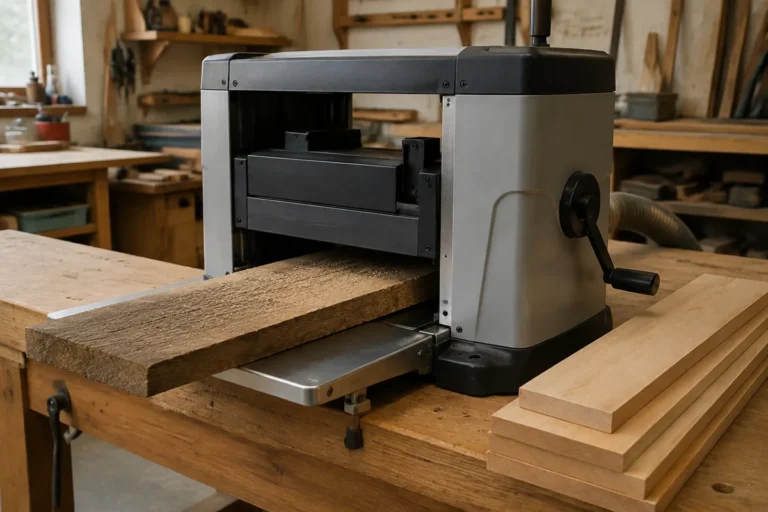
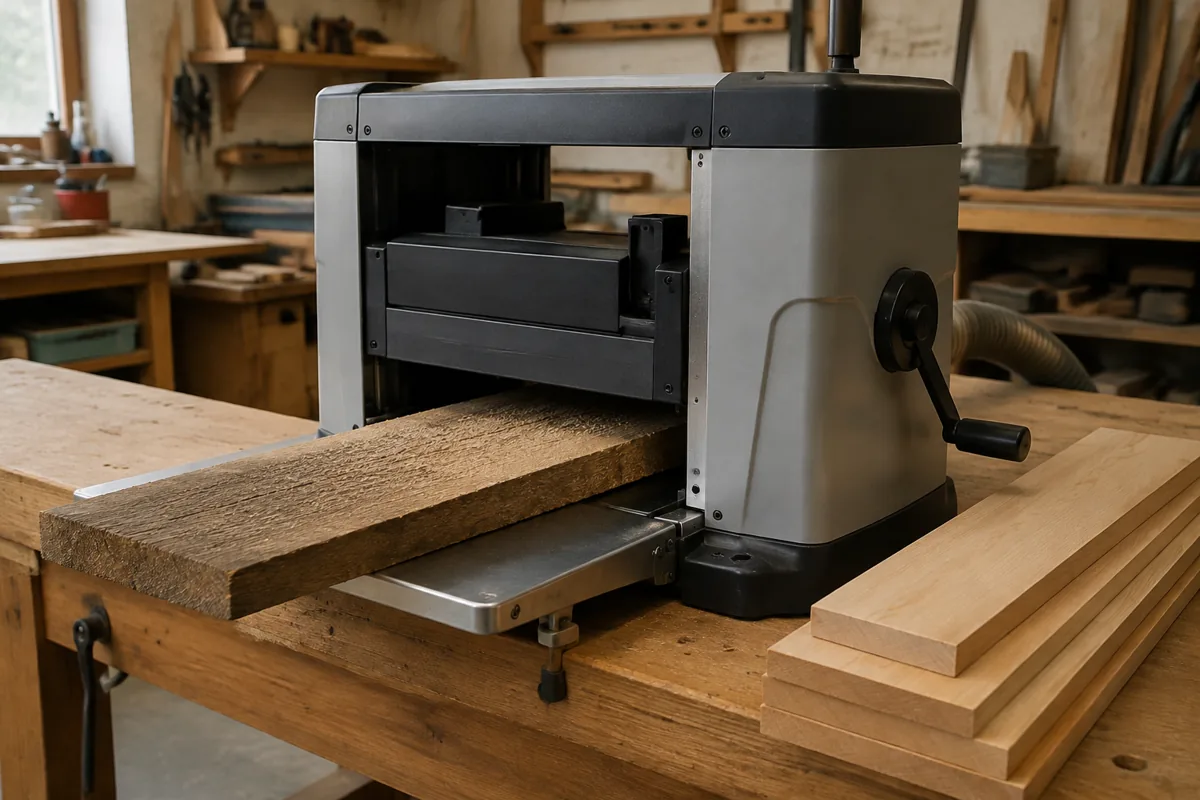
Cabinet doors and drawer fronts need flat, consistent stock, but the right planer depends on the parts you are making. A lunchbox planer can thickness solid-wood rails and drawer sides. It cannot safely or reliably turn a wide, assembled cabinet door into a thinner one: raised panels, joints, paint, and uneven surfaces make that a different job. For most small shops, the best purchase is a benchtop thickness planer sized for the stock—not a large industrial machine.
As an Amazon Associate we earn from qualifying purchases at no extra cost to you.

Contents
What a planer can—and cannot—do
A thickness planer makes the two faces of a board parallel and brings it to a target thickness. It does not flatten a bowed board by itself. If you feed a bowed piece through without first flattening one face, the planer can reproduce the curve while making the board uniformly thinner. Flatten one face with a jointer, a planer sled, or another reliable method, then plane the opposite face parallel.
For cabinet work, a planer is useful for bringing door rails and stiles, drawer sides, and solid-wood edging to consistent thickness. It is not a substitute for a wide-belt sander or drum sander on a glued-up door panel, and it is not a good choice for removing finish from a completed door. Check the machine’s maximum width and thickness against your parts before buying; many portable models accept stock around 12 to 13 inches wide, which is narrower than some cabinet doors.
Planer types compared
| Type | Typical use | Trade-off |
|---|---|---|
| Benchtop lunchbox planer | Solid-wood rails, stiles, drawer parts, and narrow panels | Affordable and portable; limited width, dust collection, and feed consistency |
| Portable planer with helical-style cutterhead | Frequent work, figured wood, and quieter cutting | Usually costs more; inserts can be rotated or replaced, but the machine still needs sound setup and dust collection |
| Floor-standing thickness planer | Regular batches and wider or heavier stock, depending on capacity | More stable and capable, but takes space, power, and a larger budget |
| Wide-belt or drum sander | Flattening or finishing glued panels and delicate assemblies | Better suited to broad panels, but it is not a thickness planer and may be costly |
Choose capacity and cutterhead for the parts
For a hobby shop making face-frame components and drawer boxes, a 12-inch benchtop thickness planer is often enough. Measure the widest real part, not just the lumber you usually buy. Leave a little margin for imperfect edges and future projects. If your doors include solid panels wider than the planer’s stated capacity, do not assume you can rotate and feed them safely; plan to use another method.
Most portable planers use either straight knives or small replaceable inserts arranged in a helical-style head. Straight-knife machines are generally the less expensive option and are perfectly serviceable for ordinary cabinet stock. They can leave visible scallops or tear-out in figured grain, and dull knives often produce fuzzy, chipped edges. An insert head usually cuts more quietly and leaves less severe tear-out in difficult grain, though it does not eliminate tear-out. Compare the full price of replacement knives or inserts, not just the machine price.
A benchtop planer with an insert cutterhead makes sense if you plane frequently, work with figured hardwood, or want to avoid sharpening and setting long knives. For occasional straight-grained drawer parts, a basic knife-head planer is often the better value. Either way, the cutterhead is only one factor: a solid infeed and outfeed support setup can matter as much as the head when handling long boards.
Manage snipe, tear-out, and thickness
Snipe is a deeper cut near the leading or trailing end of a board, commonly a few inches long. It is especially frustrating when parts are cut to finished length first. Plane longer stock, support both ends level with the planer table, and trim the ends afterward. Many portable machines also allow small adjustments to the extension tables; test a scrap before running a batch of door components.
Take modest cuts rather than forcing the machine to remove a large amount at once. The safe depth depends on wood species, board width, machine power, and feed rate, so follow the manual. If the motor slows, the board stalls, or the surface starts tearing badly, reduce the cut. Keep hands away from the opening, use the specified dust collection, and do not plane short pieces unless the manufacturer explicitly permits them. Never feed loose, cracked, or badly cupped stock that can rock or catch.
Planer thickness settings are not a guarantee of exact finished dimensions. Make a test pass, measure with calipers or a reliable thickness gauge, and sneak up on the target. For paired door parts, plane them together where practical, then verify thickness at several points. A small difference can show up as a proud rail or uneven door face after assembly.
A practical buying checklist
Check maximum width, maximum thickness, minimum safe workpiece length, motor requirements, cutterhead replacement cost, and dust-port size. Planers produce a large volume of chips quickly; a shop vacuum may struggle with sustained use, while a suitable dust collector helps maintain airflow and reduces clogging. Also account for the machine’s footprint and weight. A portable planer that is difficult to support or store may be less useful than a slightly larger floor-standing unit in a dedicated shop.
If you are choosing between spending more on a planer and buying a jointer, consider how you prepare rough lumber. A planer alone cannot reliably flatten one face, so a jointer or a safe sled setup may be the more important missing tool. For prepared, straight stock bought from a lumber supplier, the cheaper planer can be entirely adequate. For regular batches of rough hardwood, budget for the complete workflow rather than expecting the planer to solve every milling problem.
For most cabinetmakers working in a home shop, a capacity-appropriate benchtop planer is the sensible starting point. Upgrade when its width, finish quality, duty cycle, or support needs are clearly limiting the work—not simply because a more expensive cutterhead sounds better.