How to Choose Jointer Knife Type for Figured Wood
What's inside
As an Amazon Associate I earn from qualifying purchases. This post may contain affiliate links at no extra cost to you.
Contents
Why knife type matters on figured wood
Curly maple, bird’s-eye maple, highly figured walnut, and other reversing-grain boards can tear out on a jointer even when the knives are sharp. The grain changes direction along the board, so a cut that works with the fibers in one spot may lift them in the next. Knife geometry and cutting action affect how cleanly the jointer shears those fibers, but setup, feed direction, and depth of cut matter just as much.
For occasional work, sharp conventional straight knives can be perfectly adequate. If you routinely joint expensive or difficult-to-replace figured stock, a helical or spiral cutterhead with small carbide inserts can make tear-out less severe and maintenance more convenient. Neither type guarantees a flawless surface: expect to adjust technique and, sometimes, follow the jointer with a hand plane or scraper.
Know the options
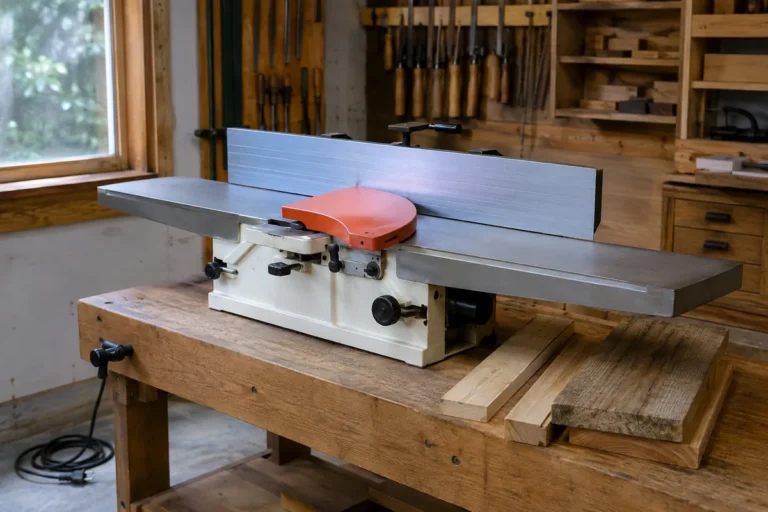
“Helical” and “spiral” are often used loosely in product descriptions. Check the cutterhead’s actual insert layout and your machine’s compatibility rather than relying on the label. Straight-knife heads use long knives spanning the cutterhead. Insert heads use many short, typically square or rectangular carbide cutters, set at an angle to the direction of travel.
| Type | Cutting action and surface | Upkeep and cost | Best fit |
|---|---|---|---|
| Straight HSS knives | Full-width knives take a continuous cut; tear-out is possible where grain reverses. Can leave faint knife marks if setup is off. | Usually the least expensive replacement option. Knives must be sharpened or replaced and carefully set at equal height. | Budget-conscious shops, softer or cooperative grain, and users who can set knives accurately. |
| Straight carbide knives | Similar cut to straight HSS, but carbide generally holds an edge longer. It does not eliminate reversing-grain tear-out. | Costs more than HSS; availability depends on the jointer. | Shops that want longer edge life but prefer a straight-knife head. |
| Angled carbide inserts | Small cutters slice across the grain at an angle. Often produce less severe tear-out and finer marks than straight knives. | Higher initial cost. Individual damaged inserts can usually be rotated or replaced. | Frequent work with figured wood or a preference for localized insert maintenance. |
Choose for your work, not the label
Start with the wood you actually joint. If figured boards are occasional and you can tolerate a little extra cleanup, keep a straight-knife head and buy a quality set of compatible knives. A replacement straight-knife set is a sensible purchase only after you confirm the knife length, thickness, hole pattern, and steel type required by your jointer.
If you regularly process curly or reversing-grain stock, consider an aftermarket jointer cutterhead with carbide inserts. Match the exact machine model, cutterhead diameter, bearing arrangement, drive system, and mounting dimensions. Do not assume that a head advertised for a similar-width jointer will fit yours. A retrofit may also require new bearings, belts, or electrical work, and installation can take more time than the listing suggests.
Compare total ownership cost, not just the price of the head. Straight knives can be sharpened, but changing and resetting them takes care. Inserts cost more up front, and a chipped edge can leave a repeating mark until you rotate or replace that cutter. Keep spare inserts on hand if downtime matters. With either type, avoid jointing stock with embedded grit, fasteners, or loose knots; a single impact can damage a cutting edge.
Get cleaner cuts with either head
Before blaming the knives, check that they are sharp, clean, and set correctly. On a straight-knife head, all knives must be at the same height; a knife set too high can produce ridges, while one set too low may not cut cleanly. On an insert head, inspect for a chipped or dirty cutter. If a narrow ridge repeats at the same spacing, look for a damaged insert or a setup problem rather than assuming the whole head is worn out.
Take a light cut. For figured stock, start around 1/32 inch or less, then test a scrap from the same board. Deep cuts increase the chance of tear-out and put more load on the cutterhead. Feed steadily without forcing the wood, and use push blocks that keep your hands clear while holding the board flat. Joint one face flat before jointing an edge; a twisted or rocking board can shift during the cut and create a safety hazard as well as a poor surface.
Test both feed directions when the grain changes along the board, but do so only if the board remains safely supported and the operation follows your machine’s manual. A direction that improves one section may worsen another. If tear-out remains, reduce the depth again, consider a skewed-insert cutterhead, or leave a small amount of material for scraping or hand-planing. For a finished surface, many woodworkers joint only enough to establish a flat face, then use a planer with a suitable strategy or hand tools for the final cleanup.
A practical buying checklist
Confirm that replacement knives or a retrofit head are explicitly compatible with your jointer. Check the manufacturer’s instructions for knife changes, cutterhead installation, and adjustment; disconnect power before service, and do not run the machine with missing, loose, or damaged cutters. For insert heads, verify that inserts are indexed consistently and tightened to the specified torque. Overtightening can damage a cutter or its seat.
Choose straight knives if low purchase cost and easy sourcing matter most, and you are comfortable maintaining them. Choose angled carbide inserts if figured wood is a regular part of your work and you value reduced tear-out, longer edge life, and the option to replace one cutter at a time. Whichever you buy, a sharp edge, shallow cut, stable workpiece, and careful test pass will make more difference than marketing claims about any single knife type.