How to Choose Jointer Bed Length for Long Boards
What's inside
As an Amazon Associate I earn from qualifying purchases. This post may contain affiliate links at no extra cost to you.
Contents
Why Bed Length Matters More Than Cutterhead Width
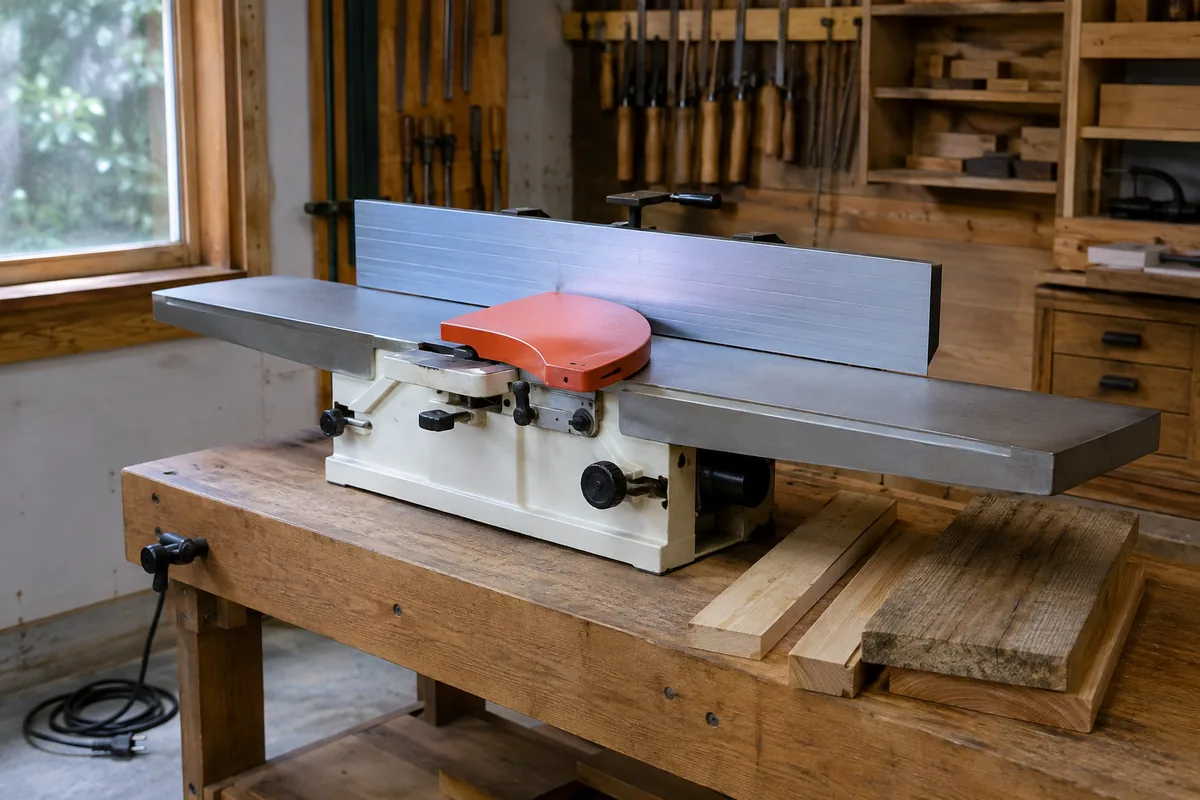
When people shop for a jointer they obsess over cutterhead width – 6 inch vs. 8 inch – but for straightening long boards, bed length is the real limiter. The jointer only cuts straight if the board is fully supported and referenced to the tables before and after the cutterhead. If the bed is too short, a long board will tip, rock, or flex, and you will joint a bow or twist right back into it.
A short bed does not make flattening impossible, it just makes it inconsistent. You can get one 5-foot board flat with skill and a short jointer, but you cannot do it repeatably for eight boards for a table top without fighting snipe, taper, and fatigue. If you regularly work with stock 4 feet and longer, bed length should drive your buying decision more than horsepower or helical vs. straight knives.
The Rule of Thumb for Board Length vs. Bed Length
The old shop rule is that you can reliably flatten a board up to about 2x the total bed length. That is generous and assumes good technique. A more realistic working limit for most woodworkers is 1.5x to 2x.
So on a 46-inch benchtop jointer, you can expect clean results to about 3 to 4 feet. On a 66-inch floor-standing 6-inch jointer, about 5 to 6 feet. On a 72 to 76-inch long-bed 8-inch jointer, about 6 to 7.5 feet is comfortable. Beyond that you are bridging the board over the cutterhead without full support, which means any downward pressure in the wrong place will create a hollow or a taper.
This assumes the board is reasonably stiff. A thin, 4/4 board 8 inches wide and 6 feet long will sag under its own weight if it overhangs the table by 2 feet. That sag changes how it contacts the knives. Heavier 8/4 stock is more forgiving, but still needs support to avoid rocking on a crown or twist.
What You Actually Get by Machine Size
Actual bed lengths vary by manufacturer, but they fall into predictable ranges. Total length is infeed plus outfeed combined, measured end to end.
| Jointer Type | Typical Total Bed Length | Infeed / Outfeed Each (approx.) | Reliable Max Board Length | Trade-off |
|---|---|---|---|---|
| 6-inch benchtop | 28 – 32 inches | 14 – 16 inches | 30 – 48 inches | Portable and cheap, but too short for anything over 4 feet. Tables often aluminum and flex. |
| 6-inch floor standing | 46 – 56 inches | 23 – 28 inches | 48 – 72 inches | The classic starter jointer. Fine for cabinets and short furniture parts, struggles with 6-foot dining table boards. |
| 8-inch standard bed | 60 – 72 inches | 30 – 36 inches | 60 – 84 inches | Sweet spot for most small shops. Handles 6-foot boards well if tables are flat and coplanar. |
| 8-inch long bed / 8-inch parallelogram | 72 – 83 inches | 36 – 42 inches | 72 – 96 inches | Best value for long stock without jumping to 12-inch. Longer infeed gives better registration. |
| 12-inch and up | 82 – 90+ inches | 41 – 45 inches | 84 – 108 inches | Built for long, heavy boards. Overkill if you rarely joint over 8 inches wide. |
If you are choosing between a standard 8-inch and a long-bed 8 inch long bed jointer, that extra 10 to 12 inches of cast iron matters more than it looks on paper. It is the difference between a 6-foot board being supported on both tables through most of the cut versus teetering on the cutterhead.
What Goes Wrong When the Bed Is Too Short
The main failure mode is not that the jointer cannot cut, it is that it cuts the wrong shape. With insufficient support, three things happen:
First, tip and snipe. As the board exits the cutterhead, its unsupported tail drops. That lifts the edge off the outfeed table and the knives take a deeper bite at the end, leaving a dip in the last 3 to 6 inches. You will chase it by taking more passes and make it worse.
Second, rocking on twist or bow. A long board with a slight twist will pivot on the high spots if the tables are short. Instead of shaving the high corners, you press the board flat with hand pressure, flexing it, and the jointer just makes a twisted board thinner. Long beds force you to use light pressure over the tables and let the high spots register.
Third, taper on face jointing. When you face-joint a wide board that overhangs the infeed table, the unsupported weight levers the leading edge up. You take more off the front than the back and end up with a board that is flat but wedge-shaped in thickness, which then will not plane parallel.
You can feel when this is happening. If you need significant downward pressure near the ends of the board to keep it from tipping, the bed is too short for that length.
How to Get Away With a Shorter Bed
If you already own a short jointer or are tight on space and budget, you can extend the usable range, but understand the limits. Roller stands and outfeed supports help, but they are not the same as a longer machined table.
Set roller stands for jointer exactly level with the infeed and outfeed tables, not slightly below. A stand set low still allows sag. Place one within 12 inches of the end of each table so the board transfers smoothly without dropping. Even then, rollers add friction and a pivot point – they cannot prevent a thin board from flexing under hand pressure.
Technique matters more on a short bed. Take very light cuts, 1/32 inch or less, and keep pressure only over the tables, never over the cutterhead. For face jointing, start with the concave side down so the board has two stable contact points. Use a push block over the outfeed table as soon as enough board is across, and shift all pressure to the outfeed. For edge jointing long boards, joint in sections: take a few short passes just on the high middle to knock down bow, then take full-length passes.
When this is fine: if your long boards are only occasionally over 5 feet and you do not mind extra setup and test cuts, a 56-inch 6-inch jointer with supports will get you by. When it is not fine: if you are flattening 6 to 8-foot 4/4 stock for tabletops or doors every week, you will save hours and lumber with a longer bed.
What to Buy Based on the Work You Do
Buy for the longest board you flatten at least once a month, not the longest you have ever flattened.
If you build mostly cabinets, boxes, nightstands, and cutting boards with stock under 4 feet, any floor-standing 6-inch jointer with a 46-inch or longer bed is sufficient. Do not pay extra for a long-bed 8-inch you will not use. Spend the savings on a good planer and sharp knives.
If you build dining tables, workbenches, entry doors, or bookcases with 6-foot-plus stock, get the longest bed you can fit and afford. In practice that means a standard 8-inch jointer at minimum, and ideally a long-bed 8-inch. The jump from 56 inches to 76 inches of bed length is more valuable than the jump from 6 to 8 inches of width if long boards are your bottleneck. A 6 inch floor standing jointer can edge-joint a 7-foot board for glue-up, but it will take much more fiddling to get a flat face on that same board than an 8-inch long bed will.
Check two specs before you buy: total bed length and table construction. Look for cast-iron tables, not aluminum extrusions, and parallelogram adjustment if possible. Parallelogram beds stay coplanar as you raise and lower the tables, which matters more on long beds. Also measure your shop. An 83-inch jointer needs at least 14 feet of wall to run an 8-foot board through without hitting anything, plus infeed clearance.
For most one-person shops that work with 4/4 and 5/4 hardwood, an 8-inch jointer with a 72-inch or longer bed is the point of diminishing returns. Beyond that you are paying for width and weight, not usable straightness. If you need to handle 10-foot slabs regularly, skip the jointer upgrade and consider a planer sled or a router flattening jig instead – no jointer bed is long enough to be practical at that length without industrial space.