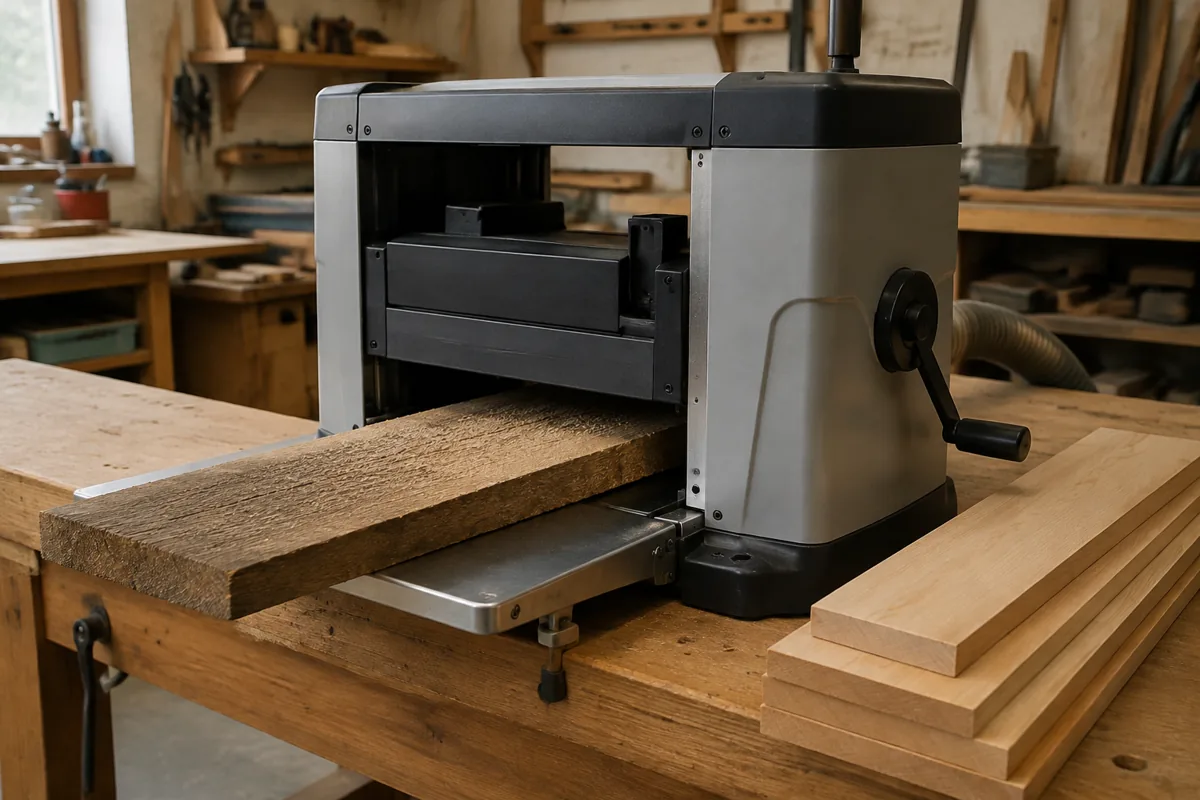
How to Prevent Snipe When Planing Long Cabinet Parts
What's inside
As an Amazon Associate I earn from qualifying purchases. This post may contain affiliate links at no extra cost to you.
Snipe is the shallow dip a planer can leave near the leading or trailing end of a board. On long cabinet parts, even a small dip can show up as a gap at a face-frame joint or a hollow under a straightedge. The cause is usually a change in how firmly the rollers hold the board as it enters or leaves the machine—not a bad cutterhead.
You can reduce snipe by supporting the work, keeping it flat against the bed, and feeding it so the rollers maintain control through the cut. Start with the adjustments you can make for free before buying accessories.
Contents
Why snipe happens
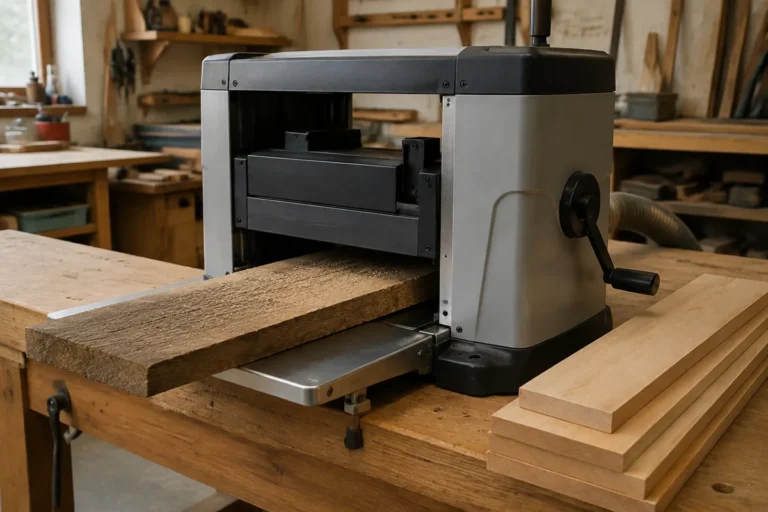
A thickness planer has infeed and outfeed rollers that press the board onto the bed. When the leading end first reaches the infeed roller, or the trailing end passes the outfeed roller, only one roller may be gripping the board. The board can tip slightly, letting the end rise into the cutterhead. That produces a deeper cut at the end.
Long, heavy cabinet parts make this more noticeable. Their weight can pull an unsupported end down, while a narrow or warped board may rock on the bed. Snipe is also more likely if the planer’s tables are poorly aligned, the rollers are dirty, or the feed mechanism is worn. A board that bows or twists under its own weight can still snipe even when the machine is adjusted well.
Set up the planer first
Unplug the machine before cleaning or checking it. Remove dust and resin from the bed and rollers using the method recommended in the manual. A slick, clean bed helps the board feed evenly; dirty rollers may slip or grip unevenly.
Check the infeed and outfeed tables with a straightedge. On many portable planers, the tables should be level with or slightly raised at their outer ends, but follow the machine’s instructions: the right setting varies by design. If the tables droop, the work can tip as its weight moves off the bed. Tighten loose fasteners and inspect for damaged rollers or feed parts before trying to compensate with technique.
Keep the board flat on the bed as it enters and exits. Do not push down hard on the free end; that can change the board’s angle and make the opposite end lift. Use light pressure to guide the stock until both rollers have control, then release it. At the exit, support the board without lifting it into the cutterhead.
Support long stock without steering it
Set roller stands or a long outfeed table near the planer’s bed height. For a long cabinet side, support the board far enough from the machine that the overhang does not sag, but do not force the board up or down. A stand set even a fraction too high can lever the board against the cutterhead; one set too low can let it dip. Check alignment with a straightedge or a scrap board before planing your finished parts.
Roller stands are inexpensive and easy to move, but their rollers can encourage a narrow board to drift sideways. A flat, smooth support table gives more continuous support and is often better for wide panels. Either approach is useful only if it stays aligned and does not bind the stock.
Feed technique and stock preparation
Use a steady feed. Do not stop midway through a pass, and avoid pulling or pushing the board aggressively while the rollers are driving it. If you have several boards of similar thickness, feed them one after another without a long pause; this does not eliminate snipe, but it can make the roller action more consistent.
Take modest cuts, especially on wide or hard stock. A cut of about 1/32 inch is a sensible starting point for final sizing; heavier cuts increase load and can worsen chatter or uneven feeding. Make a test pass on scrap from the same material before running cabinet parts. Measure the first and last few inches with calipers or a reliable thickness gauge, then adjust support or technique.
Do not try to plane a board that rocks badly or has severe twist as if it were flat. A thickness planer makes the opposite face parallel to the face resting on the bed; it does not flatten a warped board. Flatten one face first with a jointer or a suitable sled, or the board may shift and produce inconsistent thickness as well as snipe.
Which fix makes sense?
| Method | Cost and effort | Best use | Trade-off |
|---|---|---|---|
| Correct feed technique | Free; takes practice | Small amounts of snipe on occasional work | May not fully control a heavy, long board |
| Roller stands or aligned support table | Low to moderate cost; requires setup | Long cabinet sides, rails, and stiles | Misalignment can make the problem worse |
| Sacrificial lead-in and tail pieces | Uses scrap; adds handling | Parts where end snipe must stay off the finished piece | Needs stock of similar thickness and width |
| Adjustable or folding planer tables | Moderate cost; machine-dependent | Frequent planing of long stock | Still needs careful alignment and support |
Keep snipe off the finished part
When the ends must stay clean, feed a sacrificial piece of similar thickness and roughly the same width before and after the workpiece. The lead piece helps the rollers engage before the cabinet part reaches the cutterhead; the tail piece helps keep roller pressure steady as the workpiece exits. Keep the pieces in contact, but do not force them through.
This is often the cheapest reliable solution for a small shop. The scraps need to be flat and thick enough to feed safely. Very short pieces can be unsafe or may not engage both rollers as intended, so follow the planer manual’s minimum stock-length rules. If your machine requires a minimum board length, do not use a tiny offcut as a carrier.
When an accessory is worth buying
If you plane long parts often, a stable support setup saves time. A pair of adjustable woodworking roller stands is a reasonable budget choice for occasional use. For repeated work with wide panels, a planer infeed and outfeed table may offer better continuous support, if it is designed to fit your machine.
Neither accessory cures a poorly adjusted planer. If snipe persists across short, well-supported boards, recheck table alignment, roller condition, and the machine’s setup before spending more. If the dip is only a few thousandths of an inch and you have enough stock length, you can also plane the parts slightly oversize, then trim the affected ends on the table saw. That is often simpler than chasing perfect snipe-free performance from a portable planer.