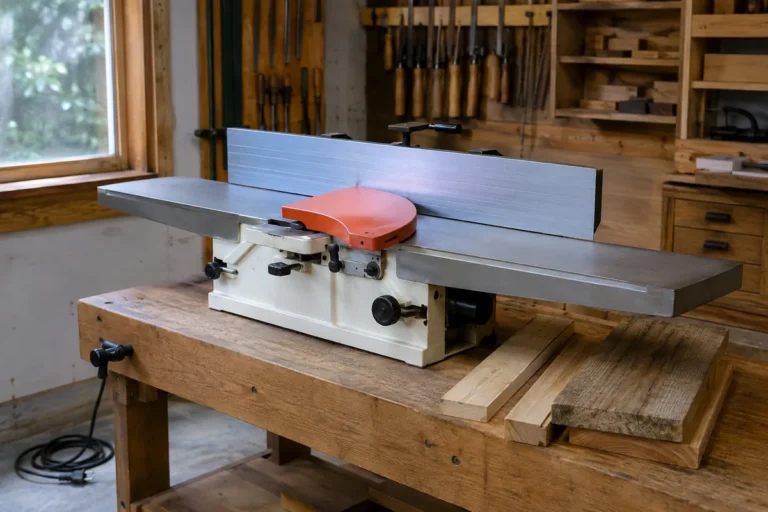
Best Jointers with Carbide Inserts for Reduced Maintenance
What's inside
As an Amazon Associate I earn from qualifying purchases. This post may contain affiliate links at no extra cost to you.
A jointer with carbide inserts reduces knife-changing work, but it does not eliminate setup, cleaning, or the need to handle cutters carefully. For a small shop, the main choice is between a helical-style cutterhead with many small inserts and a conventional straight-knife head fitted with disposable carbide knives. The right choice depends on how often you use the machine, what you cut, and whether lower maintenance is worth a higher purchase price.
As an Amazon Associate we earn from qualifying purchases at no extra cost to you.


Contents
What carbide inserts change
On an insert cutterhead, small carbide cutters sit around a rotating head, usually in a helical or staggered pattern. If one edge gets nicked, you rotate that insert to a fresh edge instead of sharpening or replacing a full-width knife. Many inserts have four usable edges, though the exact count depends on their shape and design.
Carbide holds an edge longer than typical high-speed-steel knives, especially in abrasive stock such as reclaimed lumber. It is also less forgiving of impact: a hidden nail or stone can chip an insert. The damage is usually limited to one cutter, but the board may still show a repeating mark until you rotate or replace it. Inserts also need to be seated cleanly and tightened to the manufacturer’s torque specification. Dust under an insert can leave it proud and create a ridge in the cut.
Which type should you buy?
For frequent use, figured wood, or rough stock, a helical-style head is usually the lower-maintenance choice. Its staggered cutters take narrower bites than straight knives, which can reduce tear-out and make the machine sound less harsh. That does not guarantee a glass-smooth finish: feed rate, cutter sharpness, grain direction, and board support still matter.
A straight-knife jointer with carbide replacement knives is a simpler, often cheaper route. It can be a sensible choice if you joint clean, ordinary lumber occasionally and are comfortable replacing or setting knives. Carbide does not turn a straight-knife head into an insert head; the knives are still long blades, and setup remains more sensitive to alignment across the full cutter width.
When comparing machines, check the cutterhead’s replacement-part availability and price before buying. A low initial price loses its appeal if replacement inserts are hard to find or sold only in costly sets. Browse carbide-insert jointers and compare the cutterhead design and service parts, not just the number of inserts advertised.
Cutterhead options at a glance
| Option | Maintenance | Best fit | Main trade-off |
|---|---|---|---|
| Helical head with carbide inserts | Rotate or replace individual cutters; clean seats and screws | Regular use, rough or figured stock | Higher purchase price; inserts can chip on foreign objects |
| Straight-knife head with carbide knives | Replace long knives; careful alignment may be needed | Occasional use on clean lumber | Less localized repair; knife setting can take time |
| Traditional HSS straight knives | Sharpen or replace and reset knives | Budget-conscious shops with sharpening access | More frequent sharpening and setup work |
Size the machine to the work
For face-jointing boards, bed width matters more than a large motor claim. A 6-inch jointer handles common small-shop stock; an 8-inch model gives more room for wider boards but takes more floor space and usually costs more. Bed length helps support long material, but a long board still needs infeed and outfeed support. Check the machine’s actual fence length and the footprint with the fence tilted, not only the width in the catalog listing.
Look for a fence that locks square and stays put when moved, accessible cutterhead-cover hardware, and a reliable adjustment mechanism for the tables. Verify the dust-port diameter and your collector’s capacity. A jointer produces a large volume of chips; a clogged hood can leave chips on the table and interfere with feeding. If you are buying a machine without a cutterhead you prefer, compare the cost of an aftermarket upgrade against buying a factory-equipped unit. Search for 8-inch helical-head jointers only if your space, power, and work justify that size.
Maintenance and safe use
Before changing an insert, disconnect power and follow the machine manual. Mark the first cutter you rotate so you do not lose track of which edges are fresh. Remove resin and dust from the cutter pocket, inspect the screw, and use the specified torque rather than overtightening. A stripped screw or damaged pocket can turn a quick rotation into a repair. Keep spare inserts and screws on hand; one damaged cutter should not stop a job.
For clean cuts, set a modest depth of cut—often around 1/32 inch for a finishing pass—and take more than one pass rather than forcing a heavy cut. Keep hands clear of the cutterhead, use push blocks, and never joint stock too short or thin for the machine’s safety guidance. A jointer makes one face flat and one edge square; it does not make a twisted board safe simply by removing more material. Inspect reclaimed lumber with a metal detector before it reaches the cutters.
When the cheaper option is fine
If you joint a few clean boards a month, a well-adjusted straight-knife jointer may be the better value. The savings can go toward a decent dust collector, push blocks, or longer support tables—items that affect daily use and safety regardless of cutterhead type. Choose inserts when reduced knife-setting time, longer edge life, or improved performance on difficult grain will matter often enough to repay the added cost. Carbide is a maintenance advantage, not a substitute for sound stock preparation or careful setup.