Best Stationary Table Saws for Crosscutting Long Furniture Parts
What's inside
As an Amazon Associate I earn from qualifying purchases. This post may contain affiliate links at no extra cost to you.
Crosscutting long furniture parts on a table saw is less about maximum horsepower than controlling the workpiece. A 6-foot rail, table apron, or cabinet side can lever against the fence, sag off the table, or twist as it reaches the blade. The result is a wandering cut, burn marks, kickback, or a damaged edge.
The best stationary saw for this work has a rigid table, a fence that locks square, enough table depth to support the stock, and a sensible way to add outfeed and side support. For repeated crosscuts, you also need a safe method of holding the part against a stop without trapping it between the blade and fence.
Contents
What Makes a Table Saw Suitable
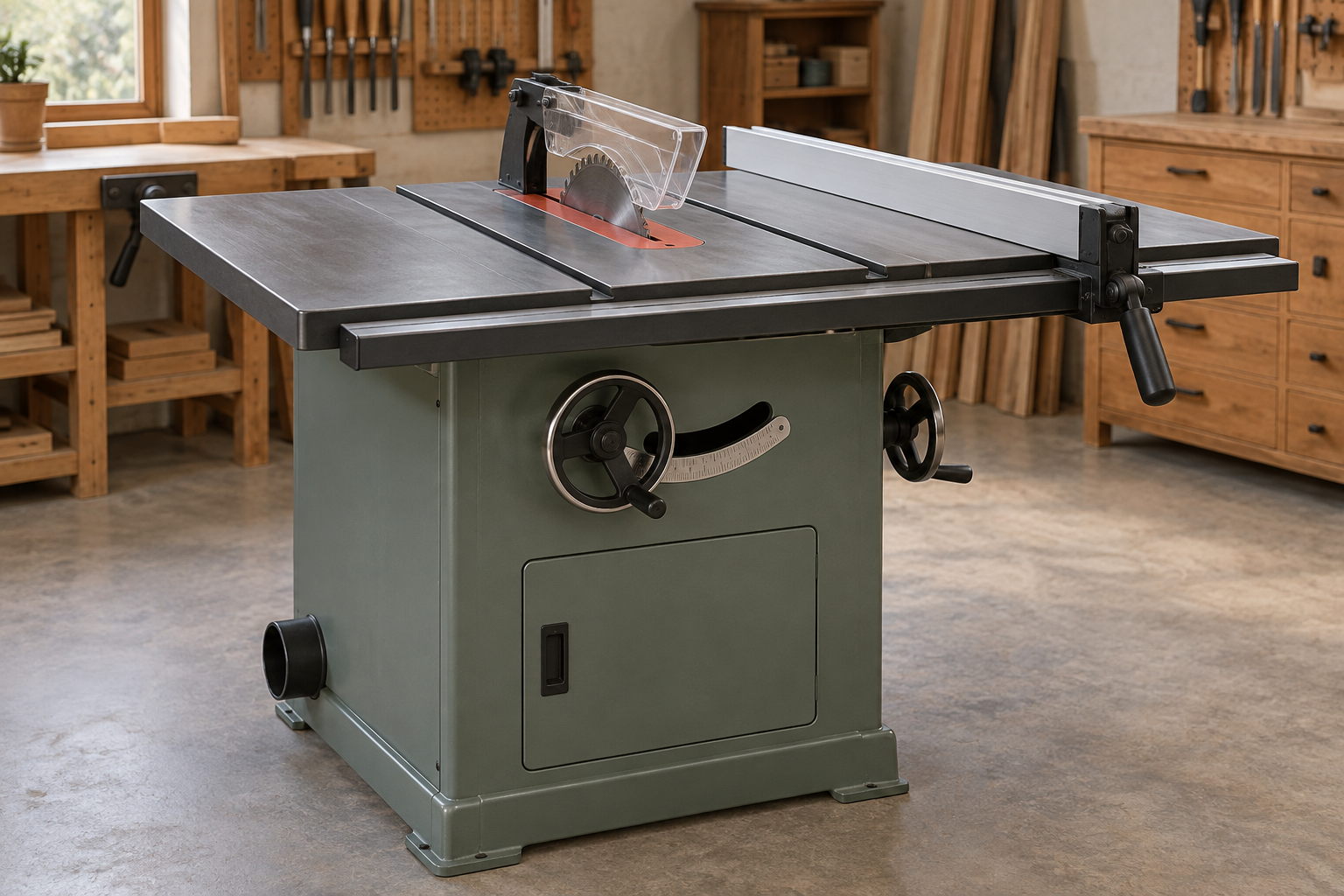
A cabinet saw is usually the strongest choice. Its enclosed steel base, cast-iron top, and trunnion assembly resist movement when a long board is pushed across the blade. Most use a 10-inch blade and a 3-hp motor, though a 1-1/2- to 2-hp hybrid saw is adequate for typical furniture lumber and sheet goods.
A good hybrid saw is often the better value for a small shop. It generally has a cast-iron center table, an enclosed or partially enclosed base, and a fence capable of locking accurately. It may vibrate slightly more than a cabinet saw, and its dust collection can be less effective, but those differences matter less than proper support and setup.
Look for at least 27 inches of rip capacity if you also work with plywood, but do not mistake rip capacity for crosscut capacity. For long crosscuts, table depth and support around the saw matter more. A 24-inch-wide top gives more control than a compact jobsite-style table, particularly with a crosscut sled.
Best Stationary Saw Types for Long Crosscuts
| Saw type | Best use | Main advantage | Main limitation |
|---|---|---|---|
| Cabinet table saw | Frequent furniture production | Rigid, powerful, stable | Expensive and heavy |
| Hybrid table saw | Small professional or serious home shop | Good accuracy for less money | Less robust trunnions and dust control |
| Sliding-table saw | Repeated crosscuts and panel work | Workpiece travels on a supported carriage | Costs more and needs more floor space |
| Compact benchtop saw | Occasional short parts | Low purchase cost | Poor support and limited stability |
A sliding-table saw is the most natural specialist for long crosscuts. The carriage supports the material as it moves, and a crosscut fence can register parts without relying on the rip fence. This is particularly useful for cabinet panels, table components, and batches of identical parts. The trade-off is cost, footprint, and the need to keep the carriage track clean and adjusted.
For most woodworkers, a 10-inch cabinet table saw is the durable all-around choice. If your work is occasional and the parts are manageable, a 10-inch hybrid table saw can be enough.
Support the Workpiece Before Cutting
Do not use the rip fence as a crosscut stop for a long part unless the offcut is completely free to move away from the blade. A long piece trapped between the fence and blade can bind as the cut closes. That is a common kickback condition.
Use a crosscut sled, miter gauge with an auxiliary fence, or sliding carriage. Set the stop on the side of the blade opposite the fence, or use a stop block that ends before the blade path. For a 72-inch board, support the infeed and outfeed ends so they remain within about 1/8 inch of the saw table height. A support that is too high lifts the stock; one that is too low lets it drop and pull the cut out of square.
Side support is just as important. A long cabinet side can rotate around the edge of the saw table unless an outboard table or roller support keeps it flat. Roller stands are inexpensive, but their rollers can steer narrow parts or allow the board to drift. A flat auxiliary table is slower to set up but more predictable.
A woodworking outfeed table and roller support setup is worth considering if you routinely cut parts longer than 48 inches. Make sure supports cannot roll away during the cut.
Crosscut Sled and Blade Setup
A properly tuned crosscut sled is usually more accurate than a standard miter gauge. Use a sled wide enough to support the part on both sides of the blade, with a tall rear fence for registration. Check it with the five-cut method or by comparing opposite corners of a test panel. A small angular error becomes obvious over a long part: a 0.2-degree error produces roughly 0.25 inch of deviation across 72 inches.
Use a sharp 40- to 60-tooth combination or crosscut blade for solid wood and veneered panels. A general-purpose blade with a flat enough tooth profile gives cleaner shoulders than an aggressive ripping blade. Set the blade only about 1/8 inch above the workpiece. Excessive height increases exposed carbide and makes the cut less controlled.
Confirm that the blade is parallel to the miter slots and that the fence is square to the table. If the rear of the blade is closer to the fence than the front, the work can pinch. If it is farther away, the cut may show burning or a rough rear edge. A dial indicator, combination square, and feeler gauges are more useful here than a factory scale.
When the Cheaper Saw Is Enough
A hybrid saw is fine when you crosscut a few furniture parts each week, use a sled, and provide solid support. You do not need a 3-hp cabinet saw to cut 3/4-inch plywood or hardwood rails. The cheaper saw becomes a poor choice when you routinely cut thick hardwood, run long production batches, or expect the fence and trunnions to stay stable after frequent adjustments.
A stationary saw also cannot replace a dedicated miter saw or panel saw in every shop. For very long, narrow rails, a well-supported miter saw may be faster. For large panels, a track saw can be safer and easier to manage. Choose the table saw when you need repeatability, a clean reference edge, and the ability to make both crosscuts and rip cuts on the same machine.
Buying Checklist
Before buying, verify that the fence locks consistently at the same setting, the miter slots accept a sled runner without excessive play, and the table can accept an outfeed extension. Check the available floor space with a 72-inch workpiece on both sides of the blade. If dust collection matters, favor an enclosed cabinet and a 4-inch port, but still expect to clean the throat plate and lower cabinet regularly.
The practical choice for most furniture shops is a rigid hybrid or cabinet saw paired with a dedicated crosscut sled, flat outfeed support, and an auxiliary side table. That combination controls the stock better than spending the same money on horsepower alone.