Stationary Band Saw vs Scroll Saw for Thick Curved Parts
What's inside
As an Amazon Associate I earn from qualifying purchases. This post may contain affiliate links at no extra cost to you.
Contents
The short answer
For thick curved parts, a stationary band saw is usually the better choice. Its continuous blade can cut stock several inches thick, and a suitable blade handles broad curves without the small, fragile teeth and tight turning limits of a scroll saw. A scroll saw excels at thin material, intricate interior cutouts and tight curves—not at making deep cuts through thick lumber.
“Thick” depends on the machine and the job. A 2-inch hardwood blank is routine for many floor-standing band saws but beyond the practical range of most scroll saws. Even where a scroll saw’s throat and cutting capacity physically accept a piece, its fine blade may wander, overheat or break during a deep cut.
As an Amazon Associate we earn from qualifying purchases at no extra cost to you.

What each saw is built to do
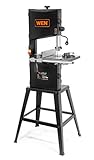
A band saw runs a continuous loop of toothed blade around two wheels. The blade cuts downward through the work, so it removes material efficiently and can follow curves. Blade width and tooth spacing determine how tight a curve it can turn and how well it clears chips from a thick cut.
A scroll saw moves a short blade up and down. The blade is narrow and can turn very tightly, making the tool useful for fretwork and delicate patterns. Many scroll saw blades can be unclamped and threaded through a drilled starting hole, allowing enclosed cutouts without sawing in from an outside edge. That convenience does not make the blade suitable for deep stock.
Band saw vs. scroll saw
| Factor | Stationary band saw | Scroll saw |
|---|---|---|
| Best material thickness | Often 3–6 inches on common shop machines; check the stated resaw or cutting capacity | Generally best for thin stock, often around 1 inch or less for clean, controlled work |
| Curve size | Broad to moderate curves; minimum radius depends on blade width | Very tight curves and small interior details |
| Cut speed | Faster material removal, especially in thick stock | Slower; fine teeth remove material gradually |
| Typical cut quality | May leave blade marks that need sanding | Can leave a finer edge on thin material, but may wander in thick stock |
| Main limitation | Cannot make sharp turns tighter than the blade allows | Limited depth, slower cutting and greater risk of blade breakage in thick stock |
These are practical ranges, not promises. Read the machine’s capacity figures and test cuts in scrap from the same species and thickness. A dense hardwood can feel much harder to cut than softwood of equal dimensions.
Choosing a band saw for thick curves
Check cutting capacity first: it is the maximum height of stock the machine can pass under its guides. For parts up to roughly 4 inches thick, a well-set-up 14-inch band saw may be enough, but capacity varies by model, riser block and guide arrangement. If you need to cut thicker stock, verify the actual capacity rather than relying on the saw’s wheel diameter or a product photo.
Blade choice matters as much as capacity. A narrow blade turns tighter curves, while a wider blade tracks straighter and is less likely to twist in a deep cut. For a 2-inch-thick part, a 1/4-inch blade with roughly 4–6 teeth per inch is a reasonable starting point for many curves; a tighter radius may require a narrower blade. Match the blade to the curve and material, and follow the saw maker’s blade-width recommendations.
A wide blade forced around a tight curve can bind or deflect. A very narrow blade used for a broad curve can flex and leave a wavy edge. In thick stock, teeth that are too fine also pack with sawdust, slowing the cut and heating the blade. Feed steadily without pushing hard; if the saw slows, the blade wanders or the cut starts to burn, stop and check the blade, guides and feed pressure.
If thick curved parts are the main job, consider a stationary 14-inch band saw with enough cutting capacity for your stock. For deeper work, compare larger-capacity machines rather than assuming a compact saw will handle it.
When a scroll saw is still the right buy
A scroll saw is the better choice when the work is thin and detailed: ornaments, small signs, fretwork, narrow interior openings or curves too tight for a band saw blade. It is also useful when the cut edge needs less cleanup on thin plywood or softwood. If your parts are mostly 1/2-inch material and the curves are intricate, a scroll saw can be an economical, sensible purchase.
Do not buy one expecting it to replace a band saw for thick blanks. In deep stock, the short blade has less room to clear sawdust, and the blade can deflect away from the line or break. Forcing the feed increases heat and makes those failures more likely. A machine’s advertised maximum capacity is not the same as a comfortable thickness for accurate curved cuts.
How to get a cleaner, safer cut
Draw the curve clearly and leave a small margin outside the finished line—about 1/16 to 1/8 inch is enough for many parts. Make relief cuts from the waste side toward the curve, stopping short of the line. These narrow kerfs give waste pieces somewhere to fall and reduce the chance of the blade pinching during a tight turn.
Keep the band saw guides close to the work, set blade tension and tracking according to the manual, and keep hands out of the blade’s path. Do not twist the stock to force a turn; back out only if it is safe to do so, and never pull the work backward against a moving blade. After cutting, sand to the line or use a template and flush-trim bit if the part needs a repeatable final shape.
If the main need is detailed cutouts in thin stock, choose a scroll saw. If you need thick curved parts, choose a band saw sized for the stock and the tightest curve you need to cut. One machine rarely does both jobs equally well.