How to Reduce Tearout When Resawing Figured Lumber
What's inside
As an Amazon Associate I earn from qualifying purchases. This post may contain affiliate links at no extra cost to you.
Contents
Why figured wood tears out
Resawing turns a board on edge and cuts it into thinner boards, usually on a band saw. In figured lumber, the grain changes direction over short distances. The blade may cut cleanly through one patch, then lift fibers instead of severing them in the next. The result can be torn fibers on the face, a rough, wandering cut, or both.
Some roughness is normal: resawn faces generally need planing or sanding. The aim is to avoid deep tearout and keep the cut straight enough that you can flatten the faces without losing too much thickness. Sharpness, blade choice, feed rate, and how the board is supported all matter. No blade can make interlocked grain behave like straight-grained stock.
Choose a blade for the cut
For most resawing, start with a wide band-saw blade that fits your saw’s capacity. A 3/4-inch blade is a common choice on a saw built to tension it; a smaller saw may work better with a 1/2-inch blade. Check the manufacturer’s blade-width and tension guidance rather than assuming the widest blade is best. A wider blade resists wandering, but it also needs enough saw capacity to tension properly.
Tooth geometry matters as much as width. A blade with fewer teeth per inch leaves more room for sawdust to clear from a deep cut. A skip-tooth or hook-tooth resaw blade is often a sensible choice; around 2 to 3 TPI is common. A very fine-tooth blade can clog, heat the wood, and drift. A coarse blade cuts quickly but may leave a rougher surface, so you trade cleanup time against cutting time.
For figured stock, a sharp blade is essential. A dull blade needs more feed pressure, heats the cut, and is more likely to deflect or tear fibers. If the cut begins to wander, the blade burns the wood, or you have to force the board, stop and inspect the blade before changing your feed technique. A dedicated coarse-tooth resaw blade is a practical upgrade if your current blade is narrow or fine-toothed; the cheaper blade is fine for occasional work if it is sharp and suits your saw.
Set up the saw before cutting
Set blade tension according to the saw and blade instructions. Too little tension makes a wide blade wander; too much can strain the saw or blade. Then check tracking, guides, and thrust bearings with the blade installed and tensioned. Guides should be close enough to support the blade without pinching it. Keep the blade exposed above the work only as much as needed for the board’s height, and use a tall fence to support the full face of the board.
Check that the table is square to the blade, then make a test cut in straight-grained scrap of similar height. Measure the kerf’s drift rather than trying to steer the work mid-cut. If the blade consistently cuts at an angle, adjust the fence to match the blade’s natural drift, following your saw’s instructions. A fence that forces the board straight against a drifting blade can twist the blade and make the cut worse.
Brush or vacuum dust from the table and fence. A small chip caught under one edge of a board can tilt it enough to spoil the cut. Make sure the stock has a flat reference face and a stable edge; if it rocks, joint one face or secure it against a carrier. A tall resaw fence can improve support on a deep board, but a straight auxiliary fence clamped to the saw is often adequate for occasional resawing.
Feed steadily and support the board
Mark the intended cut on both ends of the board and watch the line as you feed. Keep the board pressed firmly against the fence and table, but do not twist it to correct a line that is getting away from you. Feed at a steady rate that lets the blade clear sawdust. If the motor slows, the cut heats up, or the blade starts to bow, ease off. Forcing the feed increases deflection; feeding too slowly can also burn the cut by rubbing the blade in one place.
Long or heavy stock needs outfeed support set to the same height as the saw table. Have a helper support the far end if needed, but agree beforehand that the helper should guide, not push sideways. Keep hands out of the blade path and use a push stick or other suitable aid near the end of the cut. Do not resaw stock with nails, loose knots, checks that could close on the blade, or a warped shape that cannot sit securely on the table.
Reduce tearout at the face
For a cleaner face, use a sharp blade and avoid aggressive feed pressure. A light scoring pass is not practical on a band saw, and masking tape rarely prevents tearout across a large resawn face. The more reliable strategy is to leave cleanup stock. If the board is thick enough, plan the cut so each half will have perhaps 1/16 to 1/8 inch available for flattening, adjusting for how rough or irregular the saw’s cut is. That allowance is a starting point, not a promise: a drifting cut may need more.
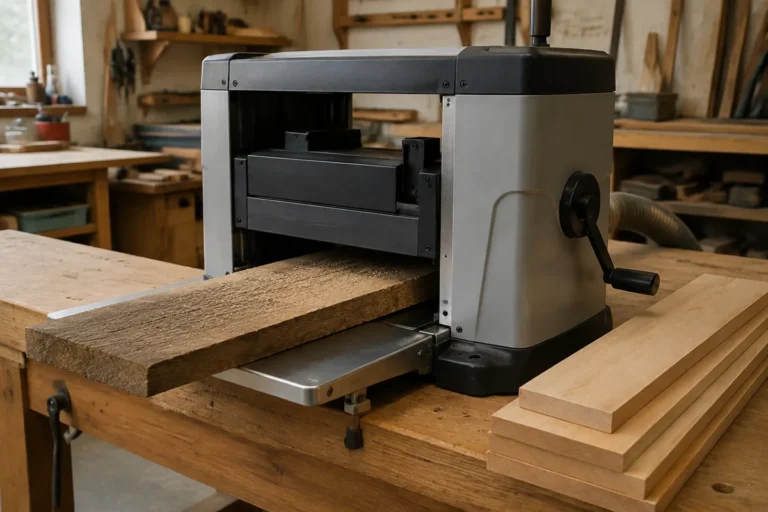
After resawing, let the pieces settle before final dimensioning, especially if the lumber is not fully dry or has built-in stress. The halves can cup or bow as internal tension is released. Flatten one face with a planer only after establishing a stable reference face, or use a jointer within its width and depth limits. A planer can preserve thickness efficiently, but feeding a bowed or cupped half without a sled may press it flat temporarily and reproduce the bend after it exits.
For figured wood, sharp knives and shallow cuts help during cleanup too. Take light passes rather than trying to remove the full saw texture in one go. If the grain tears in the planer, try a very light cut, reduce feed speed only if your machine permits it, or switch to careful scraping and sanding. A helical-head cutterhead can reduce tearout on difficult grain, but it is an expensive solution and does not eliminate the need for sensible cut depth.
Which change is most useful?
| Change | Best for | Trade-off |
|---|---|---|
| Sharp, coarse resaw blade | Most cuts, especially deep ones | Coarser surface than a fine blade; blade quality and saw capacity still matter |
| Wider blade, if the saw supports it | Reducing blade deflection on tall stock | Cannot be tensioned properly on every saw |
| Tall fence and outfeed support | Keeping the board upright and steady | Setup takes time; support must be aligned and stable |
| Extra cleanup allowance | Figured stock where a perfect cut is unrealistic | Uses more thickness and may not be possible on thin stock |
Know when to stop
Stop if the board shifts, the blade binds, the cut closes behind the blade, or the blade begins making an unfamiliar noise. Turn off the saw and wait for the blade to stop before clearing anything. Do not pull a pinched board backward while the blade is running. Recheck for internal stress, a dull blade, poor support, or a fence alignment problem before trying again.
If the lumber is valuable and the cut is tall, make a short test cut in a less precious piece first. That reveals whether your saw can tension the blade and hold the line before you risk the figured board. A slower, supported cut that leaves a little extra cleanup stock is usually a better bargain than a fast cut that sacrifices usable thickness.