Best Jointers with Helical Cutterheads for Small Shops
What's inside
As an Amazon Associate I earn from qualifying purchases. This post may contain affiliate links at no extra cost to you.
A helical cutterhead can make a small-shop jointer quieter and leave less obvious tear-out than a traditional straight-knife head. It does not fix a short bed, a weak fence, or a board that is bowed beyond the machine’s capacity. For most hobby shops, the right choice comes down to jointer width, available floor space, and whether the work justifies the extra cost of carbide inserts.
As an Amazon Associate we earn from qualifying purchases at no extra cost to you.
Contents
What “helical” means in practice
On a true helical head, small carbide inserts sit at an angle to the direction of travel. Each insert cuts a short section of the board, rather than a full-width knife striking all at once. That usually reduces the sharpness of the impact and can improve the surface on figured grain. Many manufacturers call any head with staggered inserts “helical,” though, so check the layout and replacement-insert availability rather than relying on the label.
Insert edges are indexed or rotated when dull, instead of sharpened and reset like straight knives. A common insert has four usable edges, but the number varies. A chipped edge can leave a repeating mark; rotate that insert or replace it, and inspect the rest of the head before adjusting the tables. Inserts are convenient, not immune to damage. A nail or hidden staple can take out more than one edge.
Choose width before cutterhead
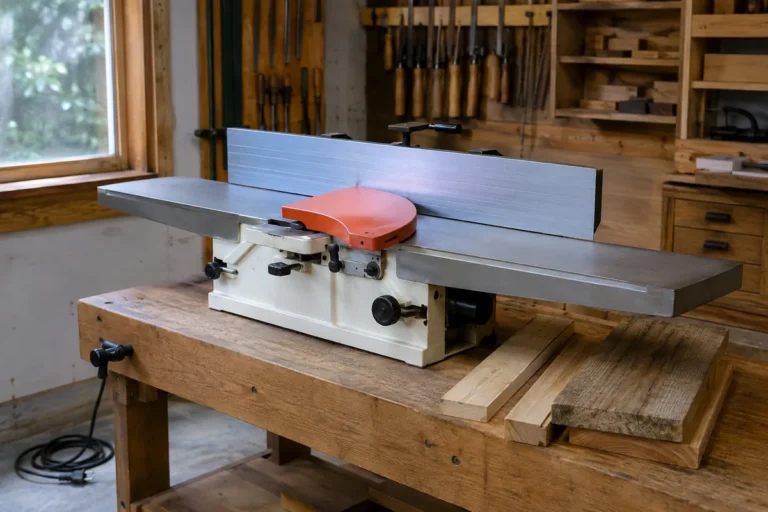
A 6-inch jointer is a practical fit for narrow boards, face-jointing parts for small furniture, and edge-jointing stock up to roughly 5½ inches wide. It is also easier to fit in a garage shop. The limitation is real: a board wider than the cutterhead cannot be face-jointed in one pass, and repeated passes are not a dependable substitute for a wider machine.
An 8-inch machine handles wider furniture parts and gives more room for imperfect stock. It is usually heavier and takes more floor space. A long bed matters at least as much as an extra two inches of width: short infeed and outfeed tables make it harder to straighten a long board. If your typical stock is 6 to 8 feet long, prioritize bed length and sturdy support at both ends.
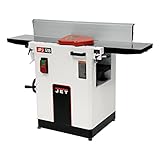
Compare stationary 6-inch helical-head jointers and 8-inch helical-head jointers by table length, fence travel, motor requirements, and included mobile base—not just cutterhead claims. Product listings sometimes use “spiral” and “helical” loosely, so verify that the machine actually has replaceable carbide inserts.
Which size fits a small shop?
| Type | Best fit | Main trade-off |
|---|---|---|
| Benchtop, typically 6 inches | Very limited floor space and short stock | Short tables and lighter construction make long-board jointing harder |
| Stationary 6-inch | Small furniture, cabinet parts, and routine edge-jointing | Cannot face-joint boards wider than its capacity |
| Stationary 8-inch | Wider parts and a more flexible general-purpose shop | Higher cost, greater footprint, and often more demanding electrical needs |
Benchtop machines can be the sensible choice if you mostly work with short, narrow pieces. Their light weight and compact tables are disadvantages when feeding a long board: the work can tip or sag, and the resulting face may be tapered or twisted. A roller stand helps support the board, but it must be set to the table height and should not steer the stock sideways.
What to check before buying
Check the machine’s actual cutting width, bed length, fence size, and maximum depth of cut. A 1/8-inch maximum cut is not an invitation to remove that much on every pass. For ordinary flattening, start around 1/32 inch and take lighter cuts near the end. Heavy cuts can overload a small motor, leave scallops, or push the board off the fence.
Inspect how the fence locks and whether it stays square through its travel. A fence that shifts under hand pressure can spoil an edge even with a sharp head. Also confirm whether the machine runs on the power available in your shop. Some larger jointers require 230-volt service; do not assume a standard outlet will work just because the machine fits in the room.
Dust collection is not optional for regular use. Check the port diameter and your collector’s airflow at the machine, not just its advertised rating. Chips packed around the cutterhead can affect cut quality and create a cleanup problem. Leave room to open the access covers and rotate inserts; a machine pushed tight against a wall is harder to maintain.
Getting clean, straight results
Joint one face flat before using it as the reference for edge-jointing. Mark the face with pencil lines, take light passes, and check the result with a reliable straightedge. Keep pressure over the infeed table until the board reaches the cutterhead, then shift pressure to the outfeed table. Pressing down hard on the unsupported end can bend the board during the cut and produce a surface that springs back crooked.
For edge-jointing, keep the board firmly against the fence and use push blocks when your hands would otherwise come close to the cutterhead. Do not joint stock shorter than the machine maker’s stated minimum; short work can catch or kick back. If the board rocks on the table, has loose knots, or contains metal, stop and deal with that problem before cutting.
Helical heads cost more upfront, but the trade-off can make sense if you work with figured hardwood, value lower cutting noise, or want to avoid straight-knife sharpening and alignment. If most of your stock is clear, straight-grained softwood and you are comfortable maintaining knives, a cheaper straight-knife jointer is adequate. Either way, table alignment, a steady feed, and safe stock handling matter more than the cutterhead label.