How to Plane Narrow Boards Safely in a Stationary Planer
What's inside
As an Amazon Associate I earn from qualifying purchases. This post may contain affiliate links at no extra cost to you.
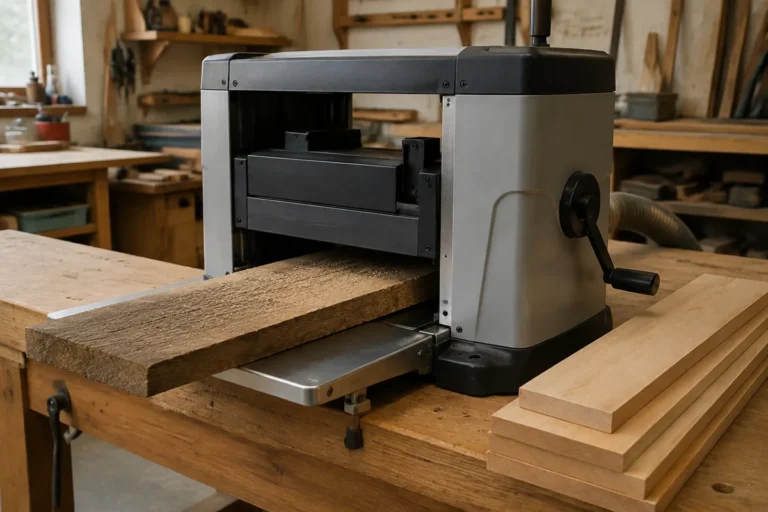
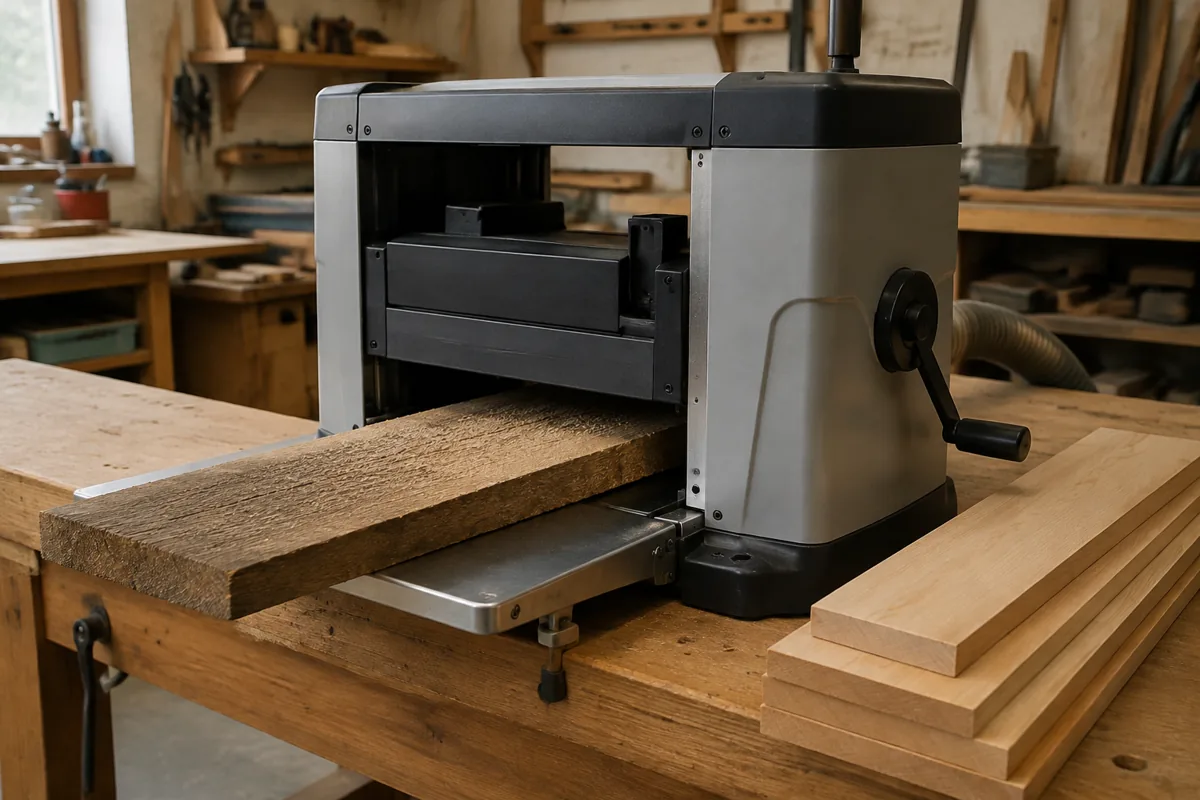
A thickness planer can bring a narrow board to an even thickness, but a board that is much narrower than the cutterhead opening can be hard to control. It may tip, skew, or shift as the rollers pull it through. The safest approach depends on the board’s width, thickness, length, and grain—and on whether you can keep it supported and flat.
Contents
Check the board before feeding it
Read your planer’s manual first. Minimum workpiece dimensions and feeding instructions vary, and the manual takes precedence over general advice. Don’t plane stock below the machine’s stated minimum thickness or length. Also check that the board is free of nails, screws, staples, loose knots, and other defects that could come free under the cutterhead.
A planer makes one face parallel to the other; it does not reliably flatten a board that is bowed, twisted, or cupped. If a warped board rocks on the planer bed, the rollers can press it flat during the cut, then release it still warped. Flatten one face first with a jointer, a planer sled, or hand tools. Start with a flat reference face down.
For a narrow board, width alone does not determine safety. A long, straight board that sits flat is easier to control than a short, thin strip that can tip. If the stock is so narrow that it can tilt or rotate in the planer, don’t feed it alone.
Choose a safe way to support narrow stock
When several similar-width pieces need planing, a simple option is to feed them side by side. Their combined width helps resist tipping, provided the pieces are similar in thickness, long enough to stay stable, and held with a small gap between them. Don’t force them together or allow one board to ride up on another. Follow the manufacturer’s instructions about feeding multiple pieces at once; some machines limit this practice.
For a single narrow board, use a planer sled if the board is too narrow to sit securely by itself. A sled is a flat, rigid carrier that keeps the workpiece supported as it passes through. Secure the board against shifting with suitable stops or shims, and check that nothing can come loose and enter the cutterhead. The assembly must fit within the planer’s width and height limits. A planer sled for a thickness planer can save setup time, but a well-made shop-built sled may be enough if it is flat, rigid, and compatible with your machine.
Don’t treat a carrier board as a cure-all. A loose workpiece, tall improvised side fences, or a sled that rocks can create a new hazard. If you cannot restrain the stock without putting hands near the cutterhead or feed rollers, choose a different method or machine.
Compare the main options
| Method | Best for | Main limitation |
|---|---|---|
| Feed several boards side by side | Matching strips that are stable and similar in thickness | Not suitable if a board can tip, overlap, or shift |
| Use a planer sled | A single narrow or unstable board | Needs secure workholding and enough planer capacity for the sled |
| Use a jointer or hand plane | Stock that is too short, thin, or awkward to feed safely | May take more setup or hand work; a jointer does not set final thickness |
Set up the planer and work area
Set the planer on a stable surface and provide infeed and outfeed support for the full length of the board or sled. If the board droops at either end, it may lift as it enters or exits, causing snipe—an unwanted deeper cut near the end. Roller stands or extension tables help, but adjust them to the planer bed height and make sure they cannot roll or sag. A stable adjustable roller stand is useful for long stock; for short pieces, the planer’s own tables may be enough.
Set the depth of cut conservatively. For hardwood, start around 1/32 inch per pass; softer wood may tolerate more, but the machine’s manual and the sound of the cut should guide you. Narrow stock is not a reason to take a heavier cut. Deep cuts increase feed resistance and can worsen tear-out, snipe, or stalls. Check thickness with calipers or a reliable gauge, and make small adjustments rather than trying to reach final size in one pass.
Wear eye and hearing protection, tie back long hair, and remove loose clothing and jewelry. Use dust collection if available; planers produce chips quickly. Keep hands away from the infeed and outfeed openings, and never reach into the machine while it is running or coasting down.
Feed the board steadily
Place the board or secured sled flat on the bed, with the reference face down. Stand to one side of the feed path, not directly behind the workpiece. Let the feed rollers take the stock; don’t push it into the cutterhead or pull it out from the other end. Support the stock without lifting its leading edge. If the board shifts, tips, chatters, or stops advancing, switch the planer off and wait for it to stop completely before investigating.
Watch for warning signs: sudden changes in motor sound, repeated slipping, a board that tracks sideways, or a sled that rocks. These can indicate excessive cut depth, poor support, loose workholding, or a dull or damaged cutter. Don’t try to correct a moving board by hand. Unplug the machine before clearing a jam or inspecting the cutter area.
Know when not to use the planer
Skip the planer if the piece is below the manual’s minimum dimensions, too short for the rollers to hold securely, or too thin to resist tipping. Very short offcuts can be ejected or pulled through unevenly. Don’t tape pieces together or clamp a loose bundle as a shortcut unless the planer maker specifically allows that method. A jointer can help establish a flat face on stock that is wide and long enough for its own safety rules; a hand plane or a sanding setup may be more appropriate for very small pieces.
The least expensive safe option is often to change the workholding, not buy a larger machine. If you plane narrow boards regularly, a rigid sled and good support are practical purchases. If this is a one-time job and the stock is too awkward for your planer, a jointer, hand tools, or a local woodworking shop may be the better trade-off.