Best Bench-Top Drill Presses for Woodworking Shops with Low Ceilings
What's inside
As an Amazon Associate I earn from qualifying purchases. This post may contain affiliate links at no extra cost to you.
Contents
Why choose a bench-top drill press for a low-ceiling shop?
A bench-top drill press is often the practical choice when an upright machine would be awkward to move, difficult to fit beneath a ceiling, or more capacity than the work requires. It can handle cabinet hardware, dowel holes, small parts, and many general woodworking tasks while leaving floor space for a table saw or planer.
Check the machine’s assembled height before buying, not just its shipping-box dimensions. A press listed at roughly 24 to 30 inches tall still needs clearance to raise the belt cover and swing the table. Measure from the bench to the lowest obstruction, then check the manufacturer’s manual for access requirements. A machine that fits under a shelf but cannot open its cover is a nuisance when speed changes are needed.
As an Amazon Associate we earn from qualifying purchases at no extra cost to you.

Measure the work, not just the machine
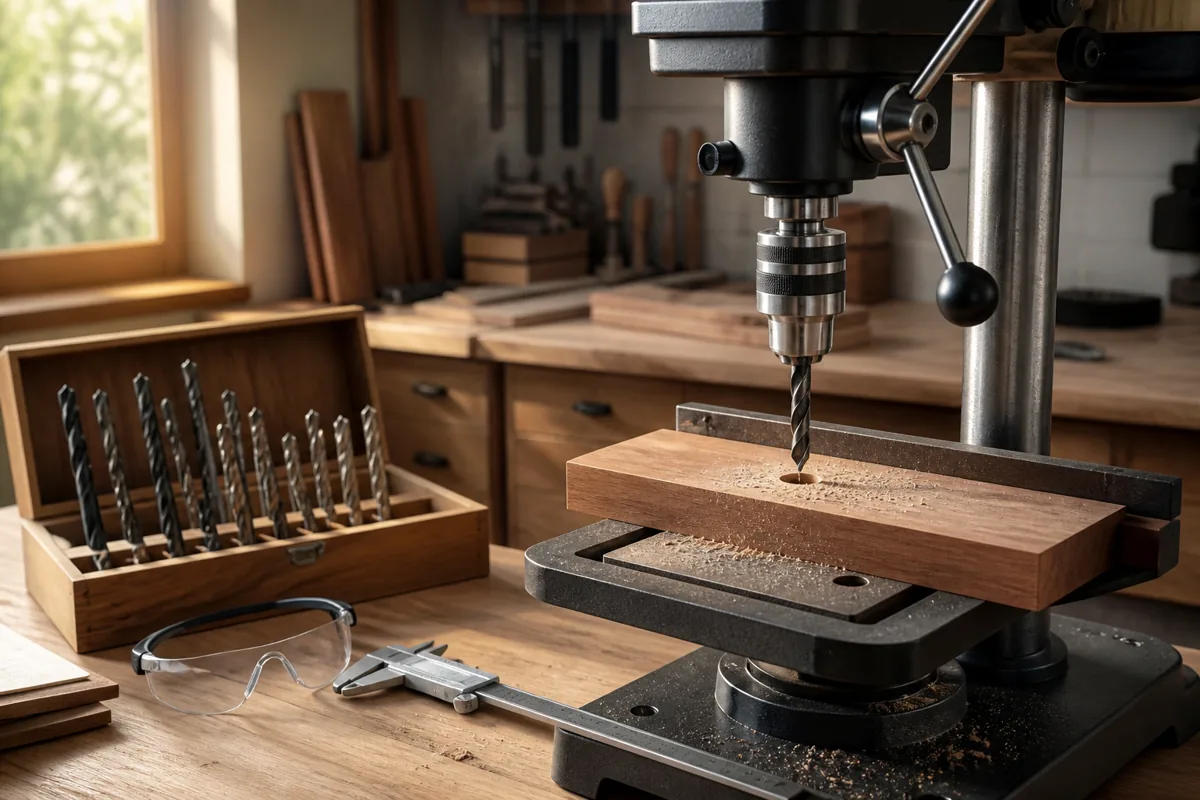
Three specifications matter most: swing, quill travel, and distance from the spindle to the table. Swing is twice the distance from the column to the spindle, so a 10-inch swing press can center a hole in a board about 10 inches wide. That is useful for many furniture parts, but too little for wide panels. Quill travel is how far the bit moves in one stroke; 2 to 3 inches is common on small presses. Deeper holes may require withdrawing the bit and drilling in stages.
Also consider the distance from the spindle to the base. If a workpiece is too tall to fit between the table and the chuck, lowering or removing the table may help, but it is not a substitute for adequate capacity. For repeated holes in tall work, compare this measurement with your actual stock height.
Bench-top press types compared
| Type | Typical strengths | Main trade-off | Best fit |
|---|---|---|---|
| Compact press, about 8–10-inch swing | Small footprint; usually easy to place on a sturdy bench | Limited reach for wide stock; often lighter and more prone to vibration | Small parts, occasional holes, tight shops |
| Mid-size press, about 12–15-inch swing | More reach and often a larger table | Taller and heavier; check ceiling and bench capacity | Regular furniture and cabinet work |
| Variable-speed press | Speed changes without moving belts on many designs | Usually costs more; electronic controls add complexity | Frequent changes between small bits and larger cutters |
These ranges are useful for comparison, not guarantees of performance. A heavier machine may feel steadier, but a poor table lock or loose quill can still make accurate work difficult.
Features worth paying attention to
Look for a rigid column, a table that locks securely, and a depth stop that is easy to set and repeat. A laser can help place a hole, but it does not replace a center punch, a fence, or a test on scrap. Check whether the table tilts and whether it returns square; a tilting table is handy for angled holes, but can be slower to reset precisely.
Speed range matters more than a long list of pulley positions. Small bits generally need higher speeds than large bits, while large Forstner bits and hole saws should run slower. Wood species, cutter diameter, and manufacturer guidance all affect the right setting. If changing belts means removing a cover and moving pulleys, expect to stop work for the adjustment. A variable-speed control is convenient, but not essential for a shop that mostly uses a few common bit sizes.
For a comparison of compact machines, browse bench-top drill presses for woodworking. Compare actual height, swing, quill travel, and table size rather than choosing by motor horsepower alone. For many woodworking tasks, a sharp bit and a properly supported workpiece matter more than a modest difference in motor rating.
The bench is part of the machine
A press bolted to a light folding table can vibrate, shift, or tip when a bit catches. Mount it to a heavy bench or a dedicated stand, and fasten that support to the floor or wall if needed. Leave room to swing the table and to reach the depth stop. If the machine must live under a ceiling shelf, make sure the head can be serviced and the belt cover can open.
Keep the work from spinning. Clamp boards to the table, especially when drilling with Forstner bits, hole saws, or larger twist bits. A rotating workpiece can injure hands and damage the bit. Use a sacrificial backer to reduce tear-out on the exit side, and clear chips from deep holes so the cutter does not bind or overheat.
When a budget press is enough
A lower-cost compact press is reasonable if you drill mostly small holes in short parts, work at moderate speeds, and can clamp the stock carefully. It is less attractive for frequent large-diameter holes, long sessions, or jobs where the table must hold a wide, heavy panel. Common frustrations include a small table, noticeable runout, a weak depth stop, and a column or table that flexes under load. Ask whether the chuck and spindle can be replaced or serviced before treating a low purchase price as a bargain.
For more reach, look at a 12-inch bench-top drill press or a larger size, but verify its total height and weight. Moving up in swing can improve access to wider pieces; it does not automatically improve accuracy. If the projects routinely exceed the press’s capacity, a floor model may be the better fit despite the ceiling constraint. A compact press is useful only when its limits match the work you actually do.