Table Saw vs Planer for Bringing Reclaimed Lumber to Final Thickness
What's inside
As an Amazon Associate I earn from qualifying purchases. This post may contain affiliate links at no extra cost to you.
Contents
The short answer
A table saw and a planer do different jobs. A planer reduces board thickness while making the faces parallel; a table saw cuts a board’s width or thickness along a straight line but does not flatten a warped face. For reclaimed lumber, a planer is usually the right machine for bringing prepared stock to a consistent final thickness. A table saw is useful for ripping boards to width or resawing, but it is not a substitute for a planer.
The important catch: neither machine should be the first stop for lumber that may contain nails, grit, or embedded metal. Check and clean the wood before it reaches any cutter. Metal can chip planer knives or carbide saw teeth, and hidden fasteners can turn a routine cut into a dangerous one.
As an Amazon Associate we earn from qualifying purchases at no extra cost to you.


What each machine does
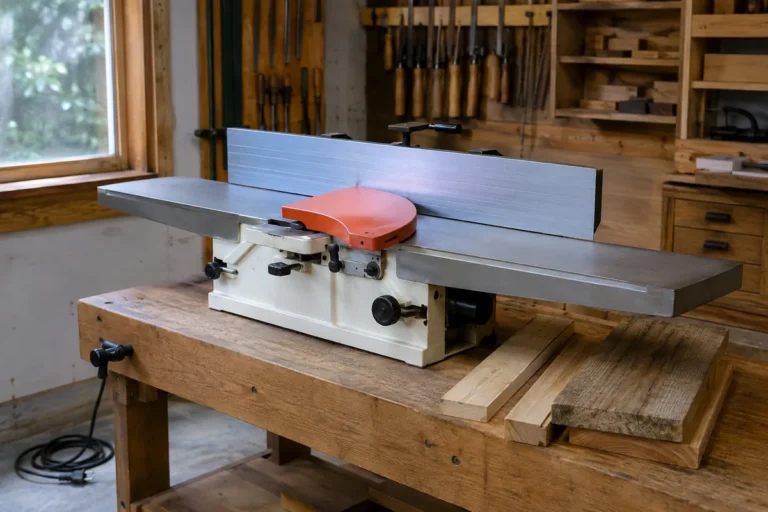
A thickness planer references the face resting on its bed and cuts the opposite face. If the bottom face is bowed or twisted, the planer generally follows that shape rather than correcting it. The result can be a board with parallel faces that is still bowed or twisted. Flatten one face first with a jointer, a router sled, or another reliable method; then plane the opposite face parallel.
A table saw guides lumber past a blade to make a straight cut. It can rip a board narrower or cut thin strips, but feeding a cupped, bowed, or twisted board against the fence can cause it to bind or kick back. Cutting the board thinner on a table saw also does not produce two flat, parallel faces. Use a planer for thicknessing, and a suitable sled or jig if you have a specific resawing or tapering task.
Which machine fits the job?
| Task | Planer | Table saw |
|---|---|---|
| Make faces parallel at a set thickness | Yes, after one face is flattened | No |
| Flatten a warped board | Not by itself | No |
| Rip to a narrower width | No | Yes, with a sound fence setup |
| Process rough reclaimed stock | Yes, once it is clean and stable | Only for suitable straight cuts |
| Typical risk with contaminated wood | Damaged knives and rough cuts | Damaged teeth, kickback, or injury |
Prepare reclaimed lumber before cutting
Start by removing old hardware, including nails, screws, staples, and fragments that may be hidden below the surface. Inspect both faces and edges under good light. A metal detector is worthwhile when working with barn wood, pallet wood, or boards with filled nail holes; it can catch fragments that a visual check misses. It cannot guarantee that every contaminant is gone, so inspect and scan again after trimming away damaged ends.
Brush or vacuum off dirt and grit, then let the stock acclimate to the shop. Sand and dirt are abrasive and can dull cutters; a board that is still changing moisture content may move after milling. Avoid planing wood that is wet, visibly rotten, or so cracked that it may break apart under feed pressure.
Check each board for twist, bow, and cup. If there is no safe, stable face to register on the planer bed, flatten one face first. A jointer is one option for boards that fit its capacity; a sled or router setup can handle wider stock. If you routinely mill reclaimed boards, a benchtop thickness planer is generally a more relevant purchase than upgrading a table saw for thickness work.
Plane in controlled passes
Set the target thickness only after accounting for the material you must remove to flatten and clean up the board. For example, if a rough board is about 1 inch thick but needs 1/8 inch removed to get a clean face and parallel surface, a finished thickness near 7/8 inch may be realistic. Do not assume every reclaimed board can be milled to the same nominal dimension.
Take shallow cuts, especially in hard, figured, or inconsistent wood. A pass of roughly 1/32 inch is a cautious starting point; reduce the cut if the machine strains, the surface tears out, or the board chatters. Read your planer’s manual for its maximum cut depth and width. Feed boards in the direction that produces less tear-out when possible, and support long stock so its weight does not lift or dip at the infeed and outfeed.
Planers can leave snipe—deeper cuts near the ends of a board—if the board tips as it enters or exits. Support the stock level, use proper infeed and outfeed extensions if available, and leave extra length to trim off afterward. For figured reclaimed wood, expect some tear-out even with sharp knives; taking lighter passes and using a final pass with reduced depth can help, but may not eliminate it.
Where the table saw fits
Use the table saw after milling when you need straight, parallel edges or a board cut to width. Confirm that the stock sits securely against the fence and table. Do not force a warped board flat during a rip; it can spring loose or pinch the blade. For thin stock, use an appropriate push stick or push block, keep hands away from the blade path, and use the blade guard and riving knife as designed.
A table saw can be the cheaper option if your only task is ripping already-flat, clean boards to width. If your reclaimed lumber is already flat and close to its needed thickness, buying a planer just for occasional cleanup may not make sense; a local mill or shop may be cheaper. But if the boards vary in thickness and you need consistent, parallel faces, the planer does the job the table saw cannot.
What to buy for regular work
For occasional small projects, a benchtop planer can be adequate if its capacity suits your boards and you can manage dust collection and snipe. For wider or longer stock, check the machine’s maximum width, available bed support, and knife or cutterhead replacement costs before buying. A planer with a spiral or helical cutterhead can make knife replacement less disruptive and may reduce tear-out on difficult grain, but it costs more and does not excuse feeding dirty or unstable wood.
If you do not already own a reliable way to flatten one face, address that need before expecting a planer to fix twisted lumber. A planer sled or router sled may be a lower-cost route for occasional wide boards; a jointer is more convenient for repeated work within its width capacity. Choose based on the size and frequency of your projects, not on the assumption that one machine can replace the others.