How to Choose a Jointer Cutterhead Width for Furniture Stock
What's inside
As an Amazon Associate I earn from qualifying purchases. This post may contain affiliate links at no extra cost to you.
A jointer’s cutterhead width determines the widest face you can flatten in one pass. For furniture stock, that matters most when you regularly buy wide boards or need to joint panels and glued-up assemblies. A wider cutterhead can save passes, but it also adds cost, takes more shop space, and may require a larger machine. Choose for the stock you actually prepare—not the widest board you might use once.
Contents
What cutterhead width means
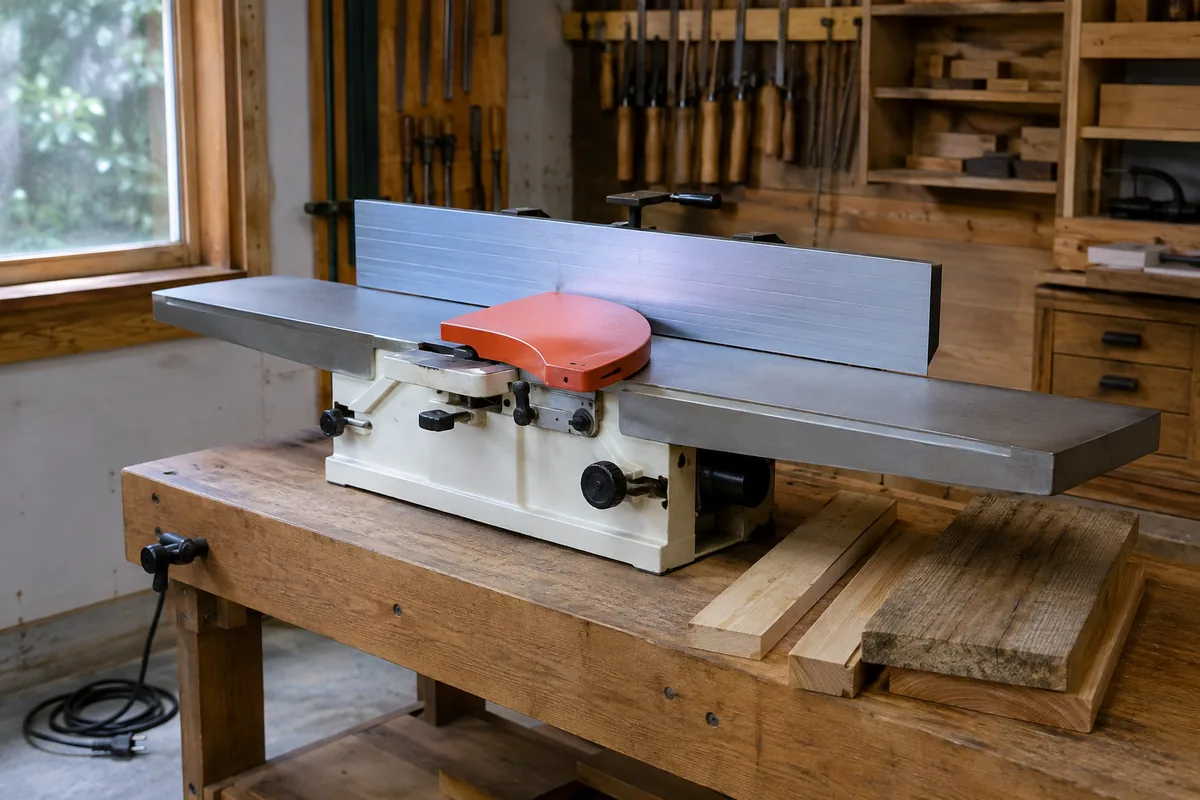
On a jointer, the cutterhead width sets the maximum practical board width for face jointing. A 6-inch jointer can flatten a board up to about 6 inches wide in a pass; an 8-inch machine handles stock up to about 8 inches. The tables and fence are also sized around that capacity.
Width is not the same as length capacity. Long boards need long infeed and outfeed support, whether the machine is 6 or 8 inches wide. And a jointer is not a planer: it establishes one flat face and one straight edge. A thickness planer brings the opposite face parallel, but it will not reliably flatten a board that rocks or bows as it enters.
Start with your stock
Measure the lumber you commonly buy before shopping. Note the widest individual boards you need to flatten, not just the finished panel width. A 14-inch tabletop assembled from four narrow boards may need no more than a 6-inch jointer. A single 9-inch slab needs more capacity, or another flattening method.
Furniture stock is often sold rough and wider than its final size. A board intended to finish at 7 inches may arrive at 8 inches or more, with an uneven edge to remove. A 6-inch jointer cannot face-joint that board across its full width in one pass. You can rip it narrower first, but that sacrifices material and may not suit a design that needs the full width.
For many small and medium furniture shops, 6 inches is adequate for drawer parts, rails, stiles, and narrower table components. An 8-inch jointer covers a broader range of solid-wood furniture boards and reduces the need to rip wide stock before flattening. If you routinely work with wide live-edge slabs or broad solid panels, even 8 inches may not be enough; consider a sled on a planer or a router-based flattening setup for those occasional jobs.
Compare common widths
| Jointer width | Typical fit | Main compromise |
|---|---|---|
| 6 inches | Small shops; narrow furniture parts; boards that will be ripped to width | Wide rough stock must be split, flattened by another method, or rejected |
| 8 inches | General furniture work; wider rails, panels, and common hardwood boards | Higher price, larger footprint, and greater setup demands |
| 12 inches or more | Wide stock, production work, or specialist slab preparation | High cost and space needs; may be excessive for occasional wide boards |
Look beyond the width
Width alone does not make a jointer perform well. Table length and stability matter when jointing long furniture parts: short tables make it harder to keep a long board supported through the cut. Check the actual table length, fence height and rigidity, cutterhead condition, and whether the machine has a reliable adjustment system. A wider machine with short or misaligned tables can still produce tapered or twisted stock.
Power and cut depth matter too. A wide board presents more wood to the knives, so a small motor may bog down on hard maple or oak if you take an aggressive cut. Regardless of width, take light passes—often around 1/32 inch for final flattening—and reduce the cut if the motor strains or the surface tears out. A helical cutterhead can make knife changes and difficult-grain cuts easier, but it does not increase the machine’s width capacity or correct poor setup.
For a new machine, compare a 6-inch benchtop jointer with a floor-standing 8-inch jointer. Benchtop machines can be a sensible, lower-cost choice when workpieces are short and narrow, and storage matters. Their shorter tables and lighter construction are less forgiving with long or heavy boards. Floor-standing machines cost more and occupy more room, but usually provide better support for furniture-length stock. Verify the machine’s actual table length and motor rating rather than assuming every machine in a width class is alike.
When 6 inches is enough
A 6-inch jointer is a reasonable buy if your stock is mostly under 6 inches wide, you routinely rip boards to narrower parts, or you have a plan for the occasional wide board. It is also a way to get a useful machine into a tight shop without paying for capacity that sits idle. Before buying, test your workflow on paper: if a wide board can be ripped safely and still yield the part you need, the narrower jointer may be all you need.
The failure mode is buying a 6-inch machine, then repeatedly discovering that your rough boards are 7 or 8 inches wide. Ripping them first can work, but it may remove the cleanest or most figured wood, and it does not solve every case of twist or cup. For occasional oversize boards, a router flattening sled or planer sled can bridge the gap. These methods take setup time, and a sled requires careful support and secure workholding; they are not a shortcut for every board.
When to buy wider
Move to 8 inches if you often need to preserve boards wider than 6 inches, want more flexibility with rough lumber, or flatten glued panels wider than a smaller jointer can handle. Jointing a panel on a machine is possible only when the panel fits safely and stays supported; wider capacity does not eliminate the need for careful handling. For large glued assemblies, a sled or other flattening method is often more practical than trying to move a heavy panel across a jointer.
Choose a 12-inch-or-wider machine only when wide stock is a regular part of the work and the budget, floor space, electrical service, and material-handling setup can support it. For occasional slabs, outsourcing the flattening or using a sled is often cheaper than buying a large jointer that rarely gets used. In any width, keep hands clear of the cutterhead, use push blocks, and never joint stock that is too short, unstable, or otherwise unsafe for the machine.