How to Choose a Jointer Table Length for Milling Long Boards
What's inside
As an Amazon Associate I earn from qualifying purchases. This post may contain affiliate links at no extra cost to you.
Jointer table length determines how well the machine supports a board as you flatten one face and make an adjacent edge square. Longer tables make long boards easier to control, but they cost more, take up more shop space, and do not fix poor technique or a twisted board. Choose based on the longest stock you actually mill, not an occasional project’s finished length alone.
Contents
What table length does
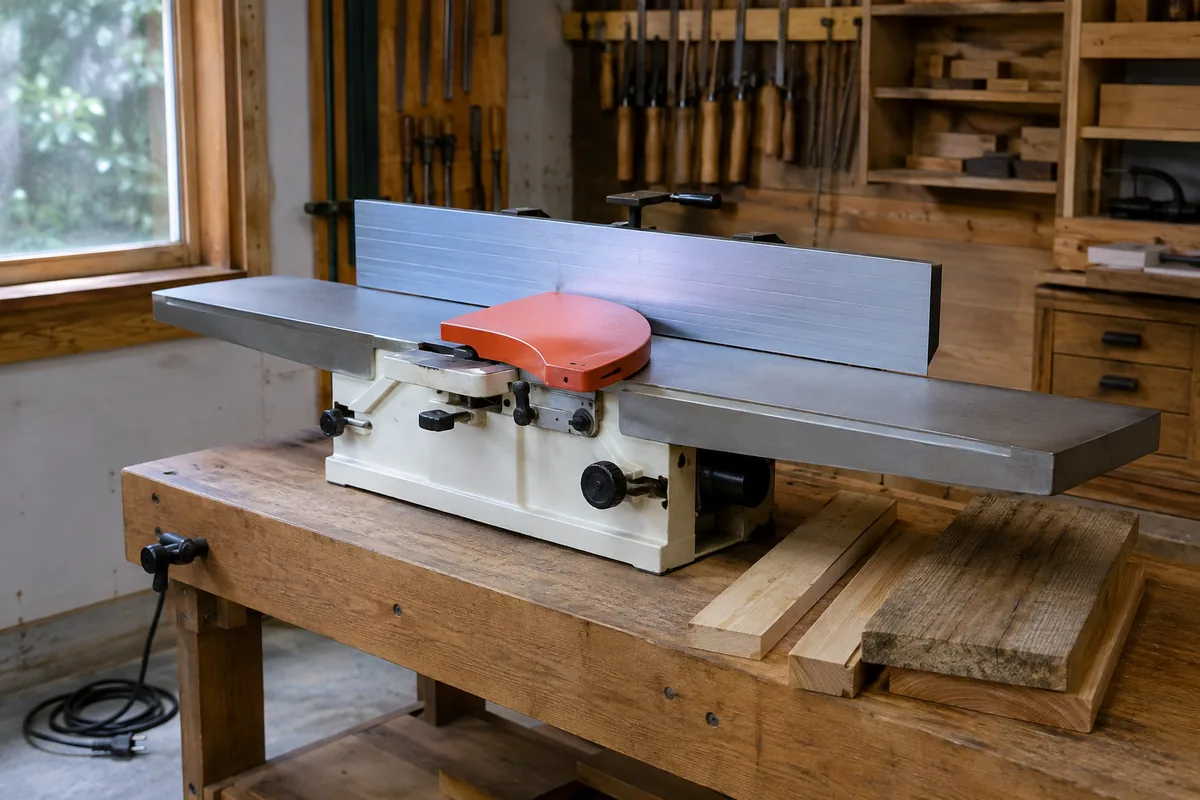
A jointer cuts only the wood passing over its cutterhead. The infeed table supports the board before the cut; the outfeed table supports it after the cut. Together, their length helps keep a board from tipping or changing angle as you feed it. That matters most near the beginning and end of a pass, when less of the board is supported on each side of the cutterhead.
A short table can joint a long board, but the operator has to manage more of its weight and leverage. If the board dips at the wrong moment, the cut can leave a hollow or a hump. Long tables reduce that risk, especially with heavy hardwood, but they still require a steady feed and a board that is safe to handle.
Match length to your stock
For occasional work on boards around 3 to 4 feet long, a benchtop jointer with roughly 28 to 35 inches of total table length may be adequate. It is usually less expensive and easier to store. Expect to support longer boards with stands or a helper, and take extra care not to let the stock lever the machine or your hands.
If you regularly mill 6- to 8-foot boards, a floor-standing jointer with about 60 to 75 inches of total table length is a more comfortable choice. Longer tables—often around 80 inches or more—make sense for frequent work on long, heavy boards, but are a substantial investment in floor space and machine capacity. Compare the combined table length and the separate infeed and outfeed lengths; manufacturers do not always present dimensions in the same way.
Board length is not the only factor. A narrow, light 6-foot board is easier to manage than a wide, heavy one of the same length. Width capacity matters too: a 6-inch jointer cannot flatten a board wider than its cutter, regardless of table length. For routine wide stock, consider a wider machine or another flattening method rather than buying extra table length alone.
Table-length trade-offs
| Approximate total table length | Best fit | Main trade-off |
|---|---|---|
| 28–35 inches | Short stock, occasional flattening, limited space | Long boards are harder to control; auxiliary support is often needed |
| 60–75 inches | Regular furniture and cabinet work with boards up to about 8 feet | Higher cost and a larger, less portable machine |
| 80 inches or more | Frequent long-stock milling or heavier boards | More floor space and expense; not necessary for most short-stock work |
These are practical ranges, not guarantees. Table flatness, fence quality, cutterhead condition, and the operator’s method all affect results. A well-set-up shorter jointer may outperform a longer machine with misaligned tables.
Use support without steering the cut
Roller stands can support a board at the machine’s entry and exit, especially when the stock is too long for the tables. Set each stand so its roller is level with the table, or just low enough that it does not lift the board. A stand set too high can steer the stock upward, producing a tapered or uneven face. If it is too low, it may offer little help.
For a long board, use a helper only if both of you can keep hands well clear of the cutterhead and maintain the same feed direction. The helper should support the board’s weight, not push it sideways or lift it. Avoid trying to control a board that is too heavy or awkward to move safely; breaking down rough stock first or using a different flattening method is preferable.
Take shallow cuts—often around 1/32 inch for difficult grain or a heavy board—and use consistent pressure. Keep pressure on the infeed table before the cutterhead, then shift it to the outfeed table once enough jointed surface is supported there. Pressing down hard on the infeed side after the cut can bend the board to the table and create a misleading result.
What to check before buying
Measure your shop’s clear floor space, including room to feed the longest board straight through the machine. An 8-foot board needs more than 8 feet of usable clearance because you must stand at the ends and guide it. Check the jointer’s total footprint, table height, fence travel, cutter width, and dust port. If the machine will share a small shop, the long-stock path may be more limiting than the machine itself.
For a space-conscious shop, compare benchtop jointers if most of your work is short or occasional. If long boards are routine, look at floor-standing jointers with longer tables and enough cutter width for your stock. Do not pay for a longer machine simply because a single project might require it; temporary outfeed support or flattening with a router sled may be cheaper for rare wide or long pieces.
Inspect the tables for damage and ask how they are aligned with the cutterhead. On a used machine, check for table wear, a fence that locks square and stays put, and a cutterhead that can be serviced. A longer jointer is a poor buy if it cannot be set accurately or moved into the shop. Choose the shortest machine that safely supports the stock you mill often, then reserve extra length for work that genuinely benefits from it.